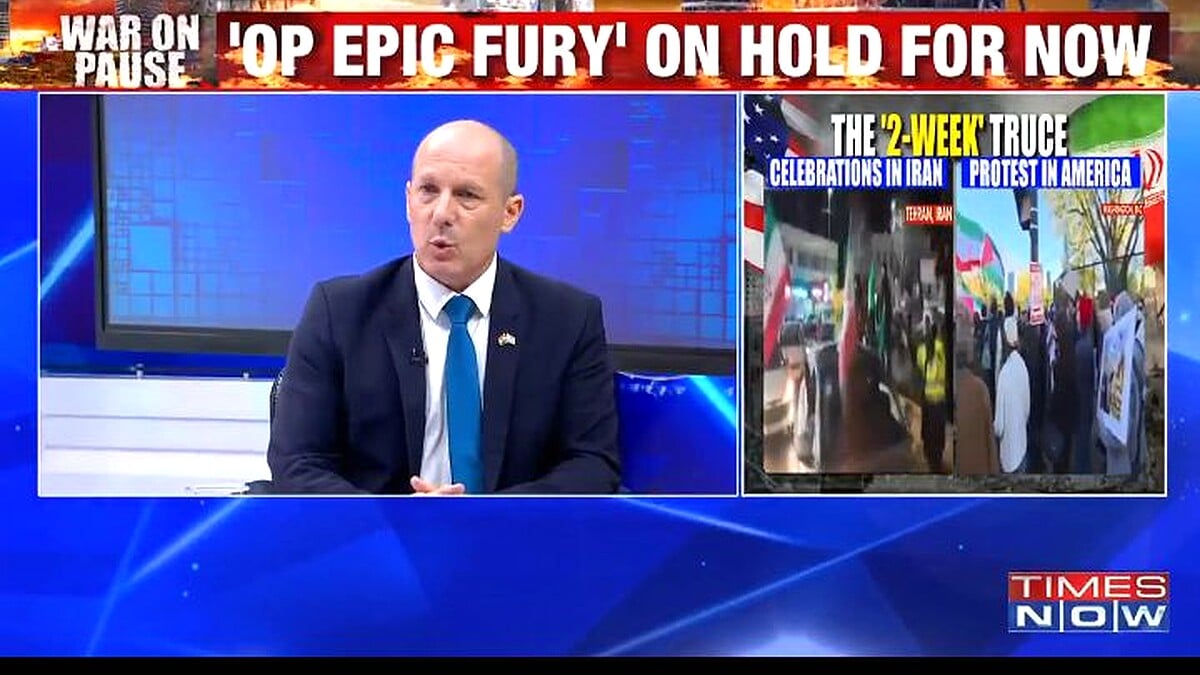




ISLAMABAD: Israeli Ambassador to India Reuven Azar has categorically stated he is unaware of any direct contact between Israel and Pakistan.
The denial came during an exclusive interview with Times Now journalist Zakka Jacob, where Azar responded to a pointed question on possible bilateral engagement.
“I am not aware of that,” Azar said when asked about direct links between the two nations.
This statement arrives amid persistent speculation in regional media about backchannel communications, especially following recent Pakistani delegations visiting Israel.
Pakistan maintains a firm policy of non-recognition of Israel, rooted in its unwavering support for the Palestinian cause since 1947.
Islamabad voted against the United Nations Partition Plan and has consistently backed the establishment of a sovereign Palestinian state on pre-1967 borders with East Jerusalem as its capital.
In 1988 Pakistan formally recognised the State of Palestine, becoming one of the earliest nations to do so.
Successive governments have reiterated this stance, with Prime Minister Shehbaz Sharif recently vowing continued aid and diplomatic backing for Gaza.
Pakistan has provided humanitarian assistance to Palestinian territories, including medical supplies and reconstruction support, underscoring its moral and religious commitment.
By contrast, India and Israel share robust strategic ties, with bilateral merchandise trade reaching 3.81 billion US dollars in fiscal year 2024-25.
Indian exports to Israel stood at 2.14 billion dollars while imports totalled 1.66 billion dollars during the period, according to official commerce data.
Defence cooperation between New Delhi and Tel Aviv has grown significantly, encompassing drone technology, missile systems and joint research projects.
The Israeli envoy’s comments to an Indian channel therefore carry weight in the context of Islamabad’s principled foreign policy.
Regional reports had hinted at momentum towards possible normalisation, citing a Pakistani delegation hosted in Israel last month.
Yet Azar’s explicit unawareness directly counters such claims circulating in sections of international and Indian media.
Pakistan’s position remains unchanged even as it navigates complex regional dynamics, including its September 2025 defence pact with Saudi Arabia.
That agreement has drawn Israeli scrutiny, particularly amid ongoing tensions involving Iran.
Pakistani officials have proposed diplomatic initiatives to de-escalate conflicts in the Middle East, hosting four-nation talks with Turkey, Egypt and Saudi Arabia in March 2026.
Foreign Minister Ishaq Dar has publicly blamed external actors for disrupting ceasefire efforts between Washington and Tehran.
The Israeli ambassador’s interview also follows his earlier remarks on Pakistan-Saudi military relations during a discussion with Indian anchor Arnab Goswami.
In that exchange Azar noted longstanding ties without indicating any shift in Israel’s assessment of Pakistani involvement.
Such exchanges highlight how third-party platforms like Indian media have become venues for indirect commentary on sensitive Israel-Pakistan matters.
Historically, unconfirmed reports of clandestine contacts have surfaced periodically since the 1980s and 1990s.
These included alleged intelligence sharing after the 2008 Mumbai attacks, where Pakistan’s ISI reportedly passed information to Israel’s Mossad via Washington.
Yet no formal diplomatic channels were ever established, and Pakistan’s military leadership has repeatedly affirmed non-recognition of Israel.
Public sentiment in Pakistan remains overwhelmingly pro-Palestine, with polls showing strong support for peacekeeping roles only under neutral Muslim-led frameworks.
Any hint of direct engagement risks domestic backlash, given the country’s vocal parliamentary and street-level solidarity with Gaza.
The Times Now exclusive therefore serves as a timely clarification, dispelling rumours at a moment of heightened Middle East volatility.
It reinforces Pakistan’s consistent diplomatic posture amid Abraham Accords-driven normalisation waves elsewhere in the Muslim world.
Experts note that economic incentives, such as potential technology transfers from Israel, have occasionally tempted private discussions.
However, official Islamabad insists resolution of the Palestinian issue remains the prerequisite for any future engagement.
Trade data further illustrates the divergence: while India-Israel commerce has fluctuated between 3.8 billion and over 10 billion dollars in peak years, Pakistan-Israel economic links remain virtually non-existent.
Indirect trade through third countries is minimal and untracked in official statistics.
The envoy’s statement may also reflect Israel’s focus on strengthening existing alliances in Asia rather than pursuing new overtures with non-recognising states.
In the broader geopolitical landscape, Pakistan continues to balance relations with China, Saudi Arabia and the United States while prioritising the Palestinian narrative.
Azar’s denial, broadcast on a major Indian network, thus carries symbolic importance for regional audiences monitoring every nuance of Middle East diplomacy.
It underscores that, despite occasional speculation fuelled by unofficial visits and global shifts, no direct government-to-government contact exists between Jerusalem and Islamabad.
Pakistani analysts view this as validation of the country’s long-held foreign policy red lines.
The development is likely to feature prominently in domestic discourse, reinforcing national consensus on the Palestine issue.
As tensions persist across West Asia, clarity on such matters helps stabilise expectations among allies and adversaries alike.
The Israeli envoy’s words, delivered in a measured tone, leave little room for misinterpretation.
They affirm the status quo that has defined Israel-Pakistan relations for nearly eight decades.