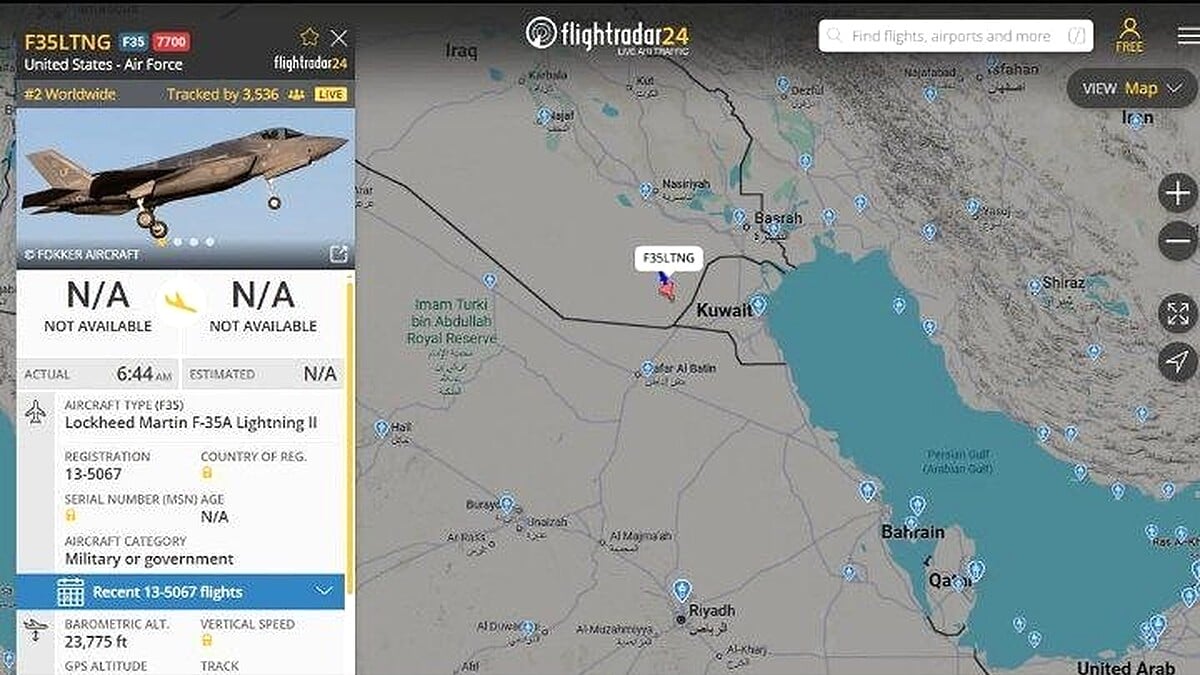




ISLAMABAD: A United States Air Force F-35 stealth fighter jet declared a serious in-flight emergency over southern Iraq on Monday activating the universal distress code 7700.
The advanced aircraft was tracked on public monitoring platforms as it flew near the Kuwait border.
Flight data identified the jet under callsign F35LTNG with serial number 13-5067 operating in the military category.
It maintained an altitude of approximately 23775 feet during the incident.
The emergency squawk occurred between 1200 and 1300 UTC before the aircraft vanished from civilian radar displays.
Such disappearances are standard for stealth platforms shifting to secure military modes after declaring distress.
No official statement has emerged from United States Central Command or the Pentagon on the cause or resolution.
Open source intelligence networks and regional media outlets quickly shared verified screenshots from Flightradar24 confirming the 7700 transmission.
Iranian sources including Fars News amplified reports framing the event as evidence of operational strain on American forces.
This incident marks the latest in a pattern of US aircraft emergencies in the Middle East amid escalating tensions with Iran.
On March 19 a separate F-35 conducted an emergency landing after a combat mission over Iran following suspected hostile fire.
CENTCOM confirmed that aircraft landed safely with the pilot in stable condition at a regional base.
The F-35 Lightning II forms the backbone of United States air superiority featuring fifth-generation stealth supercruise and sensor fusion valued at over 80 million dollars per unit.
The overall program has surpassed two trillion dollars in total costs with more than 300 aircraft now operational across US fleets.
Southern Iraq serves as a vital transit corridor for coalition missions supporting regional security operations.
Experts explain that code 7700 signals any serious issue ranging from mechanical failure to potential battle damage requiring immediate priority handling.
The brief public visibility of the stealth jet has fueled intense speculation among defense analysts monitoring the volatile Persian Gulf.
US forces operate multiple advanced air bases in the Gulf region equipped for rapid emergency recoveries of high-value fighters.
No reports of a crash pilot ejection or aircraft loss have surfaced in connection with this specific event.
Regional claims from Iranian media outlets suggest possible vulnerabilities in US tactical aviation during heightened activity.
International mainstream coverage remains absent as outlets await formal verification from Washington authorities.
The activation underscores the demanding tempo of American air operations in contested airspace where even elite platforms face risks.
Military observers note the F-35s sophisticated design makes any public emergency signal particularly noteworthy when it appears.
Flight tracking services like Flightradar24 capture only selective data from military aircraft due to operational security protocols.
The 7700 code guarantees universal recognition across global aviation networks ensuring swift coordination for assistance.
This development adds further complexity to the already tense security environment across the broader Middle East theater.
Analysts continue monitoring for any follow-up details on whether the jet diverted safely or resolved the onboard issue in flight.
The frequency of such reports in recent weeks highlights the intense pressures on United States air assets operating near Iran.
No evidence has linked this incident directly to combat damage though speculation persists in regional discourse.
The event reinforces the high-stakes realities of deploying cutting-edge stealth technology in dynamic conflict zones.