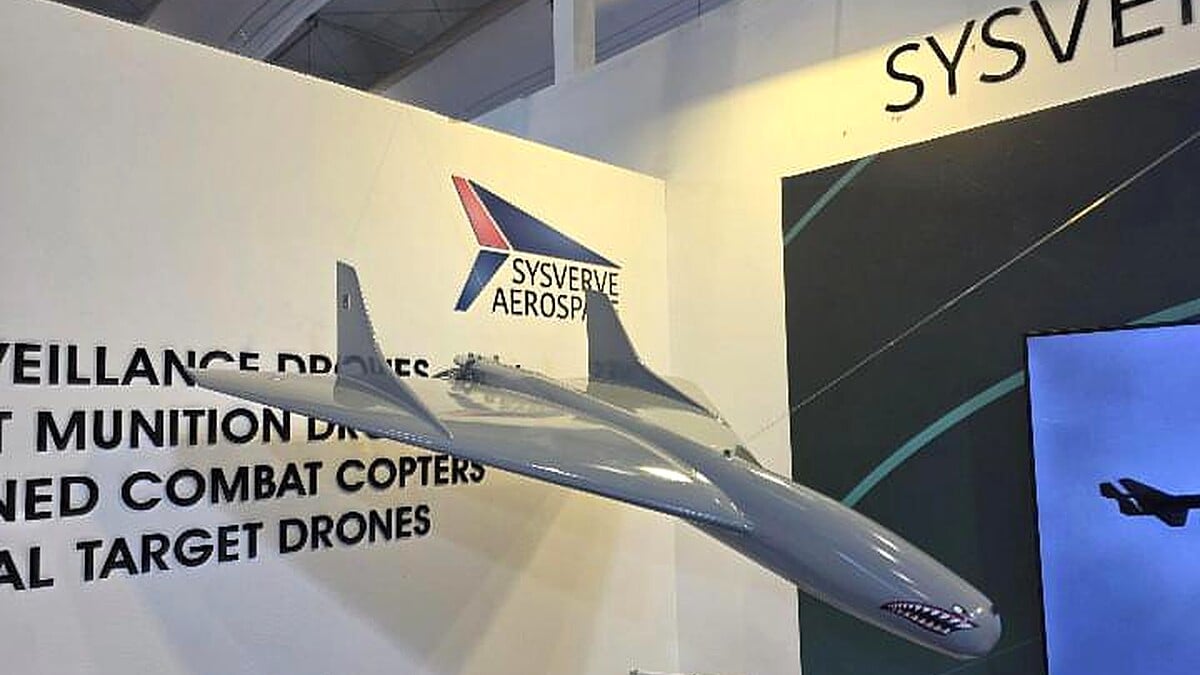




ISLAMABAD: The Pakistan Navy has unveiled a new stealth kamikaze drone system conceptually inspired by Iran’s Shahed series, signalling a bold leap into advanced unmanned warfare.
This development integrates low-observable technology with precision strike potential, transforming the service into a more agile and multi-domain maritime force.
Regional defence reports confirm the system’s focus on asymmetric capabilities to counter superior naval threats in the Arabian Sea.
The drone draws from proven Shahed-136 designs, which feature a 3.5-metre length, 2.5-metre wingspan and 200-kilogram launch weight.
Iran’s Shahed-136 carries a 50-kilogram high-explosive warhead and achieves ranges between 1,000 and 2,500 kilometres at a cruising speed of 185 kilometres per hour.
Unit costs for Shahed variants hover between 20,000 and 50,000 US dollars, a fraction of conventional cruise missiles priced in the millions.
In recent conflicts thousands of such drones have saturated air defences, delivering disproportionate strategic impact through sheer volume and economy.
Pakistan’s indigenous counterpart, the Sarfarosh loitering munition, offers a 700-to-1,000-kilometre range, endurance exceeding 120 minutes and a 50-kilogram warhead.
Canister-launched from ships or shore platforms, it targets radars, command posts and surface vessels with high precision.
In January 2026 the Navy conducted live firings of long-range loitering munitions alongside stealth drone boat trials in the North Arabian Sea.
These exercises, witnessed by senior commanders, validated integrated operations with LY-80(N) air-defence systems and demonstrated extreme low-altitude maneuverability.
Complementing aerial systems, the Corsair unmanned surface vessel functions as a 4-metre kamikaze platform carrying a 50-kilogram payload at 30 knots across 100 nautical miles.
Designed for anti-ship and port strikes, it underscores the Navy’s broader push into unmanned surface and underwater vehicles.
Pakistan operates a fleet of 109 active vessels, including 16 submarines and 15 frigates, yet faces numerical disadvantages against larger regional navies.
Unmanned assets now multiply effective combat reach while minimising risk to manned platforms and crews.
Defence analysts highlight lessons from the Red Sea and Ukrainian theatres, where inexpensive drones disrupted billion-dollar warships and exhausted high-cost interceptors.
The system supports protection of critical sea lanes linked to the China-Pakistan Economic Corridor and Gwadar port.
Low radar cross-section materials and composite construction enable the drone to evade modern detection networks at altitudes as low as 60 metres.
Precision GNSS and inertial guidance ensure accuracy even in contested electromagnetic environments.
Collaboration between the National Aerospace Science and Technology Park and Pakistan Maritime Science and Technology Park has accelerated these indigenous breakthroughs.
Private firms such as Sysverve Aerospace and Woot-Tech contributed platforms like the Mudmair loitering munition and Muhassir semi-submersible USV.
At the 2025 Pakistan International Maritime Expo, a full spectrum of naval drones was showcased, emphasising swarm tactics and autonomous decision-making.
Such capabilities promise to reshape area-denial strategies in the Indian Ocean, offering credible deterrence at sustainable costs.
Experts project that future iterations will incorporate artificial intelligence for real-time target recognition and coordinated swarm attacks.
The unveiling comes amid evolving hybrid threats, positioning Pakistan as a leader in affordable maritime innovation.
Regional media outlets describe the system as a paradigm shift that levels the playing field against numerically superior adversaries.
With stealth features and asymmetric reach, the new drone bolsters defensive resilience across vast maritime zones.
This marks not merely a weapon addition but a strategic evolution for a technologically forward-looking Navy.