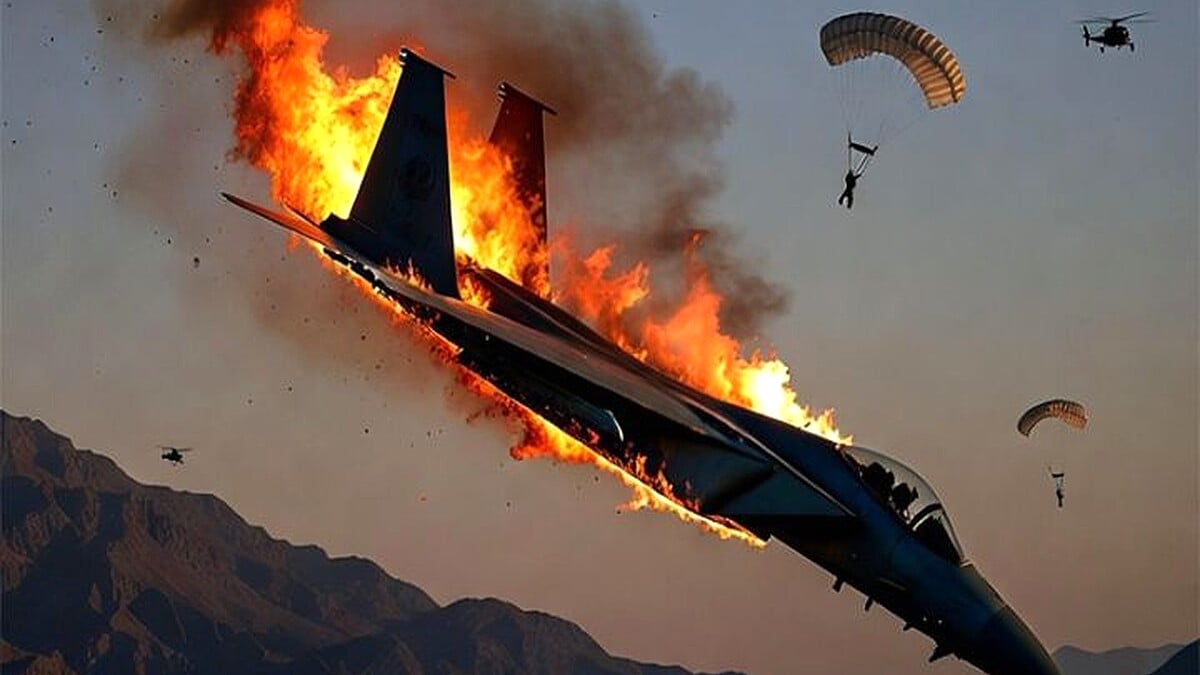




ISLAMABAD: In a high-stakes military drama unfolding amid escalating US-Iran tensions, American special forces have successfully rescued both crew members of a downed F-15E Strike Eagle fighter jet shot down over southern Iran.
The operation, described by President Donald Trump as one of the most daring search and rescue missions in US history, involved hundreds of commandos, several dozen combat aircraft and helicopters, and close coordination with the CIA.
The F-15E, a two-seat multirole fighter known as the Strike Eagle, was hit by Iranian air defences on Friday in a remote mountainous region of southwestern Iran, likely near Khuzestan or Kohgiluyeh provinces.
Both the pilot and the weapons systems officer, referred to in reports as a colonel and designated WSO, ejected safely from the aircraft before it crashed.
The pilot was extracted shortly after by two HH-60 Pave Hawk combat search and rescue helicopters.
The WSO, however, evaded capture for more than 24 hours while sustaining injuries, armed only with a handgun, hiding in a mountain crevice.
CBS News, citing US officials, reported that the second crew member was located through advanced intelligence and rescued early Sunday local time following intense ground engagements.
Hundreds of US commandos were deployed in the operation, supported by multiple transport aircraft and fighter escorts equipped with the world’s most lethal weapons systems.
At least five US transport planes participated, with two reportedly destroyed on the ground inside Iran to prevent their capture by advancing Iranian forces.
During the rescue, US forces used bombs and precision munitions to keep Iranian troops at bay, resulting in reported exchanges of fire between American and Iranian units.
No American personnel were killed in the operation, though some rescue helicopter crew members sustained wounds from Iranian fire.
President Trump personally authorised the mission from the White House and later confirmed its success on Truth Social.
He stated that dozens of aircraft were dispatched at his direction, emphasising that the rescued colonel had sustained injuries but would fully recover.
The CIA played a pivotal role, first pinpointing the WSO’s exact location in a rugged mountain area and relaying it to the Pentagon.
In a sophisticated deception campaign, the agency spread disinformation inside Iran claiming the airman had already been found and was being extracted, thereby diverting Iranian search efforts while the real rescue proceeded.
This intelligence-led tactic, combined with real-time surveillance, proved decisive in the 36-hour operation that stretched across contested territory.
Regional media and social media reports from Iran described low-flying US C-130 Hercules aircraft refuelling HH-60 helicopters near Behbahan, along with alleged footage of special forces clashing with Islamic Revolutionary Guard Corps elements near Dehdasht.
Iranian state outlets claimed their air defences downed the F-15E using advanced systems, while also reporting strikes on US rescue assets.
An A-10 Warthog close air support aircraft involved in the mission was damaged and crashed, with its pilot ejecting safely over the Persian Gulf.
The successful recovery underscores the US military’s commitment to the principle of leaving no one behind, even in high-risk environments deep behind enemy lines.
Analysts note that the scale of the operation, involving scores of aircraft and hundreds of personnel, reflects the strategic importance placed on personnel recovery amid the ongoing five-week conflict between US-Israeli forces and Iran.
The incident marks the first confirmed loss of a US fighter jet to Iranian fire since the escalation began.
It highlights persistent Iranian air defence capabilities despite earlier US claims of air superiority.
Oil markets and regional security remain on edge as the Strait of Hormuz tensions continue, with both sides issuing strong warnings.
The rescued officers are now receiving medical attention outside Iran, with officials expressing confidence in their full recovery.
This episode adds a dramatic chapter to the broader Middle East conflict, demonstrating the complexities of combat search and rescue in modern warfare.
Military experts point to the integration of special operations, air power, and intelligence as key factors in the mission’s success despite significant risks.
Further details on the exact location and full extent of engagements remain classified, but the operation has been hailed internally as a remarkable achievement.
US forces have since withdrawn all personnel from Iranian territory following the completion of the rescues.