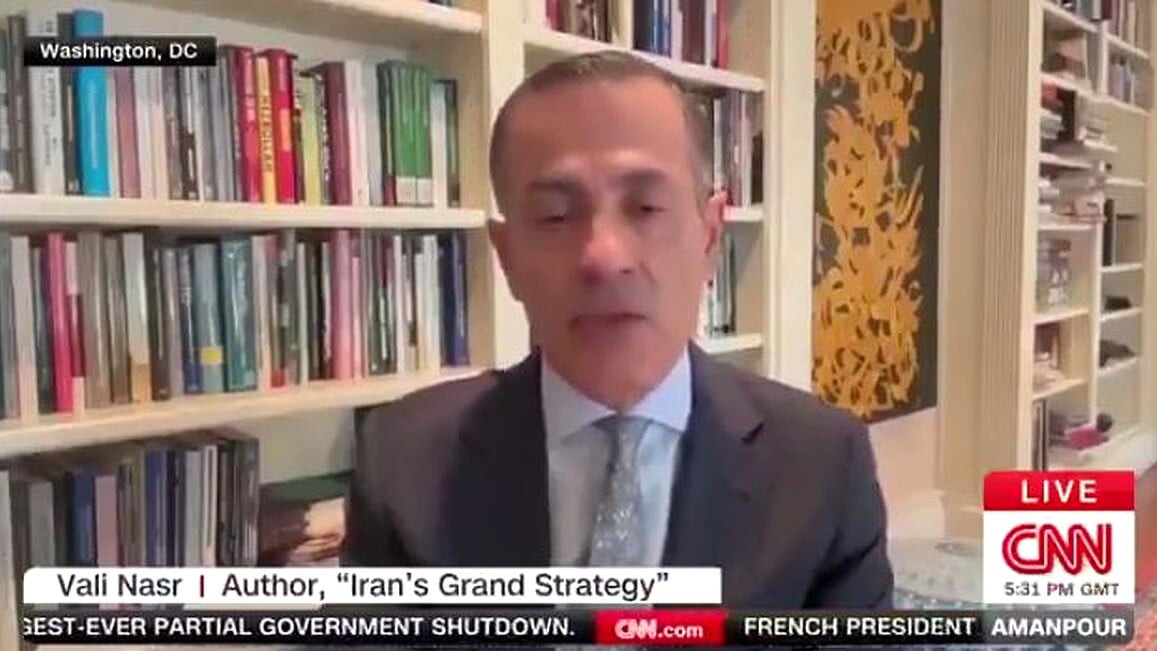




ISLAMABAD: The cat is out of the bag as former US State Department advisor Vali Nasr has claimed that President Donald Trump is employing the Islamabad talks as a strategic ploy to draw top Iranian leaders into the public eye for potential elimination.
The assertion made on CNN has sent ripples across international diplomatic channels raising serious questions about the sincerity of ongoing peace efforts.
Pakistan positioned itself as a mediator when Foreign Minister Ishaq Dar announced on March 29 that Islamabad would host US-Iran negotiations.
The declaration followed trilateral meetings with foreign ministers from Saudi Arabia Egypt and Turkey in the Pakistani capital.
This development occurs against the backdrop of a month-long US-Iran conflict that has already claimed hundreds of lives according to regional estimates.
Global energy markets have reacted sharply with crude oil prices surging more than 30 percent to exceed 110 dollars per barrel in recent weeks.
Vali Nasr a prominent Iranian-American scholar and Johns Hopkins University professor drew on historical precedents in his critique.
He referenced the 2020 US drone strike under Trump that assassinated Iranian Revolutionary Guard commander Qasem Soleimani in Iraq.
That operation resulted in immediate Iranian retaliation injuring over 100 US service members as per Pentagon data.
In the present scenario Trump has issued stark warnings including vows to reduce Iranian infrastructure to rubble.
Yet diplomatic channels reportedly conveyed a 15-point US proposal to Tehran via Pakistani intermediaries.
Iranian state media and officials have expressed deep distrust with one parliament speaker labeling the talks as a pretext for invasion.
Nasr’s CNN remarks amplified by regional outlets including Pakistani newspapers underscore the fragile trust between adversaries.
Analysts highlight that public appearances by Iranian leaders in Islamabad could expose them to intelligence gathering or worse targeted actions similar to past incidents.
Pakistan has responded by enhancing security measures deploying thousands of troops to safeguard any high-profile visitors.
The China-Pakistan Economic Corridor valued at over 62 billion dollars remains a strategic priority for Islamabad amid these tensions.
Disruption could jeopardize investments critical for regional connectivity and energy security.
International Atomic Energy Agency reports confirm Iran has advanced its nuclear program enriching uranium to 60 percent purity levels.
This escalation followed the US exit from the 2015 nuclear deal during Trump’s previous term.
Economic data from the World Bank projects potential losses exceeding 200 billion dollars to the global economy if hostilities intensify.
Pakistan’s role as host places it at the crossroads of superpower rivalries with implications for its own sovereignty.
Experts caution that such alleged ploys could undermine future multilateral efforts in the Middle East.
The claim by Nasr a veteran of US foreign policy circles carries significant weight given his advisory experience.
As preparations for the talks gain momentum the international community demands clarity and verifiable commitments from all sides.
Failure to address these concerns risks plunging the region into deeper instability with far-reaching consequences for global peace and prosperity.
Supporters of the talks argue that Pakistan’s neutral stance offers the best chance for de-escalation while critics see hidden agendas that prioritize military objectives over genuine dialogue.
The coming days will test whether Islamabad emerges as a beacon of peace or a stage for calculated deception in one of the most volatile diplomatic chapters since 1979.