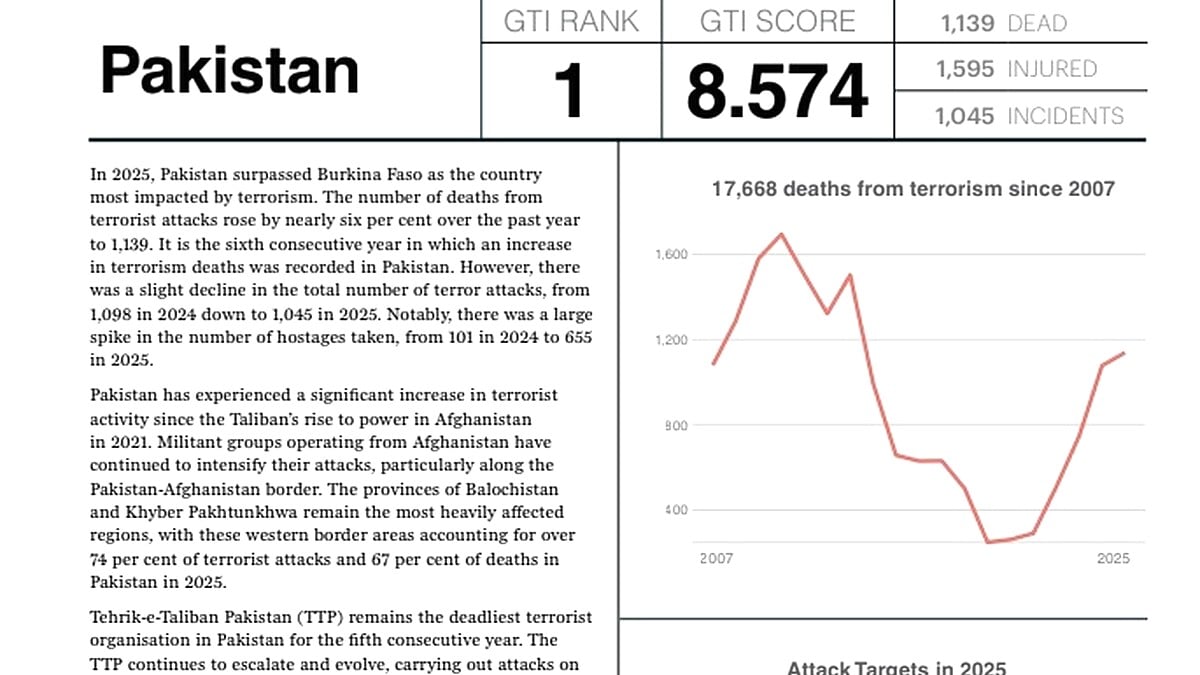




ISLAMABAD: Pakistan has for the first time claimed the top spot on the Global Terrorism Index 2026, becoming the world’s most terrorism-affected country and overtaking Burkina Faso which held the position for two years.
The Institute for Economics and Peace report shows that in 2025 Pakistan recorded 1,045 terrorist incidents, resulting in 1,139 deaths and 1,595 injuries along with 655 hostages taken.
These figures mark a 5.7 percent rise in fatalities from 1,078 the previous year, the highest level since 2013 and the sixth consecutive year of increase despite a marginal drop in total attacks.
The country’s score climbed to 8.574, edging past Burkina Faso’s 8.324 as deaths there fell 45 percent to 846.
Pakistan now accounts for 20 percent of all global terrorism fatalities, which dropped 28 percent worldwide to 5,582 while incidents declined 22 percent to 2,944, the lowest since 2007.
Khyber Pakhtunkhwa and Balochistan remained the hardest hit provinces, together responsible for 74 percent of attacks and 67 percent of deaths.
Attacks concentrated heavily along the western border with Afghanistan, where porous frontiers and ethnic ties have enabled cross-border movement of militants.
Tehrik-e-Taliban Pakistan emerged as the deadliest group for the fifth straight year, claiming 637 lives through 595 attacks, a 13 percent increase in fatalities from 2024.
The group relied on drones for targeted strikes and exploited sanctuaries across the border following the Taliban’s return to power in Afghanistan in 2021.
Balochistan Liberation Army carried out the year’s most devastating single incident, hijacking the Jaffar Express train near Quetta and taking 442 hostages, of whom 21 were killed along with four security personnel.
The assault also left 33 militants dead and highlighted BLA’s growing focus on Chinese-linked projects under the China-Pakistan Economic Corridor and resource extraction sites.
Hostage numbers surged to 655 largely because of this one operation; excluding it, the figure would have fallen 30 percent.
The report links Pakistan’s sharp resurgence to strained relations with neighbours, particularly Afghanistan and India.
Accusations of sheltering militants, retaliatory Indian airstrikes in May 2025 and failed peace initiatives have intensified border tensions.
Since 2022 terrorist incidents in Pakistan have risen six-fold compared with 2020 levels, reversing earlier gains from military operations.
Total deaths since 2007 now stand at 7,828, underscoring the long-term toll.
The government launched Operation Azm-e-Istehkam to counter the escalation, yet analysts note limited success amid ongoing infiltration.
Border fencing accelerated since 2017 has slowed some smuggling but failed to seal remote mountain passes completely.
Pakistan’s ranking among the top ten most affected countries every year since the index began in 2011 now culminates in first place.
Only four non-African nations appear in the current top ten, with sub-Saharan Africa still hosting six of the worst affected states.
Nigeria, Niger and the Democratic Republic of Congo follow closely, their combined deaths nearly matching Pakistan’s share.
The report warns that 93 percent of global terrorism deaths occur in active conflict zones, where groups like TTP function as part of larger insurgencies.
Ungoverned border regions account for 41 percent of attacks within 50 kilometres of international lines.
For Pakistan this pattern creates persistent security risks, economic disruption and pressure on foreign investment.
Chinese nationals and infrastructure have faced repeated targeting, raising questions about long-term viability of regional connectivity projects.
Youth radicalisation and online propaganda have further complicated counter-efforts, with TTP maintaining sophisticated recruitment networks.
The index methodology weighs fatalities most heavily, followed by incidents, injuries and hostages over a five-year average.
Pakistan’s score rose 0.205 in the latest year and 0.201 over the decade.
Experts from the Institute for Economics and Peace stress that coordinated military, political and socio-economic measures are essential to reverse the trend.
Without addressing root causes such as cross-border sanctuaries and local grievances, the upsurge risks becoming entrenched.
South Asia recorded 27 percent of cumulative global terrorism deaths since 2007, with Pakistan driving much of the recent regional burden.
Afghanistan itself improved, dropping to 11th place with deaths halving.
This contrast highlights how instability on one side of the Durand Line directly fuels violence on the other.
Pakistan’s emergence at number one coincides with a fragile global decline in terrorism.
While Western fatalities surged 280 percent to 57 last year due to lone-wolf attacks, the overall trend remains downward outside concentrated hotspots.
Sustained progress therefore depends heavily on outcomes in the top five countries.
For Islamabad the data serves as a stark reminder that decades of counter-terrorism operations have yet to yield lasting stability.
Continued border management, intelligence sharing and development in affected provinces will define future rankings.
The report’s findings arrive amid heightened regional tensions, urging renewed diplomatic engagement alongside security measures.