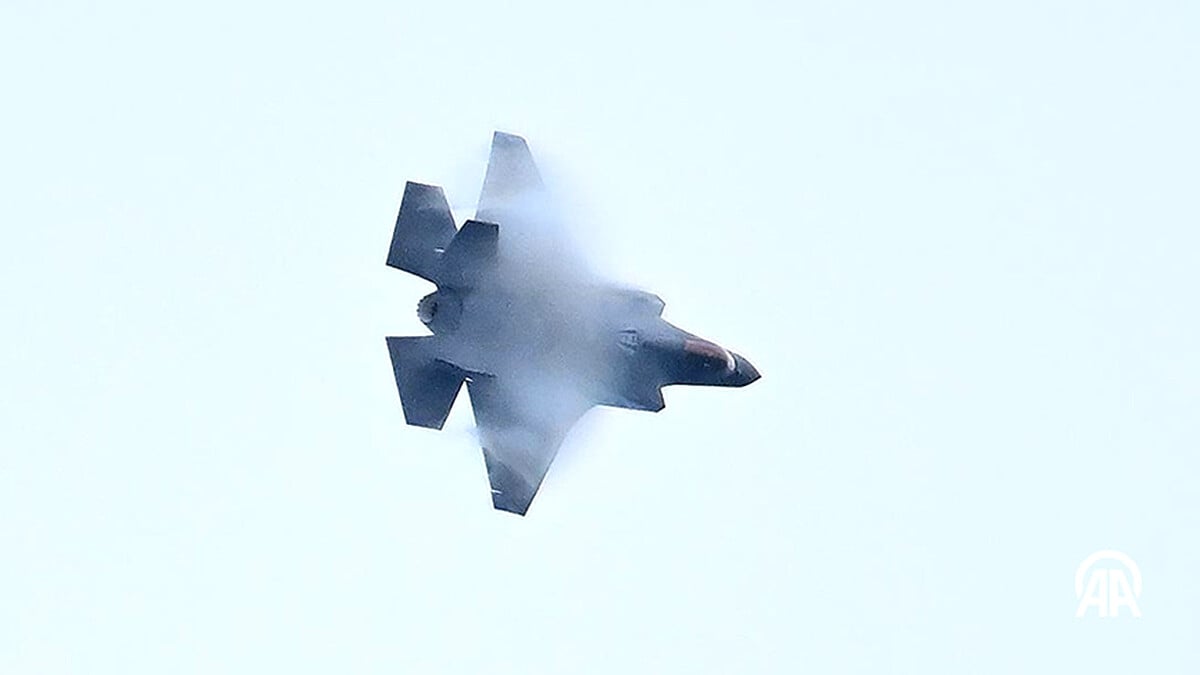




ISLAMABAD: A US F-35 Lightning II stealth fighter sustained damage during a combat mission over Iran, forcing an emergency landing at a regional American airbase in the Middle East, according to US Central Command confirmation on March 19, 2026.
The incident marks the first reported instance of an American fifth-generation aircraft taking hostile fire in the ongoing US-Israel-Iran conflict that escalated in late February.
Iran’s Islamic Revolutionary Guard Corps claimed its air defence systems struck the jet over central Iran around 2:50 a.m. local time, describing the aircraft as heavily damaged with a possible crash outcome, though US officials reported the pilot landed safely and remained in stable condition.
An investigation by US authorities continues, with no official details released on the exact nature of the engagement or weapon involved.
Chinese military experts have provided detailed assessments, suggesting Iran bypassed the F-35’s radar-evading stealth features through passive electro-optical and infrared sensor systems.
Retired People’s Liberation Army Colonel Yue Gang explained that while the F-35 excels against electromagnetic radar detection due to its low-observable design, its stealth is significantly weaker against infrared tracking that captures heat emissions from the engine and airframe during flight.
Yue noted the jet likely sustained partial damage but retained core functions, allowing the pilot to return to base rather than total loss.
Military analyst Song Zhongping emphasized that electro-optical/infrared sensors operate passively without emitting detectable waves, making it extremely challenging for the F-35’s warning systems to identify the threat in advance.
This passive detection denies the aircraft situational awareness, as it emits no electromagnetic signals that the pilot or onboard systems can readily counter.
Experts indicate Iran avoided high-end integrated systems such as the Russian-supplied S-300, which could have caused catastrophic destruction if successfully locked on.
Instead, the engagement probably involved an infrared-guided missile, inflicting limited but sufficient damage to compel diversion without complete aircraft loss.
Analyses point to a modified version of the Russian R-27T air-to-air missile, originally acquired by Iran in the 1990s alongside MiG-29 fighters.
The R-27T, with a diameter of about 0.23 meters, features infrared homing and achieves speeds up to Mach 5, surpassing many stealth aircraft velocities despite lower overall power.
Its heat-seeking guidance aligns with passive detection advantages, enabling surprise attacks where radar-based systems might alert the target earlier.
The F-35’s engine produces a substantial thermal signature, particularly during high-thrust manoeuvres or sustained operations over hostile territory.
Infrared seekers exploit this unavoidable heat footprint, rendering radar cross-section reduction less effective in multi-spectrum threat environments.
This development highlights evolving countermeasures to stealth technology, where passive sensors complement traditional radar networks.
Iran’s approach demonstrates cost-effective tactics using legacy platforms upgraded for modern asymmetric warfare.
Chinese commentary underscores broader implications for global air power dynamics, as passive infrared capabilities challenge assumptions of uncontested superiority.
The People’s Liberation Army observers view the event as valuable data on fifth-generation vulnerabilities in real combat.
While the F-35 program represents a cornerstone of US air dominance with advanced sensor fusion and networking, this incident exposes persistent infrared limitations.
Defence analysts worldwide now scrutinise how such engagements could influence future doctrine and technology investments.
The war’s progression since February has seen intensified aerial operations, with Iran employing layered defences blending imported and indigenous systems.
US sources maintain air superiority claims persist, yet isolated successes like this raise questions on penetration depth and risk tolerance.
The emergency landing underscores operational hazards even for advanced platforms in contested airspace.
Further details await official US findings, but Chinese expert insights offer early technical explanations grounded in sensor physics.
This occurrence may accelerate research into infrared signature management for next-generation aircraft.
It also reinforces the value of diversified detection methods in countering stealth advantages.
The incident remains under scrutiny as both sides advance competing narratives in the escalating regional conflict.