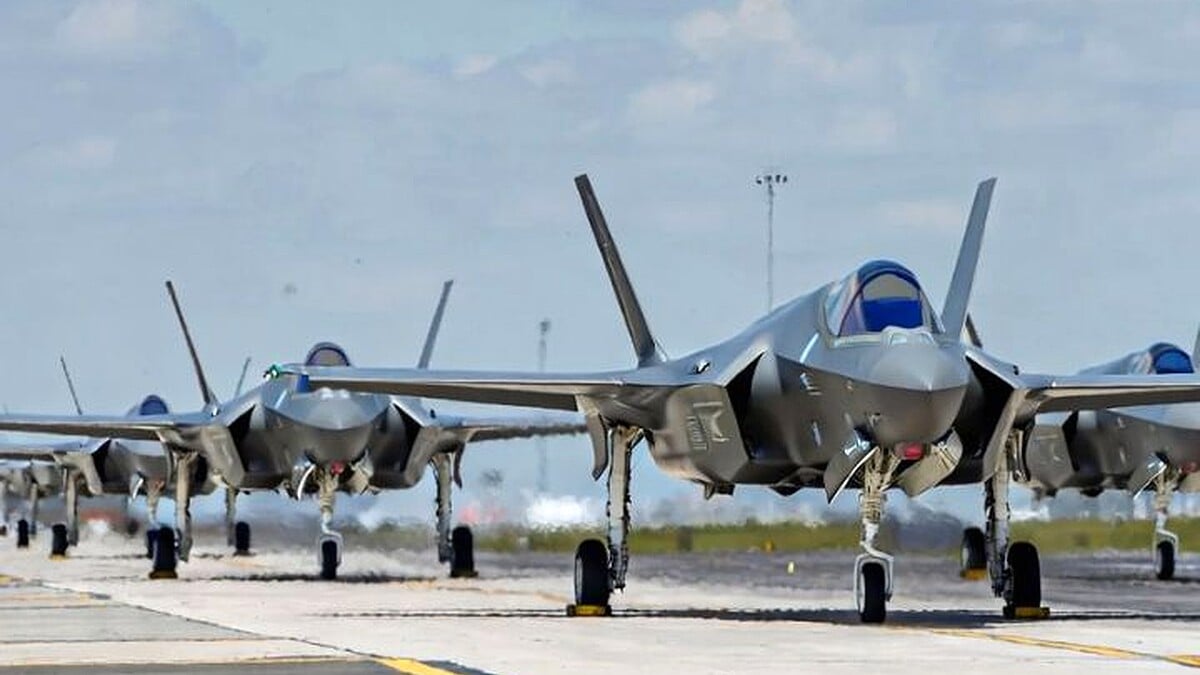




ISLAMABAD: Sri Lanka has firmly declined a request from US President Donald Trump to host two American fighter jets at one of its key airports, a move that underscores the island nation’s unwavering commitment to military neutrality.
In a detailed address to parliament, President Anura Kumara Dissanayake explained the rejection stemmed from Colombo’s determination to stay out of any potential regional military conflict in the Indian Ocean.
The decision highlights Sri Lanka’s long-standing non-aligned foreign policy amid intensifying great-power competition.
President Dissanayake told lawmakers that accepting the request would risk drawing the country into broader Indo-Pacific tensions, where strategic rivalries between major powers continue to escalate.
This stance aligns with Sri Lanka’s historical role as a proponent of peaceful coexistence and autonomy in international affairs.
Since independence in 1948, the nation has actively participated in the Non-Aligned Movement, championing resolutions like the Indian Ocean as a Zone of Peace at the United Nations.
Data from diplomatic archives show Sri Lanka maintained balanced ties even during the Cold War, including the landmark 1952 Rubber-Rice Pact with China despite temporary US aid cuts.
Today, under President Dissanayake, who assumed office in September 2024, this policy persists as the country focuses on economic stabilisation after the 2022 debt crisis.
Recent economic indicators project GDP growth near 4.5 percent this year, driven by diversified investments from multiple partners without exclusive alliances.
The proposed hosting site was understood to be Bandaranaike International Airport at Katunayake, a dual-use facility that serves millions of civilian passengers annually while retaining limited military functions.
Originally established as a British Royal Air Force base in the 1940s, the airport has grown into Sri Lanka’s primary aviation gateway with ongoing modernisation plans to handle rising traffic.
Sri Lanka’s armed forces operate with modest resources, defence expenditure remaining below two percent of GDP according to international benchmarks, far smaller than regional neighbours.
Ongoing US-Sri Lanka defence ties include joint exercises such as CARAT and leadership of a Combined Maritime Forces task force in 2025, yet these focus strictly on non-combat maritime security and training.
Analysts observe that temporary stationing of US fighter jets would represent a qualitative shift, potentially complicating relations with China and India.
China’s investments through the Belt and Road Initiative, notably the Hambantota port, form a critical economic pillar for Sri Lanka’s recovery.
India, meanwhile, views the island as integral to its neighbourhood security and has expressed historical sensitivities about foreign military footprints nearby.
By rejecting the request, Colombo signals its preference for equidistant diplomacy that preserves strategic autonomy.
Regional security experts note the Indian Ocean carries over 80 percent of global trade between Asia and Europe, making neutrality vital for smaller littoral states.
The Trump administration’s outreach reflects Washington’s broader Indo-Pacific strategy to enhance operational reach against perceived challenges.
However, Sri Lankan officials emphasised that cooperation remains welcome in humanitarian and training domains, as evidenced by recent joint rescue efforts during floods involving US and Indian personnel.
Parliamentary records indicate the decision received broad support, prioritising long-term sovereignty over short-term tactical benefits.
This episode comes as Sri Lanka courts foreign investment to upgrade airport infrastructure, targeting 20 million annual visitors by 2030 without compromising neutral status.
Observers in South Asia watch closely, seeing parallels in how nations navigate pressure to align militarily.
Sri Lanka’s refusal reinforces its identity as a bridge-builder rather than a base for any single power bloc.
The move also echoes past principled positions, such as during the Suez crisis and Congo operations, where Colombo advocated de-escalation without taking sides.
In an era of heightened geopolitical friction, the decision offers a model for developing countries seeking peace through prudence.
Diplomatic circles expect continued US-Sri Lanka engagement on economic and maritime issues, with the rejection framed as a sovereign choice rather than a rift.
Overall, the development reaffirms that neutrality remains a viable and respected path for nations like Sri Lanka in turbulent times.