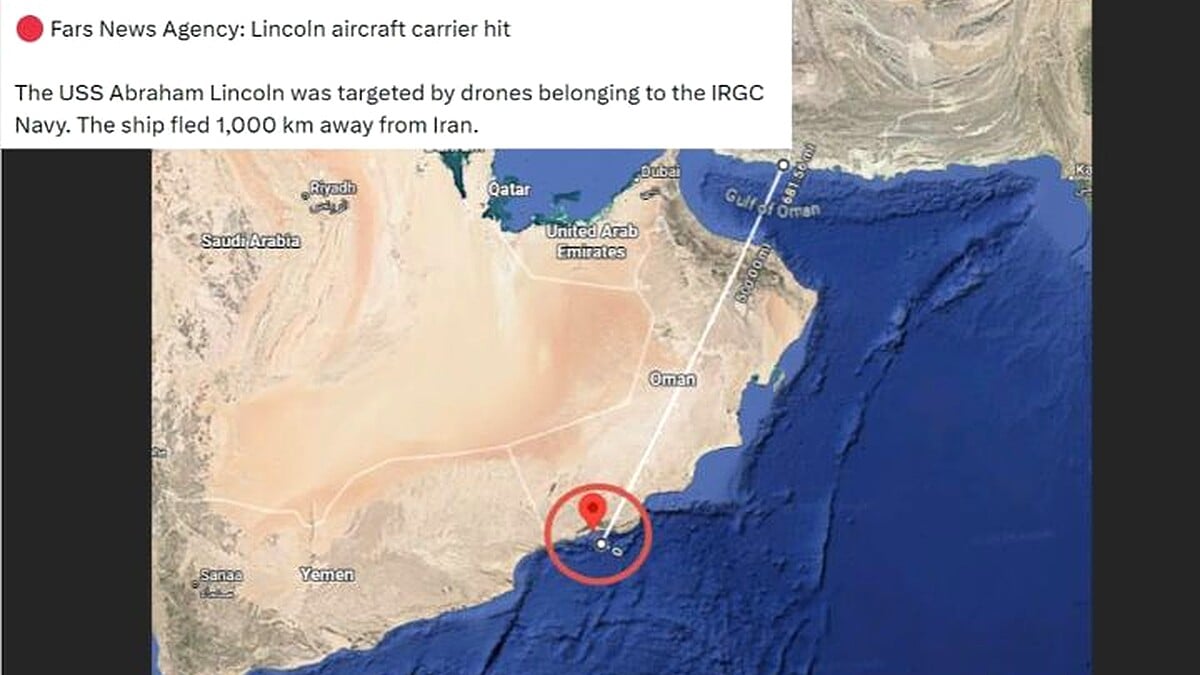




ISLAMABAD – The USS Abraham Lincoln has repositioned farther from Iranian waters amid escalating regional tensions and unverified claims of strikes, according to recent satellite observations including those attributed to Chinese sources, quoted by RT. The Nimitz-class nuclear-powered supercarrier, previously operating closer to the Gulf of Oman, now appears approximately 1,100 kilometres from Iran’s coast near the Omani port of Salalah, a shift of over 1,000 kilometres that has fueled speculation online. Iranian officials from the Islamic Revolutionary Guard Corps have claimed their drones and missiles inflicted damage, forcing a retreat, but United States Central Command has categorically denied any hits, describing such assertions as baseless propaganda.
This development occurs against the backdrop of heightened confrontations in the Middle East, where US naval forces maintain a strong presence to support regional allies and deter threats. The USS Abraham Lincoln, designated CVN-72 and commissioned in 1989, remains one of the US Navy’s most capable assets, displacing around 100,000 tons and capable of launching dozens of aircraft daily. Its carrier strike group includes guided-missile destroyers and cruisers equipped with advanced air defence systems designed to counter ballistic missiles, cruise missiles, and drone swarms.
Claims of a direct strike first emerged from Iranian state-affiliated sources in early March 2026, asserting that IRGC forces targeted the carrier with anti-ship weapons in retaliation for perceived aggressions. Proponents of these claims pointed to purported satellite imagery showing the vessel’s repositioning as evidence of damage or tactical withdrawal. Some social media posts amplified the narrative by suggesting the carrier “retreated quivering,” a phrase that gained traction in pro-Iranian channels and was echoed in certain international outlets.
Independent verification of damage remains absent. The US Department of Defense released recent photographs of the USS Abraham Lincoln conducting routine flight operations in the Arabian Sea, with aircraft launching and recovering normally. CENTCOM statements have repeatedly affirmed that no Iranian projectiles came close to the carrier or its escorts, dismissing videos and images purporting to show fires or sinking as AI-generated fabrications or unrelated footage.
Satellite data from commercial providers, including Chinese firms like MizarVision, has been cited in discussions about US naval movements. These observations confirm the carrier’s location shift toward safer waters off Oman, potentially to reduce exposure to shorter-range Iranian threats while preserving operational reach through extended-range aircraft. Such repositioning aligns with standard naval doctrine in contested environments, where carriers often operate beyond the effective range of adversary anti-access systems to maintain force protection.
The incident highlights the growing role of commercial satellite imagery in modern information warfare. Chinese commercial satellites have increasingly tracked US military assets in sensitive regions, providing data that can be interpreted differently by various parties. While some analyses interpret the movement as a forced retreat, military experts note that carrier strike groups routinely adjust positions based on threat assessments, intelligence, and mission requirements rather than direct hits.
US officials have accused Tehran of spreading disinformation to project strength amid domestic and regional pressures. The IRGC’s repeated assertions of success against high-value targets follow a pattern observed in previous incidents, where claims of major victories were later contradicted by evidence. No credible open-source intelligence has corroborated structural damage to the USS Abraham Lincoln, which continues to support air operations in the theatre.
This episode underscores the volatile dynamics in the Persian Gulf and Arabian Sea, where the Strait of Hormuz remains a critical chokepoint for global energy supplies. The presence of US carriers serves as a deterrent against potential disruptions, while Iran’s asymmetric capabilities, including fast-attack boats, drones, and missiles, pose persistent challenges. The repositioning may reflect a calibrated response to minimise risks without diminishing overall US commitment to freedom of navigation.
Observers note that such movements do not indicate weakness but strategic prudence in a multi-domain environment. The carrier’s nuclear propulsion allows sustained operations far from bases, and its air wing provides overwhelming power projection. Any actual strike on a US supercarrier would represent a major escalation with severe consequences, a threshold neither side has crossed based on available evidence.
As tensions persist, the focus remains on de-escalation efforts through diplomatic channels, even as naval forces on both sides maintain high readiness. The USS Abraham Lincoln’s continued activity demonstrates resilience, while satellite-tracked shifts illustrate how openly available data shapes public perceptions in ongoing geopolitical rivalries.