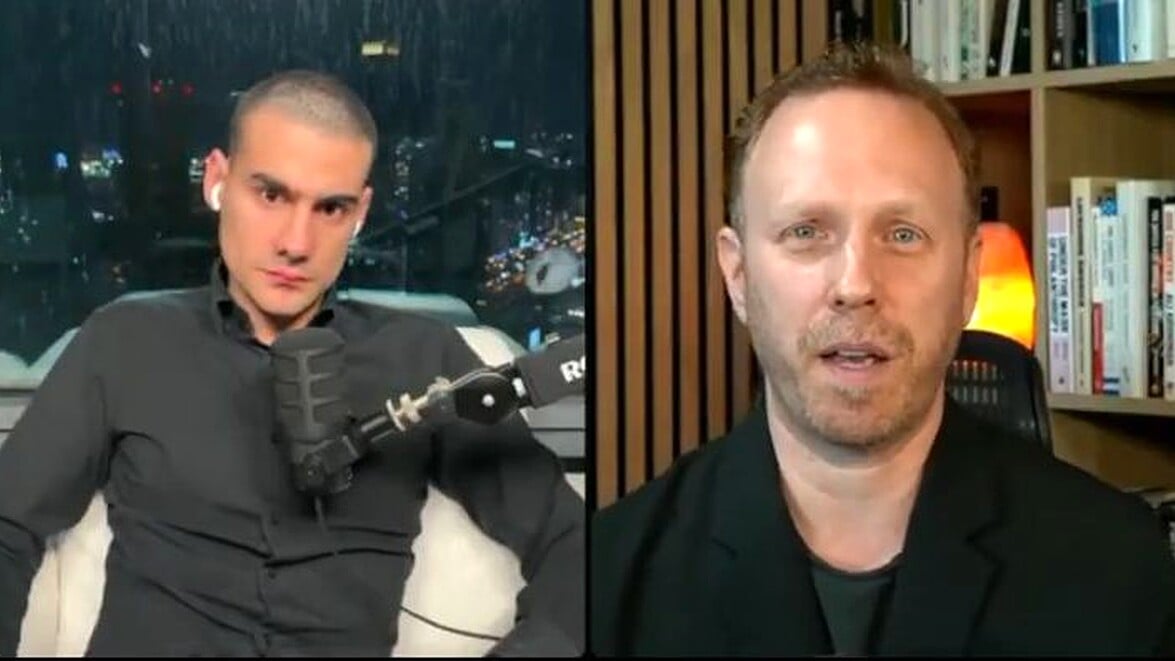




ISLAMABAD: Investigative journalist Max Blumenthal has alleged in a detailed report that the Federal Bureau of Investigation collaborated with Israeli intelligence and Prime Minister Benjamin Netanyahu to fabricate assassination plots targeting former US President Donald Trump.
The aim, according to Blumenthal’s March 6, 2026, article published by The Grayzone, was to convince Trump that Iran was actively seeking to eliminate him on American soil.
This manufactured fear, the report argues, pressured Trump into supporting aggressive military action against Iran, culminating in the ongoing US-Israeli campaign that has escalated into regional conflict.
Blumenthal’s piece draws on court records, whistleblower accounts, and public statements to outline a pattern of intelligence operations.
He points to cases like that of Asif Merchant, a Pakistani national arrested in 2024 on charges of plotting to assassinate Trump and other officials.
Merchant’s trial in Brooklyn federal court revealed interactions with undercover FBI informants who posed as hitmen.
The defendant claimed coercion by Iran’s Revolutionary Guard Corps to protect his family, but prosecutors presented evidence of a contrived scheme involving staged protests and reconnaissance.
Blumenthal describes the operation as a controlled sting where Merchant, flagged on watchlists yet granted parole entry, was steered toward incriminating actions.
He cites journalist Ken Silva’s forthcoming book on the Trump assassination plots, which portrays Merchant as a patsy in an FBI-orchestrated scenario posing no real threat.
Similar patterns appear in earlier cases, such as the 2022 charges against Shahram Poursafi for an alleged plot against John Bolton.
That operation also relied on FBI informants, with no arrest possible due to Poursafi’s location abroad.
Blumenthal connects these incidents to a broader effort by pro-Israel figures in Trump’s circle to link Iran to real assassination attempts on the former president.
These include the July 2024 shooting in Butler, Pennsylvania, by Thomas Crooks, and the September 2024 incident involving Ryan Routh at Mar-a-Lago.
No credible evidence has tied Iran directly to those events, yet Israeli-aligned advisors and Netanyahu reportedly amplified connections.
In a June 2025 Fox News appearance, Netanyahu asserted that Iran, through proxies, sought to kill Trump twice.
Blumenthal argues this narrative exploited Trump’s post-attempt paranoia, including fears of Iranian missile threats that prompted decoy flights during his campaign.
The report suggests FBI alerts about surface-to-air missiles were exaggerated or fabricated from unrelated intelligence.
Once in office, Trump authorized strikes supporting Israel’s assault on Iranian facilities.
Blumenthal frames the dynamic as psychological leverage: by heightening assassination fears, Israel and its US allies maintained influence over Trump’s foreign policy decisions.
He references Trump’s own remarks after authorizing actions against Iranian leadership, including a statement implying preemptive revenge.
The Grayzone article also highlights Netanyahu’s long-standing push for regime change in Iran, dating back to pressures on previous administrations.
Blumenthal notes the role of figures like Mike Pompeo and John Bolton, who advocated for groups like the Mujahedin-e-Khalq.
In the current context of escalating US-Israeli operations against Iran, Blumenthal’s claims portray a coordinated manipulation campaign.
The report emphasizes that no mainstream outlets have fully corroborated the fabrication allegations.
Court proceedings in Merchant’s case, concluded recently with a conviction, focused on Iranian links rather than FBI orchestration.
US officials continue to cite these plots as justification for military responses.
Blumenthal’s analysis remains confined to alternative media, podcasts, and social platforms where clips of his explanations have circulated widely.
The allegations, if substantiated further, could raise questions about intelligence practices and foreign influence in US decision-making.
As the conflict widens, with reported civilian casualties and economic fallout, the debate over motivations behind US involvement persists.
Blumenthal concludes that exploiting personal vulnerabilities proved key to aligning Trump with a belligerent stance toward Tehran.
Iranian officials have denied involvement in assassination schemes on US soil, framing US actions as aggression.
The full implications of these reported intelligence maneuvers continue to unfold amid ongoing hostilities.