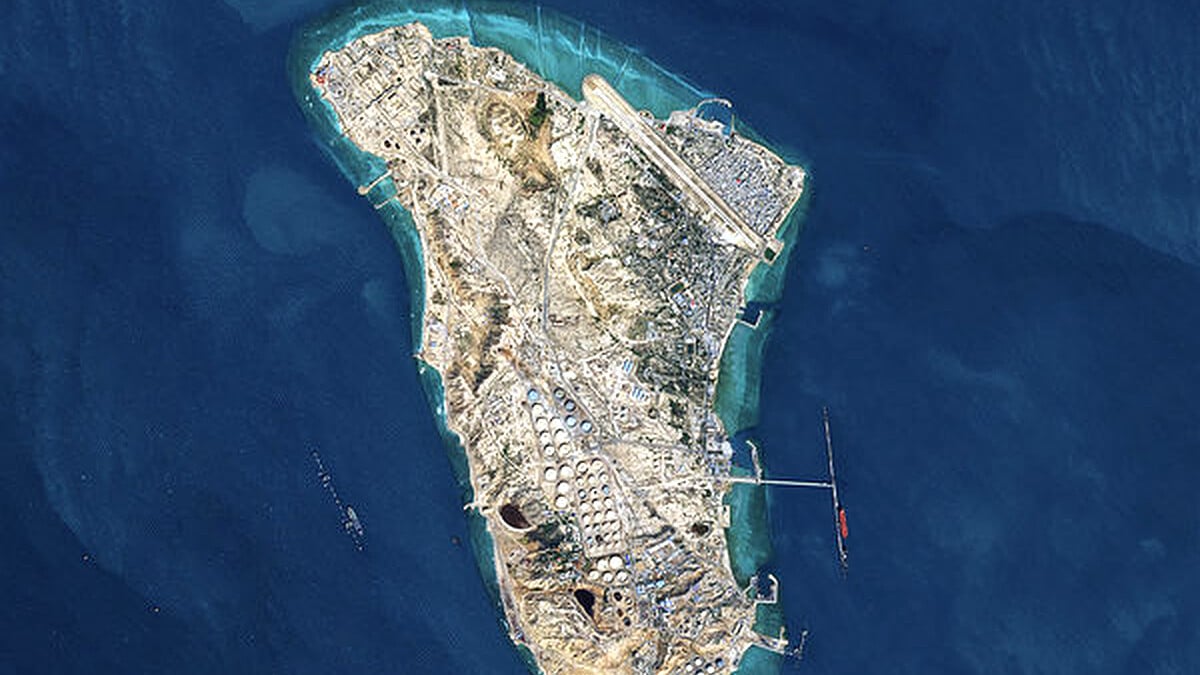




ISLAMABAD: US President Donald Trump is considering a bold military plan to seize Iran’s Kharg Island, the strategic hub that handles nearly 90 percent of the country’s crude oil exports, according to a report by Axios citing administration officials.
The discussion emerges against the backdrop of heightened US-Iran tensions, including ongoing military actions involving the United States and Israel aimed at preventing Iran from advancing its nuclear capabilities.
Kharg Island, a small five-mile-long strip in the Persian Gulf, serves as Iran’s primary oil export terminal. Pipelines connect it to major onshore and offshore fields, enabling the loading of supertankers that carry crude to international markets, predominantly China.
Data from energy analysts indicate that Kharg Island accounts for up to 90 percent of Iran’s crude shipments. Iran’s average exports hover around 1.5 to 2 million barrels per day in recent periods, though surges have occurred amid threats, with loadings sometimes reaching over 3 million barrels daily.
The island’s infrastructure includes storage tanks, loading hoses, pumps, and berths capable of handling large volumes. Disrupting or controlling this facility would severely impact Iran’s economy, which relies heavily on oil revenues to fund government operations and support entities like the Islamic Revolutionary Guard Corps.
Reports suggest that about half of Iran’s oil industry is controlled by the Revolutionary Guard, using proceeds to finance proxy groups and domestic security measures. Seizing Kharg could deprive the regime of critical funding sources, potentially weakening its ability to maintain internal control or sustain regional influence.
Administration sources told Axios that the idea of capturing Kharg Island has been floated alongside other options, such as deploying special forces to secure Iran’s stockpile of highly enriched uranium. These discussions form part of broader deliberations on escalating pressure beyond airstrikes.
President Trump has not publicly ruled out ground operations in Iran, stating that such actions would require “a very good reason.” He has emphasized preventing Iran from obtaining nuclear weapons as a core objective of current policy.
Experts note that Kharg Island represents a choke point for Iran’s energy sector. Its capture could halt exports almost entirely, given that alternative terminals handle only a fraction of the volume. This would align with past suggestions from Trump allies who advocate “taking the oil” as a means to offset military costs or gain leverage.
Analysts from think tanks like the American Enterprise Institute have described seizing the terminal as a “no-brainer” strategic move. Retired military figures, including some associated with the administration, have publicly supported the idea, arguing it would disrupt Iran’s petroleum flow and economy without requiring a full-scale invasion.
However, such an operation carries significant risks. Kharg Island is heavily defended, and any assault could provoke Iranian retaliation in the Persian Gulf, including attacks on shipping lanes or energy infrastructure in neighboring states. The Strait of Hormuz, through which oil from Kharg passes, remains a global chokepoint for about 20 percent of world oil trade.
A disruption at Kharg could spike global oil prices substantially. Estimates suggest that prolonged offline status might add $10-15 per barrel to benchmarks, with shorter interruptions still causing volatility. Iran’s exports, though sanctioned, have found markets primarily in Asia, and any cutoff would force buyers to seek alternatives at higher costs.
The proposal reflects a shift in thinking within the Trump administration toward targeted, high-impact actions rather than widespread regime change. Officials have indicated reluctance for prolonged ground commitments, preferring limited interventions with clear economic or strategic payoffs.
Iranian officials have warned against such moves, asserting that the country would respond forcefully to threats against its sovereignty or economic lifelines. Past conflicts have seen Iran demonstrate resilience in maintaining exports even under pressure.
The Axios report highlights internal debates within the National Security Council, where figures like Secretary of State Marco Rubio have been involved in weighing these options. The discussions coincide with reports of US casualties in the region and public statements from Trump on the need for decisive action.
As deliberations continue, the potential seizure of Kharg Island underscores the intersection of military strategy and energy geopolitics in the current US-Iran standoff. Observers warn that any implementation could reshape regional dynamics and global energy markets for years to come.