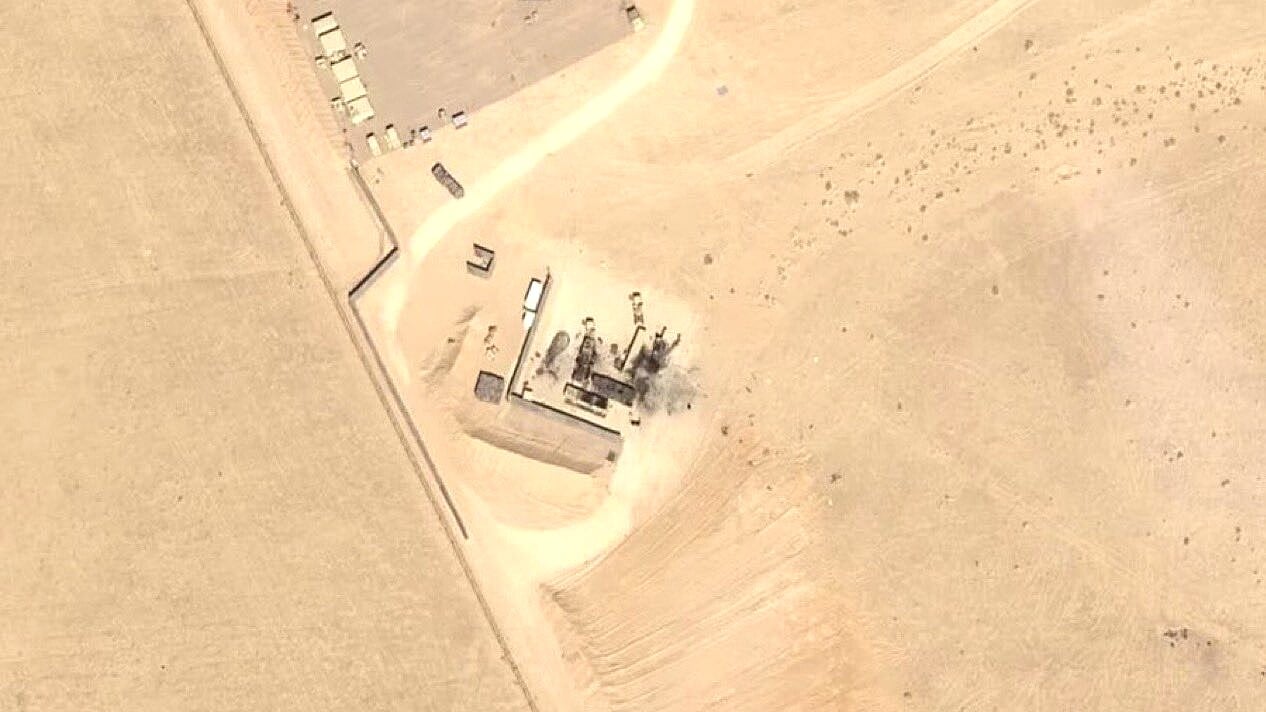




ISLAMABAD: New satellite imagery has confirmed that Iranian forces struck and apparently destroyed the radar component of a United States Terminal High Altitude Area Defense (THAAD) battery deployed at Muwaffaq Salti Air Base in Jordan during the opening phase of the ongoing US-Israeli military campaign against Iran.
The strike, which occurred in the first days of the conflict, targeted a critical detection system essential for intercepting ballistic missiles. Analysts indicate this move forms part of a broader Iranian strategy to weaken regional air defense networks protecting American and allied interests.
CNN’s investigation, supported by high-resolution satellite photographs dated March 2, 2026, shows debris scattered around a blackened and damaged radar unit at the Jordanian base. The imagery captures visible destruction to the AN/TPY-2 radar, a sophisticated sensor paired with THAAD interceptors to track and engage incoming threats at high altitudes.
The Muwaffaq Salti Air Base, located more than 500 miles from Iranian territory, hosts this American THAAD deployment, which was positioned there since at least mid-February 2026. The radar’s destruction represents a significant tactical achievement for Iran, as such systems provide early warning and targeting data vital for missile defense operations.
THAAD batteries serve as a cornerstone of layered missile defense architecture in the Middle East. The United States maintains eight operational THAAD batteries globally, with additional units operated by allies including two in the United Arab Emirates and one in Saudi Arabia.
Each battery relies on the AN/TPY-2 radar for long-range detection, capable of identifying ballistic missile launches far beyond visual range. Without this radar, the system’s effectiveness diminishes substantially, though experts note that alternative sensors and configurations may partially mitigate the loss.
The strike aligns with patterns observed across multiple US military installations in the Arabian Peninsula. Satellite analyses from sources including The New York Times and independent imagery providers reveal damage to radar domes, satellite communication terminals, and related infrastructure at bases in Bahrain, Qatar, Kuwait, Saudi Arabia, and the UAE.
In Qatar, a high-value AN/FPS-132 early-warning radar operated by the US Space Force sustained confirmed damage, shortening missile detection timelines for regional allies. Similar hits targeted communication assets at the US Fifth Fleet headquarters in Bahrain and other sites, suggesting deliberate efforts to disrupt command and control.
Iran launched retaliatory barrages involving ballistic missiles and drones in response to initial US-Israeli airstrikes, which aimed to degrade Iranian nuclear and military capabilities. Reports indicate Iran deployed dozens of projectiles toward Jordan, among other locations, overwhelming some defensive layers.
While US Patriot and THAAD systems intercepted many incoming threats in prior exchanges, the precision targeting of radar components highlights vulnerabilities in forward-deployed defenses. The cost of replacing such specialized radars runs into hundreds of millions of dollars, with limited global spares available.
Military observers point out that damaging the radar does not render the entire THAAD battery inoperable, as launchers and other elements remain functional. However, it severely restricts operational flexibility, reduces engagement envelopes, and forces reliance on less optimal backup systems.
This development escalates concerns over the sustainability of US missile defense posture in the Gulf amid prolonged hostilities. With Iran’s arsenal of precision-guided munitions demonstrating reach and accuracy, allied forces face increased risks to high-value assets.
The incident underscores the evolving nature of modern warfare, where asymmetric tactics target enabling technologies rather than frontline combat units. As the conflict enters its second week, both sides continue intensive operations, with potential implications for broader regional stability and global energy security.
The destruction of the Jordan-based THAAD radar, if fully verified through further assessments, marks a notable setback for American deterrence strategy in West Asia. Pentagon officials have yet to issue detailed public comments on the specific damage, citing operational security.
As satellite evidence accumulates, the episode highlights the high stakes involved in the current confrontation, where each side seeks to erode the other’s defensive advantages through targeted strikes on critical infrastructure.