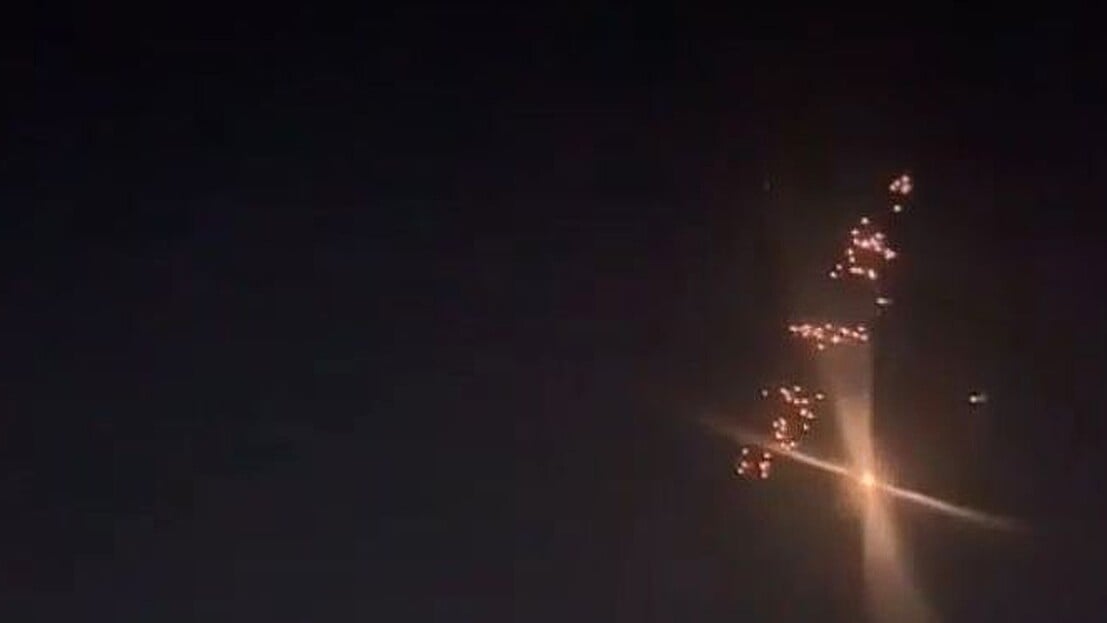




ISLAMABAD: Iran’s recent deployment of ballistic missiles armed with cluster warheads against central Israel, including areas near Tel Aviv, marks a significant escalation in the ongoing conflict and highlights advancements in Tehran’s missile technology. The Israel Defense Forces confirmed that at least one such missile released approximately 20 submunitions mid-air, scattering them over a radius of around eight kilometres and posing heightened risks to civilian populations and infrastructure in densely populated zones.
This incident, reported in early March 2026 amid intensified exchanges between Iran and Israel, involved a ballistic missile that detonated its warhead at altitude, dispersing smaller bomblets each carrying roughly 2.5 kilograms of explosives. Footage captured submunitions streaking across the sky before impacting, with reports indicating injuries to at least 12 people and damage to homes and vehicles, though no immediate fatalities were linked directly to the cluster payload in the latest strike.
Cluster munitions differ fundamentally from conventional unitary warheads. Rather than delivering a single large explosion, these warheads open during descent to release multiple independent submunitions designed to cover a broad area. Each submunition functions as a small bomb, detonating on contact or through impact fuses, which amplifies the effective strike footprint and complicates defensive measures.
The Israel Defense Forces have documented Iran launching multiple cluster-equipped missiles since the conflict’s intensification, with at least six confirmed uses in recent weeks. Earlier instances during the 2025 “12 Day War” saw similar weapons targeting residential areas in the Gush Dan metropolitan region around Tel Aviv, as well as cities like Beersheba and Rishon LeZion, leaving patterns of multiple small craters consistent with submunition dispersal.
From a technical standpoint, Iran’s arsenal features adaptable medium-range ballistic missiles capable of carrying such payloads. The Kheibar Shekan, a solid-fuel missile with a range of about 1,450 kilometres, has been associated with cluster configurations in recent attacks. Similarly, the Khorramshahr-4, also known as Kheibar in some designations, offers a longer reach of up to 2,000 kilometres and a substantial 1,500-kilogram warhead capacity, allowing for modifications to include cluster or multiple submunition options.
These systems enable Iran to saturate air defence networks like Israel’s Iron Dome and Arrow systems. By dispersing numerous targets simultaneously, cluster warheads overwhelm interceptors, which must engage each submunition individually, increasing the likelihood that some reach the ground. This tactic proves particularly effective against dispersed or soft targets, such as urban infrastructure or military installations spread across wide areas.
However, the deployment near civilian centres has drawn sharp international condemnation. Organisations like Amnesty International have described the use of cluster munitions in populated zones as violations of international humanitarian law, citing their indiscriminate nature and the long-term hazards from unexploded ordnance. Unexploded bomblets can remain dangerous for extended periods, turning affected areas into de facto minefields and endangering civilians, including children, during post-conflict recovery.
Iran’s development of cluster warhead technology expands its strategic options beyond traditional high-explosive strikes. It reflects a broader trend in modern missile warfare where payload sophistication—such as dispersal mechanisms—enhances deterrence and operational flexibility. Speculation persists regarding external assistance in this capability, with some analysts pointing to potential influences from Russian or Chinese expertise, though no definitive evidence has emerged publicly.
The strikes underscore the evolving dynamics of the Iran-Israel confrontation, where missile range, accuracy, and warhead versatility play decisive roles. As both sides continue exchanges, the introduction of cluster munitions raises concerns over civilian safety and the potential for further escalation in a region already strained by prolonged hostilities.
In response to these attacks, Israeli forces have intensified operations against Iranian missile infrastructure, claiming destruction of hundreds of launchers to curb barrages. The combination of advanced Iranian delivery systems and controversial payloads illustrates how technological adaptations are reshaping the nature of ranged conflicts, prioritising area effects over precision in certain scenarios.