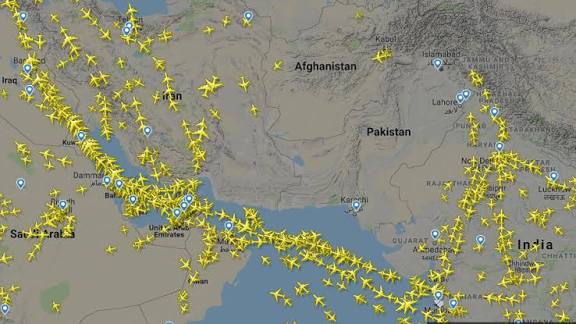




ISLAMABAD: The Pakistan Airports Authority (PAA) has firmly stated that the country’s airspace remains fully operational and safe for all flight operations.
This reassurance comes at a time when regional instability has prompted temporary airspace restrictions elsewhere, notably in Iran.
The announcement addresses growing concerns among airlines, passengers and international aviation partners following recent developments in the Middle East.
On Saturday, the PAA issued a detailed statement emphasizing that no delays, restrictions or safety issues have been reported within Pakistani airspace.
Air traffic control units across major airports including Karachi, Lahore and Islamabad are fully prepared and functioning normally.
The statement highlights proactive monitoring and coordination with national and international aviation authorities to maintain seamless operations.
Iran’s temporary closure of Tehran’s airspace, effective from 1130 to 1700 Pakistan Standard Time as per NOTAM A0715/26, has drawn attention to potential rerouting of flights.
This daytime restriction, linked to security measures after reported strikes, affects east-west transit routes but has minimal impact during those hours due to typically lower traffic volumes.
PAA officials note that Pakistani airspace could see increased nighttime overflights if the Iranian closure extends, as carriers adjust long-haul paths to avoid affected zones.
Despite such possibilities, the authority stresses robust readiness to accommodate additional traffic without compromising safety.
Pakistan’s airspace has long served as a vital corridor for international aviation, connecting Europe, the Middle East and Asia.
Major carriers routinely traverse Pakistani flight information regions, including Karachi FIR and Lahore FIR, under established protocols.
The PAA’s confirmation counters any speculation about disruptions, reinforcing confidence in the country’s air navigation infrastructure.
This comes amid broader regional challenges, including airspace closures in parts of the Gulf and advisories from various aviation bodies.
For instance, some European regulators maintain altitude-specific recommendations for overflights in certain areas, often advising levels at or above FL260.
In Pakistan’s case, no such new restrictions apply, and commercial traffic continues normally.
The authority’s statement also aligns with efforts to prioritize passenger safety and operational efficiency.
Pakistan International Airlines (PIA), the national carrier, has adjusted some services to Gulf destinations like UAE, Bahrain, Kuwait and Doha, suspending flights temporarily until respective airspaces reopen.
These measures aim to avoid conflict-related zones while rerouting others, such as to Saudi Arabia, for uninterrupted connectivity.
Travelers are advised to check flight statuses directly with airlines, as dynamic regional conditions may influence schedules.
The PAA operates under the Ministry of Defence as an autonomous body established in 2024 per the Pakistan Airports Authority Act 2023.
It manages airports nationwide, ensuring compliance with international standards set by bodies like the International Civil Aviation Organization.
Recent events underscore the importance of clear communication in aviation to prevent misinformation and maintain trust.
By declaring the airspace fully open and safe, the PAA seeks to support economic activity reliant on air travel, including trade, tourism and remittances.
Pakistan’s strategic location makes stable airspace crucial for regional connectivity.
Officials continue close monitoring of the situation, ready to issue updates if needed.
No safety concerns have emerged domestically, and operations proceed as routine.
This stance provides relief to stakeholders amid external uncertainties.
Aviation experts view such assurances as essential for sustaining confidence in Pakistan’s role as a reliable transit hub.
The PAA’s prompt response demonstrates effective crisis management capabilities.
Passengers planning travel through or over Pakistan can proceed with normal bookings, subject to airline-specific advisories.
The authority remains committed to upholding the highest safety standards.
In summary, Pakistan’s airspace stands unaffected and secure, offering continuity in an otherwise volatile regional aviation landscape.