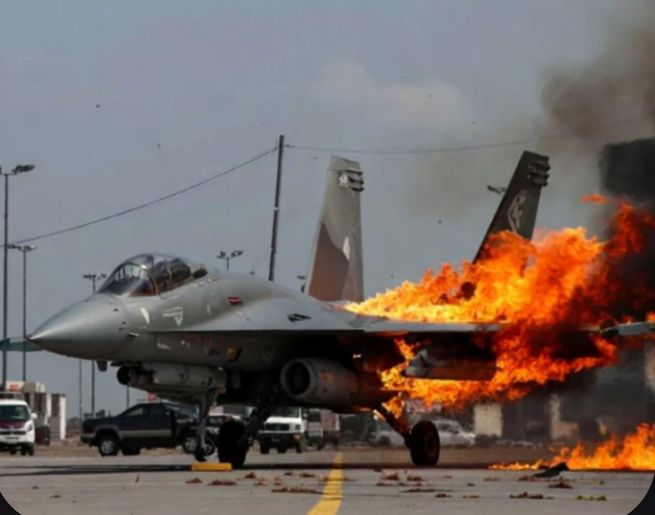




A Kazakhstan Air Force Su-30SM fighter jet crashed during a routine training flight in the central Karaganda region on Wednesday, but both pilots ejected safely and sustained no life-threatening injuries, according to the country’s Ministry of Defense.
ISLAMABAD: A Sukhoi Su-30SM multirole fighter jet belonging to the Kazakhstan Air Force crashed on February 25 during a scheduled training mission in the Karaganda region, marking yet another incident in the country’s military aviation history. The Ministry of Defense promptly confirmed the event, emphasizing that the crew ejected in a timely manner and are now under medical supervision with stable conditions.
The crash occurred in a remote and uninhabited area near the city of Balkhash, ensuring no risk to civilian life or infrastructure. Authorities immediately cordoned off the crash site to secure the wreckage and facilitate the ongoing investigation. A special commission, led by officials from the Flight Safety Department of the Ministry of Defense, has been formed to determine the precise cause of the accident.
The Su-30SM, a twin-engine, all-weather supermaneuverable fighter developed by Russia’s Sukhoi corporation, forms a critical component of Kazakhstan’s air defense capabilities. Delivered in batches starting from 2015, Kazakhstan currently operates around 24 to 27 of these advanced aircraft, acquired to modernize its air force amid regional security dynamics.
This variant features enhanced avionics, thrust-vectoring engines, and multirole versatility, enabling air superiority, ground attack, and reconnaissance missions. It has been a mainstay for post-Soviet states transitioning to more capable platforms beyond older Soviet-era jets.
Notably, this is not the first Su-30SM incident in Kazakhstan. In 2021, another aircraft from the same type crashed during a training exercise in the same general vicinity near Balkhash, with pilots also ejecting safely. That event prompted reviews of maintenance and operational protocols, though details on subsequent improvements remain limited in public domain.
The Karaganda region, home to the 610th Air Base at Sary-Arka Airport, serves as a primary hub for Kazakhstan’s Su-30SM fleet operations. The base supports routine flights and advanced training, reflecting the strategic importance of central Kazakhstan for air force activities.
Military aviation accidents during training flights, while unfortunate, are not uncommon globally due to the high-risk nature of fighter jet operations. Factors such as technical malfunctions, human error, adverse weather, or procedural issues often contribute, though preliminary reports on Wednesday’s crash have not specified any cause.
The Ministry of Defense reiterated that the incident posed no threat to the local population, underscoring the remote location and swift response measures. Both pilots, whose identities have not been disclosed, are receiving necessary medical attention to ensure full recovery.
Kazakhstan’s air force has undergone significant modernization since independence, with the Su-30SM acquisition representing a key step toward enhancing interoperability and combat readiness. The platform’s integration has bolstered deterrence in a region bordered by major powers and volatile areas.
This latest crash coincides with a cluster of military aviation incidents reported in recent days across different countries, including helicopter and fighter jet mishaps in Iran, Turkey, and South Korea. While no evidence suggests any connection, such occurrences often prompt discussions on global military aviation safety standards and training rigor.
Investigators are expected to examine flight data recorders, wreckage analysis, and pilot testimonies in the coming weeks. Outcomes could influence future maintenance schedules, pilot training enhancements, or even fleet management decisions for the Su-30SM in Kazakhstan.
The Defense Ministry’s transparent communication, including immediate confirmation and assurances of no public danger, reflects efforts to maintain public confidence amid such events. As the investigation unfolds, updates are anticipated from official channels.
Kazakhstan’s commitment to aviation safety remains evident through the establishment of dedicated commissions for each incident. Past experiences, including the 2021 crash, have informed protocols that likely contributed to the successful ejection and survival of the crew in this case.
The Su-30SM’s robust design, including ejection systems rated for high-speed and altitude scenarios, played a vital role in averting fatalities. This underscores the importance of advanced safety features in modern combat aircraft.
As Kazakhstan continues to operate a mix of legacy and modern platforms, incidents like this highlight the challenges of sustaining high-performance fleets in demanding operational environments.
The event serves as a reminder of the inherent risks faced by air forces worldwide during peacetime training, where preparedness and rapid response are paramount.