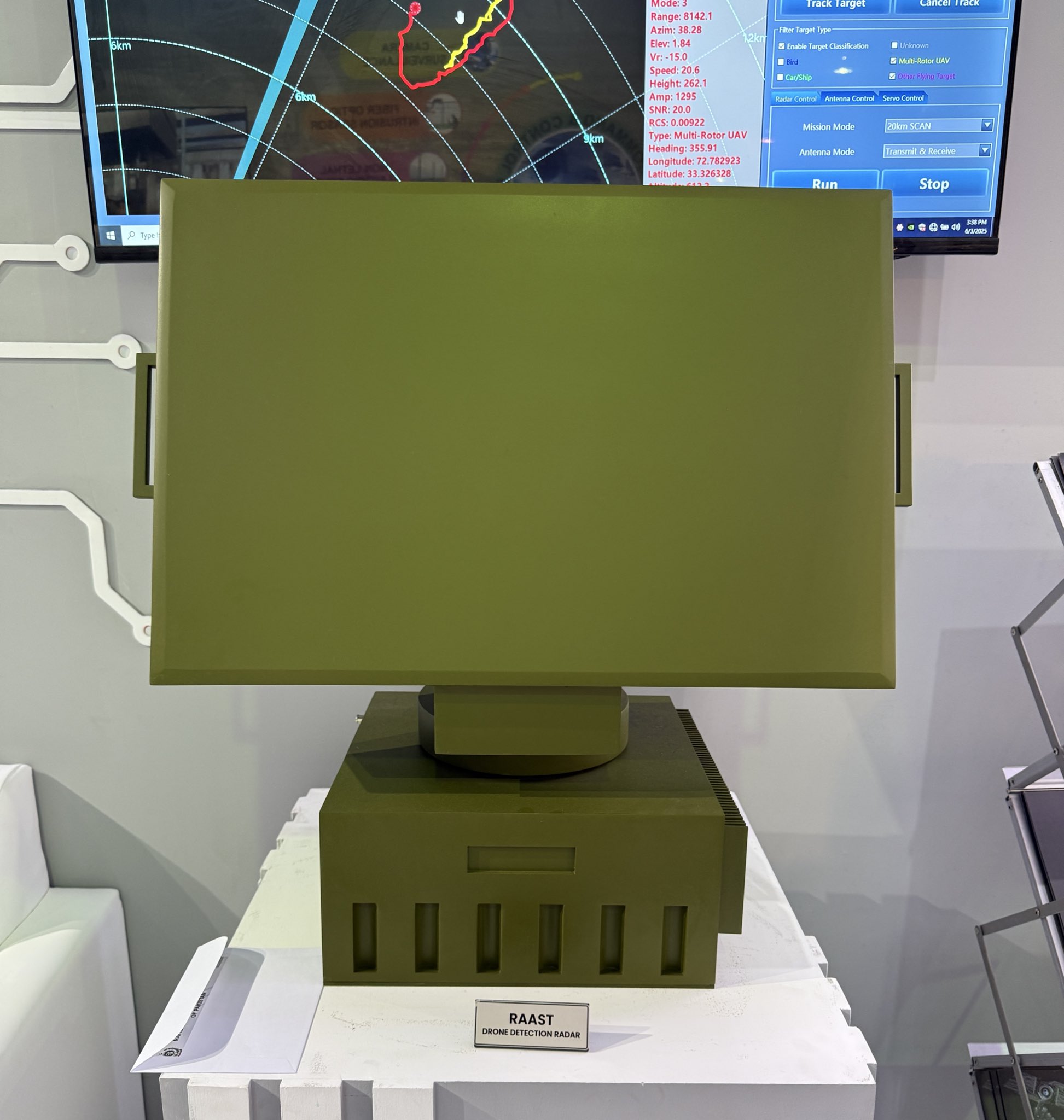




ISLAMABAD: Pakistan’s premier defence conglomerate Global Industrial & Defence Solutions (GIDS) unveiled RAAST, an indigenously designed and developed Drone Detection Radar (DDR), at the Pakistan International Maritime Expo and Conference (PIMEC) 2025 held in Karachi from November 3 to 6.
The announcement marked a significant milestone in Pakistan’s push for self-reliance in advanced surveillance technologies amid rising threats from unmanned aerial vehicles.
RAAST operates as an all-weather Ku-band Active Electronically Scanned Array (AESA) Pulse Doppler radar specifically engineered to detect and track small, low radar cross-section (RCS) UAVs in challenging operational environments.
Its development underscores Pakistan’s growing capabilities in indigenous radar production, reducing dependence on foreign suppliers for critical defence systems.
The radar provides full 360-degree azimuth coverage, ensuring comprehensive surveillance against small drones approaching from any direction.
Electronic elevation coverage extends up to 30 degrees, supported by rapid scan cycles of approximately two seconds for timely threat identification.
RAAST achieves detection of targets with RCS as low as 0.01 square metres at ranges up to 10 kilometres, while maintaining a minimum detection range of about 150 metres.
This performance enables early warning against micro-UAVs, quadcopters, and other low-observable drones that conventional radars often miss.
Accuracy stands at 10 metres in range and around 3 degrees in angle, with a declared detection probability of 85 per cent.
The system handles over 200 targets simultaneously, making it suitable for dense, cluttered airspace scenarios.
GIDS positions RAAST as a versatile platform optimised for force protection, border security, coastal defence, battlefield surveillance, and counterterrorism operations.
Its lightweight design, with the radar unit weighing 43 kilograms and dimensions of 780x460x130 millimetres, allows rapid deployment in under 10 minutes.
A separate servo unit weighing 32 kilograms supports mechanical azimuth rotation while elevation scanning remains electronic through digital beamforming.
This combination of mechanical and electronic scanning balances performance with practicality in field conditions.
The radar’s pulse-Doppler architecture excels in clutter rejection, distinguishing moving targets from ground or environmental returns in complex terrains.
Ku-band operation enhances resolution for small targets, though it faces limitations in adverse weather compared to lower frequencies; all-weather capability is achieved through advanced signal processing.
RAAST integrates into broader counter-UAS ecosystems, cueing jammers, kinetic interceptors, or short-range air defence systems for layered responses.
Pakistan faces increasing drone-related challenges along borders, in maritime zones, and in internal security contexts, including smuggling, reconnaissance, and potential terrorist use.
Indigenous systems like RAAST address these by providing affordable, maintainable solutions tailored to local operational needs.
GIDS, serving as the marketing arm for entities like NESCOM, has built a portfolio of unmanned systems, precision munitions, and electronic warfare technologies.
The unveiling at PIMEC 2025, focused on maritime domains, aligns RAAST with coastal and naval security priorities where small drones pose risks to ships, ports, and offshore assets.
Reports indicate RAAST is already in service with Pakistani forces, with PIMEC marking one of its early public showcases, followed by appearances at international events like EDEX 2025 and World Defense Show 2026.
This progression highlights growing confidence in the system’s reliability and export potential.
Defence analysts view RAAST as part of Pakistan’s broader strategy to enhance technological sovereignty in radar and counter-drone domains.
Collaborations among local entities such as GIDS, NRTC, and PAC Kamra contribute to a robust domestic defence industry.
The radar’s specifications position it competitively against global counterparts designed for similar low-RCS detection roles.
As drone proliferation accelerates worldwide, systems like RAAST bolster situational awareness and deterrence.
Pakistan’s investment in such technologies signals commitment to modernising defences through innovation and self-reliance.