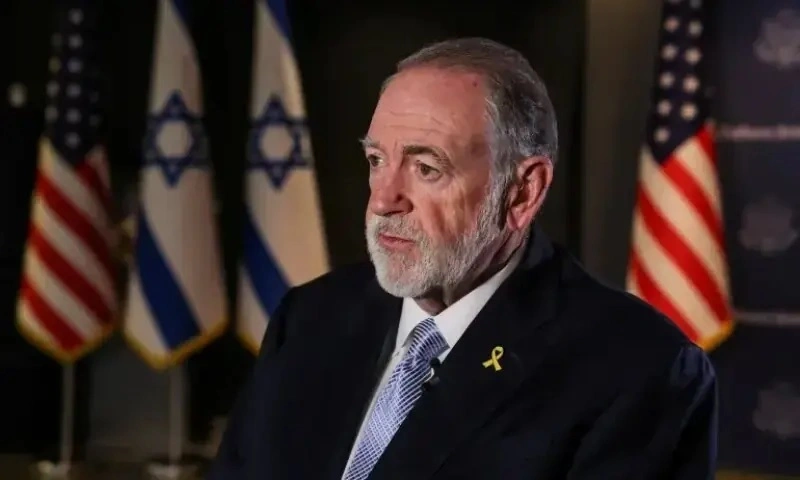




ISLAMABAD: US Ambassador to Israel Mike Huckabee has accused social media accounts operated from Pakistan and Turkey of propagating a dangerous conspiracy theory aimed at delegitimizing Jewish history and identity, sparking fresh diplomatic tensions amid ongoing backlash from his recent interview with Tucker Carlson.
The ambassador’s clarification came in a post on X, formerly Twitter, following intense criticism from Islamic nations over remarks made during the lengthy discussion with Carlson.
Huckabee expressed surprise at the depth of questions posed by Carlson, which delved into distinctions between modern Jews and those described in the Bible.
He emphasized that he had no prior knowledge of the so-called Khazar hypothesis, which Carlson appeared to reference indirectly.
This theory, long debunked by scholars, posits that Ashkenazi Jews, who form a significant portion of the global Jewish population, are descendants of the Khazars, a medieval Turkic people from Central Asia who converted to Judaism.
Huckabee described it as an “odious conspiracy theory” originating from fringe corners of the internet and amplified on social media.
According to the ambassador, such narratives are being weaponized to portray Jews as illegitimate heirs to their ancestral lands, thereby undermining Israel’s historical claims.
He specifically pointed to Islamic accounts from countries like Pakistan and Turkey as key promoters of this falsehood.
This accusation has drawn sharp responses from officials in both nations, who deny any state involvement in such online activities.
Pakistan’s Foreign Ministry issued a statement rejecting the claims as baseless and inflammatory, urging the US to focus on regional peace instead.
Turkey’s government echoed similar sentiments, labeling Huckabee’s words as an attempt to deflect from Israel’s policies in the Middle East.
The controversy stems from a nearly three-hour interview released on February 20, 2026, where Carlson pressed Huckabee on biblical entitlements to land and Jewish ethnic continuity.
Carlson suggested that contemporary Jews might differ fundamentally from ancient Israelites, a line of questioning Huckabee later said caught him off guard.
In his X post, Huckabee clarified that Ashkenazi Jews, often targeted by this theory, have lived in Europe for centuries but constitute only a minority in Israel’s Jewish population.
Data from Israel’s Central Bureau of Statistics supports this, showing that as of 2023, Ashkenazi Jews make up about 25-32% of the country’s Jewish citizens.
In contrast, Mizrahi Jews, with roots in Middle Eastern and North African communities, comprise 40-45%, while Sephardi Jews, from Iberian and other regions, add to the diverse mosaic.
A 2016 Pew Research Center survey further highlights this split, with 45% of Israeli Jews identifying as Ashkenazi and 48% as Sephardi or Mizrahi.
These figures underscore the multi-ethnic nature of Israel’s Jewish society, countering claims of a singular “European” origin.
The Khazar hypothesis, first popularized in the 1970s by Arthur Koestler in his book “The Thirteenth Tribe,” has been repeatedly discredited by genetic and historical research.
A 2013 study published in Human Biology, co-authored by over 20 experts, criticized earlier attempts to link Ashkenazi ancestry to Khazars, citing flawed methodologies.
Genetic analyses, including those from the National Geographic Genographic Project, confirm that Ashkenazi Jews share Middle Eastern origins with other Jewish groups, with minor admixtures from European populations.
Despite this, the theory persists in antisemitic circles, often used to argue that Ashkenazi Jews are “fake” and have no legitimate ties to Israel.
The Anti-Defamation League (ADL) reports a surge in such narratives on social media since the 2020s, particularly during conflicts involving Israel.
In 2022, during Russia’s invasion of Ukraine, the Khazar myth was invoked to portray Ukrainian leadership as part of a “Jewish cabal,” according to the Institute for Strategic Dialogue.
Similar patterns emerged in discussions around the Israel-Hamas war, with conspiracy theorists linking unrelated events to delegitimize Jewish claims.
Huckabee’s statement ties this spread directly to platforms like X and Telegram, where anonymous accounts amplify disinformation.
Research from the Network Contagion Research Institute indicates that antisemitic content, including Khazar-related posts, often originates from regions with high anti-Israel sentiment.
A 2023 report by the ADL noted that over 15% of such conspiracy theories on X were traced to users in the Middle East and South Asia, including Pakistan.
Turkey, with its vocal stance on Palestinian issues, has seen a rise in online activism, some of which veers into antisemitism, per a 2024 European Union monitoring study.
The ambassador insisted he does not believe Carlson intentionally promoted the theory, stating, “I don’t know what was in his heart or what he was thinking.”
However, Huckabee criticized the focus on this topic, suggesting it fuels division at a time of heightened global tensions.
Critics argue that Huckabee’s own comments in the interview, affirming Israel’s biblical rights to expansive Middle Eastern territories, exacerbated the backlash.
Arab nations, including Saudi Arabia, condemned those remarks as provocative, leading to the initial outcry from Islamic countries.
The US State Department has distanced itself slightly, emphasizing that ambassadors’ views do not always reflect official policy.
Yet, Huckabee’s role as a Trump appointee in 2025 positions him as a key figure in US-Israel relations.
His background as former Arkansas governor and evangelical Christian aligns with strong pro-Israel stances, often rooted in biblical interpretations.
This incident highlights the intersection of religion, history, and digital misinformation in modern diplomacy.
As social media continues to democratize information, theories like the Khazar hypothesis gain traction despite lacking evidence.
Experts warn that such narratives not only distort history but also incite real-world violence against Jewish communities.
In Pakistan, where internet penetration reaches 40% of the population per World Bank data, social media plays a pivotal role in shaping public opinion on international issues.
Similarly, Turkey’s 85 million X users make it a hotspot for viral content, according to Statista’s 2025 figures.
Huckabee’s accusation thus points to a broader challenge: regulating online hate without infringing on free speech.
Responses from affected countries suggest potential escalations in cyber diplomacy.
Pakistan has ramped up efforts to counter what it calls “Islamophobic” narratives from Western officials.
Turkey, under President Erdogan, has frequently clashed with Israel and its allies over similar issues.
The ambassador’s clarification aims to quell the storm, but it may have ignited new debates on the origins and impacts of online conspiracies.
As the dust settles, the episode serves as a reminder of how historical myths, amplified digitally, can strain international relations.
With ongoing conflicts in the region, such statements risk further polarizing already divided audiences.
Huckabee concluded his post by reaffirming his commitment to factual discourse, urging a rejection of divisive theories.
Whether this will mend fences with Islamic nations remains to be seen.