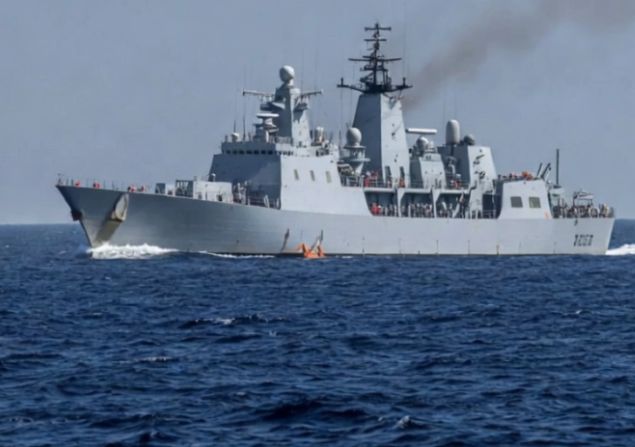




ISLAMABAD: Pakistan Navy ships will undertake live firing drills involving missiles and gunnery in the Arabian Sea on February 24 and 25.
The exercises are scheduled daily between 0300 Zulu time and 1300 Zulu time, equivalent to 0800 Pakistan Standard Time to 1800 Pakistan Standard Time.
Such live weapon firings form a critical component of routine naval training to maintain operational proficiency and validate weapon systems under realistic sea conditions.
The Inter-Services Public Relations directorate typically coordinates these activities through navigational warnings issued via NAVAREA IX, advising mariners and aviators to avoid designated danger zones during the specified periods.
These warnings ensure the safety of commercial shipping, fishing vessels and international air traffic transiting the busy Arabian Sea corridor.
The Arabian Sea remains a vital maritime domain for Pakistan, serving as a gateway for energy imports, trade routes and strategic interests along the Makran coast.
Pakistan Navy has consistently emphasized regular live firing to keep its fleet in peak readiness, particularly in response to evolving threats in the Indian Ocean region.
Recent exercises in the same area have included advanced systems such as the LY-80(N) surface-to-air missile, successfully test-fired from vertical launching systems on Tughril-class frigates like PNS Taimur in January 2026.
Those drills demonstrated extended-range air defence capabilities, with missiles engaging aerial targets effectively at long distances.
Loitering munitions also featured in those tests, showcasing precision strike options against surface threats.
Open-sea trials of indigenously developed unmanned surface vessels further highlighted Pakistan Navy’s push toward autonomous technologies.
Such integrations reflect a broader modernization drive, incorporating both conventional firepower and emerging unmanned platforms.
The upcoming February 24-25 drills focus on missiles and gunnery, likely involving surface-to-air, surface-to-surface or anti-ship systems alongside main gun engagements.
Gunnery practice sharpens close-range defence and bombardment accuracy, essential for fleet operations.
Missile firings test guidance, propulsion and warhead performance in dynamic maritime environments, including wave motion and electronic warfare conditions.
Pakistan Navy routinely conducts these in designated exclusion zones to minimize risks, with coordinates shared through hydrographic offices and international maritime channels.
The timing in late February follows other activities, including the national-level Exercise SEA GUARD 2026 held earlier in the month.
SEA GUARD emphasized coordination among shipping, fishing, law enforcement and private sectors to counter multifaceted maritime challenges.
Live search and rescue components during that exercise underscored humanitarian aspects alongside security roles.
Pakistan Navy’s commitment to regular live firings aligns with global naval practices, where hands-on weapon employment remains indispensable despite simulations.
These drills bolster deterrence posture while assuring allies of sustained capability.
In the context of regional security, the Arabian Sea witnesses periodic exercises by multiple navies, including simultaneous notifications from neighbouring forces in past instances.
Such activities occur independently but highlight the need for de-confliction through established maritime communication protocols.
Pakistan Navy maintains a professional approach, issuing timely advisories to prevent inadvertent incidents.
Mariners are urged to monitor NAVAREA IX warnings and adhere to recommended safe distances.
The February drills coincide with ongoing efforts to enhance fleet interoperability and combat effectiveness.
Pakistan Navy operates a diverse inventory, from submarines and frigates to patrol vessels and aviation assets.
Live firings ensure crews remain proficient across platforms.
The exercises also support indigenization goals, validating locally integrated systems.
Defence analysts view these as standard yet essential for maintaining credible maritime defence.
With Pakistan’s extensive coastline and strategic location, naval readiness directly impacts national security.
The drills reaffirm Pakistan Navy’s role in safeguarding sea lines of communication.
No unusual escalation is associated with the scheduled firings, which are pre-planned and routine.
Observers note the continuity of such training amid broader regional naval developments.
Pakistan Navy continues to balance operational tempo with international maritime responsibilities.
The February 24-25 window allows for comprehensive evaluation of weapon performance.
Successful execution will further affirm the navy’s high state of preparedness.
These activities contribute to overall deterrence and stability in the maritime domain.
Pakistan Navy remains committed to transparent and safe conduct of all exercises.