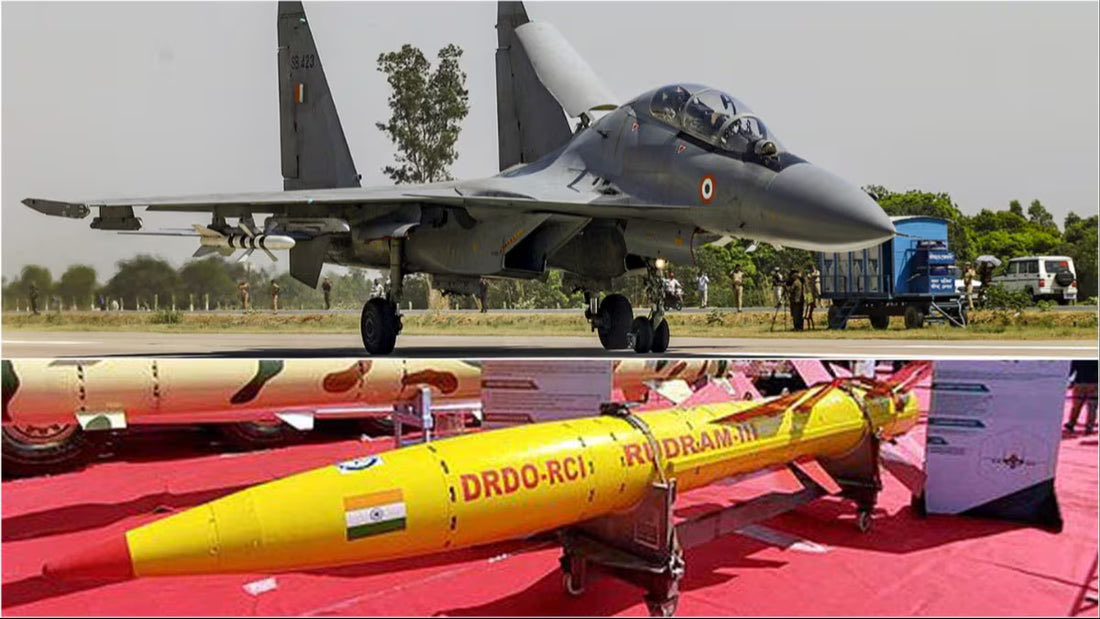




ISLAMABAD: Israel has reportedly agreed to offer India the Golden Horizon air-launched ballistic missile (ALBM), a sophisticated weapon system designed for integration with the Indian Air Force’s Sukhoi Su-30MKI fighters.
This development marks a significant milestone in defence cooperation between the two nations, as no other country is believed to have received such an offer from Israel so far.
Open-source defence reporting indicates that the Golden Horizon ALBM provides an estimated range of around 800 kilometres when launched from an airborne platform.
This capability would allow Indian fighter jets to conduct stand-off strikes, targeting enemy positions from well beyond the reach of long-range beyond-visual-range (BVR) air-to-air missiles and most surface-to-air missile (SAM) networks.
The ballistic trajectory of the Golden Horizon follows a high-arc path, ascending to near-space altitudes before descending at high speeds toward its target.
Such characteristics make interception extremely challenging for conventional air defence systems, which are typically optimised against lower-flying cruise missiles or shorter-range threats.
Integration with the Su-30MKI, one of the Indian Air Force’s mainstay multirole fighters, would enhance operational flexibility.
The Su-30MKI already forms the backbone of India’s aerial strike capabilities, with over 250 units in service and ongoing upgrades to avionics and weaponry.
By equipping these aircraft with the Golden Horizon, India could extend its deep-strike options without requiring forward basing or risking pilots in contested airspace.
Defence analysts highlight that this system draws from Israel’s advanced missile technology lineage, including adaptations from target missiles like the Sparrow series originally developed for testing ballistic missile defences.
Reports suggest the Golden Horizon may represent an offensive derivative of such platforms, refined through operational experience in recent regional conflicts.
Israel has demonstrated the effectiveness of ALBMs in precision strikes, bypassing dense air defence belts by launching from safer distances or altitudes.
For India, facing a two-front security environment with potential adversaries possessing layered air defences and long-range interceptors, the Golden Horizon could address critical gaps.
It would enable strikes on high-value targets such as command centres, missile sites, or logistics hubs from standoff positions, reducing exposure to threats like advanced fighter jets equipped with extended-range missiles.
The offer aligns with deepening Indo-Israeli defence ties, evidenced by recent multi-billion-dollar deals involving precision-guided munitions and other systems.
Israel remains one of India’s top arms suppliers, providing technologies that complement indigenous efforts under the ‘Make in India’ initiative.
Previous acquisitions include Israeli-origin ALBMs such as the Rocks (also known as Crystal Maze-II), which India has tested from Su-30MKI platforms with ranges exceeding 250 kilometres.
The Golden Horizon, with its purported greater reach, would represent a qualitative leap, offering greater strategic reach.
Experts note that air-launched ballistic missiles combine the speed and difficulty-to-intercept nature of ballistic weapons with the mobility and rapid response of fighter aircraft.
A launching jet can position itself optimally before release, extending effective range beyond that of ground-based systems.
For the Indian context, this could prove decisive in scenarios requiring rapid escalation control or pre-emptive options against time-sensitive threats.
While details remain limited due to the classified nature of the system, open-source intelligence points to its development as part of Israel’s efforts to maintain qualitative military edge.
The missile’s high-speed terminal phase and potential for precision guidance further enhance its value.
No official confirmation has emerged from either government, consistent with sensitive defence transfers.
However, defence circles in New Delhi view the offer as a testament to strategic trust built over decades.
India’s pursuit of advanced standoff capabilities reflects broader modernisation goals for its air force amid evolving regional dynamics.
The Golden Horizon could bolster deterrence by ensuring credible long-range precision strike options.
As negotiations proceed, integration challenges including certification, training, and potential local production would need addressing.
Success in this domain would further solidify India-Israel partnership in cutting-edge aerospace technologies.
Overall, the reported offer underscores shifting global defence alignments and the premium placed on standoff weaponry in contemporary warfare.