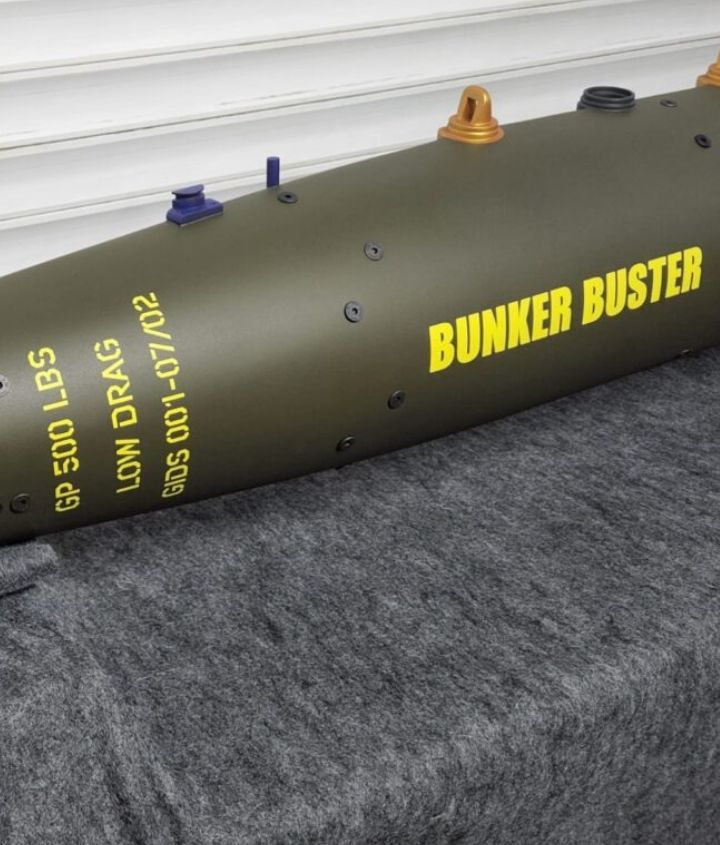




ISLAMABAD: Pakistan has validated the AZB-83 LR, an advanced long-range variant of its indigenous range-extension kit, paving the way for its deployment in 2026 by the Pakistan Air Force.
The breakthrough, announced by Qaswa Industries, transforms the standard 1,000-pound Mk-83 class general-purpose bomb into a standoff precision-guided weapon capable of reaching up to 280 kilometres.
This development follows successful testing and builds on earlier achievements, including the Taimoor air-launched cruise missile trials, underscoring Pakistan’s growing self-reliance in advanced munitions.
The AZB-83 LR integrates a miniature turbojet engine with upgraded subsystems, enabling extended range beyond traditional glide bombs.
Qaswa Industries, the developer, has confirmed the system’s validation, highlighting its pure indigenous engineering with no reliance on ITAR-restricted components.
This ensures full sovereignty in production and deployment, a key advantage in strategic autonomy.
The base AZB series, originally a range-extension kit for Mk-82, Mk-83, and Mk-84 bombs, converts unguided munitions into precision-guided ones using GNSS/INS navigation.
Standard AZB-83 variants achieve ranges of around 100 kilometres with circular error probable accuracy under 10 metres.
The LR version significantly enhances this capability through propulsion integration and aerodynamic refinements.
Weighing 800-825 kilograms while retaining the Mk-83 or indigenous PK-83 warhead, the AZB-83 LR maintains compatibility with crewed aircraft platforms.
These include the JF-17 Thunder multirole fighter and legacy Mirage III/V series, widely operated by the Pakistan Air Force.
Guidance combines inertial navigation with satellite assistance, optional imaging infrared seekers for terminal homing.
This dual-mode system delivers accuracy below 10 metres CEP in standard configuration and under 0.3 metres with IIR, minimising collateral damage.
The turbojet propulsion allows sustained powered flight, distinguishing it from pure glide kits limited by launch altitude.
Experts note this positions the weapon in the class of advanced standoff munitions, enhancing aircraft survivability against modern air defences.
By launching from safer distances, pilots avoid entering high-threat zones equipped with surface-to-air systems.
The announcement aligns with recent displays of Pakistani munitions at international forums, including the World Defense Show.
There, related systems like the Taimoor ALCM drew attention for their low-altitude flight profile and precision.
The Taimoor, tested successfully in early 2026, demonstrated ranges up to 600 kilometres with terrain-hugging capabilities.
Its validation reinforced confidence in indigenous propulsion and guidance technologies, now applied to the AZB-83 LR.
Qaswa Industries has progressively evolved the AZB family since initial deployments around 2017.
Integration with the JF-17 marked early operational success, followed by improved variants from 2019.
Long-range showcases emerged later, with the AZB-83 LR featuring prominently in company specifications.
Official tables list its range at 250-280 kilometres, weight class at 800-825 kg, and CEP values matching or exceeding competitors.
Absence of foreign restrictions enables unrestricted export potential and domestic scaling.
This supports Pakistan’s defence industrial base, reducing import dependency amid regional tensions.
Analysts view the AZB-83 LR as part of a broader push toward layered standoff capabilities.
Combined with cruise missiles and other precision weapons, it bolsters conventional deterrence.
The system’s cost-effectiveness derives from retrofitting existing bomb stocks rather than developing entirely new platforms.
This approach mirrors global trends in affordable precision upgrades.
Deployment in 2026 will integrate it into operational squadrons, enhancing strike options.
It allows engagement of high-value targets from standoff distances, preserving force integrity.
The turbojet integration reflects advancements in miniature engine technology, akin to developments in related ALCM projects.
Pakistan’s focus on indigenous solutions addresses strategic needs in a contested environment.
The validation marks a step toward operational maturity for the AZB-83 LR.
Ongoing refinements may include further seeker enhancements or platform integrations.
As deployment nears, the system promises to strengthen aerial strike proficiency.
This achievement highlights sustained investment in research and development by local entities.
It contributes to national security through technological independence.