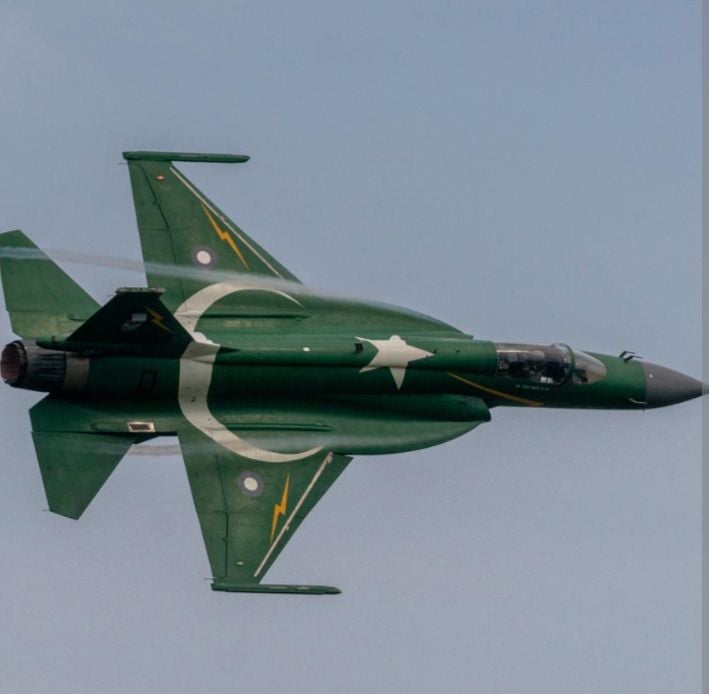




ISLAMABAD – The United States is exerting significant pressure on Saudi Arabia to abandon potential fighter jet acquisitions from non-American sources, particularly Turkey’s KAAN program and Pakistan’s JF-17 Thunder, amid efforts to maintain dominance in the kingdom’s arms market.
The United States has expressed strong dissatisfaction with Saudi Arabia’s pursuit of diversified military partnerships, particularly its exploratory engagements with Turkey on the fifth-generation KAAN fighter jet and earlier considerations of Pakistan’s JF-17 Thunder aircraft.
Recent reports indicate that Washington views these developments as direct threats to American arms exports, which have long formed the backbone of Saudi defence procurement. During Crown Prince Mohammed bin Salman’s visit to Washington, President Donald Trump reaffirmed the potential sale of F-35 Lightning II stealth fighters to the kingdom, alongside a broader strategic defence agreement aimed at strengthening bilateral ties.
Despite this commitment, American officials continue to seek explicit assurances from Riyadh regarding its contacts with other regional suppliers. The Trump administration emphasises the need for the United States to remain the primary, if not exclusive, provider of advanced weaponry to Saudi Arabia, aligning with a policy of prioritising American exports in global defence markets.
Saudi Arabia’s interest in Turkey’s KAAN programme has drawn particular scrutiny. Turkish President Recep Tayyip Erdogan stated in early February during a visit to Riyadh that joint investment in the KAAN could be finalised at any moment. At the World Defense Show held in Riyadh this month, Turkish Aerospace Industries displayed a KAAN model prominently featuring a Saudi flag, signalling advanced discussions.
Industry executives from Turkish Aerospace have described negotiations as being in the final stages of decision-making, with possibilities including procurement of up to 100 aircraft, local production involvement, and broader industrial cooperation aligned with Saudi Vision 2030 objectives. Such participation could provide substantial financial and technological momentum to the KAAN project, which aims to deliver initial operational aircraft to the Turkish Air Force around 2028-2030.
The United States Department of Defense has questioned the strategic rationale for Saudi Arabia to pursue Turkish platforms, noting the kingdom’s existing robust fleet of F-15 Eagles and Eurofighter Typhoons, supplemented by the prospective F-35 acquisition. Officials argue that investments directed toward the KAAN would divert resources from American systems, potentially undermining long-term interoperability and dependency on US-supplied equipment.
In contrast, Washington successfully secured commitments from Riyadh to forgo the acquisition of Pakistan’s JF-17 Thunder. Earlier discussions had explored converting portions of Saudi loans to Pakistan—estimated at around $2 billion—into a fighter jet purchase, potentially valued at $4 billion including additional systems and support. Under American pressure, these talks were halted, with Saudi Arabia providing guarantees against proceeding with the deal.
This outcome reflects broader concerns in Washington about the JF-17’s Sino-Pakistani origins, including Chinese technological contributions, which could complicate Saudi access to sensitive American platforms like the F-35 due to technology security risks. Reports suggest that pursuing the JF-17 might have jeopardised F-35 negotiations, similar to past instances involving other Gulf states.
Saudi Arabia’s diversification efforts stem from strategic imperatives to enhance self-reliance, reduce over-dependence on a single supplier, and address regional security dynamics, including tensions with Iran and balancing relations among Gulf neighbours. Engaging with Turkey aligns with improving bilateral ties between Ankara and Riyadh, encompassing defence industrial collaboration beyond fighter jets.
Nevertheless, the Trump administration maintains that unmet needs in Saudi requirements should be addressed through American offerings rather than alternatives. Current and former US officials have conveyed directly to Riyadh that the KAAN does not fill a capability gap not already covered by existing or forthcoming US systems.
Defence analysts observe that Saudi Arabia maintains one of the world’s largest military budgets, allocating substantial resources to modernisation. The kingdom’s fighter inventory includes advanced fourth-generation platforms, positioning it to potentially integrate fifth-generation capabilities from multiple sources without immediate operational necessity for non-US options.
The ongoing friction highlights evolving geopolitical alignments in the Middle East, where traditional alliances are tested by emerging defence partnerships and economic considerations. Riyadh’s hedging strategy seeks leverage in negotiations with Washington, potentially securing better terms on technology transfer, co-production, or pricing for the F-35.
As discussions progress, the United States continues to press for clarity and prioritisation of American systems. The resolution of these tensions will likely influence the broader regional defence landscape, including the balance of power and arms trade dynamics in the Gulf.