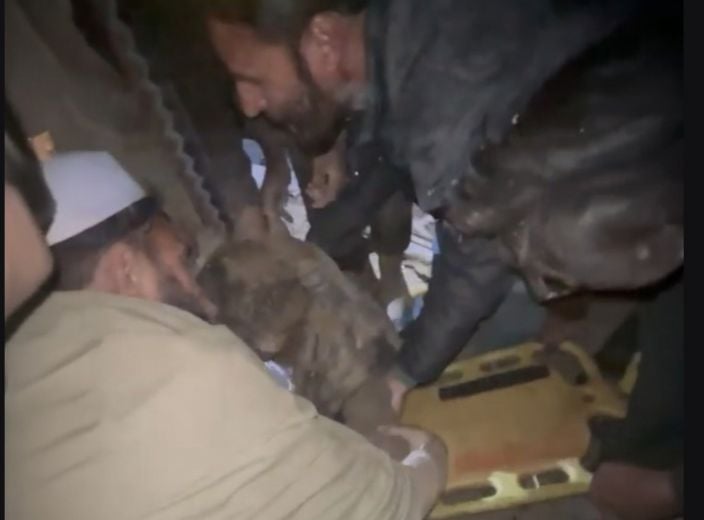




ISLAMABAD: Eleven security personnel embraced martyrdom and one innocent young girl lost her life when terrorists rammed an explosive-laden vehicle into a joint checkpost in Khyber Pakhtunkhwa’s Bajaur district on February 16.
The brazen assault, described by the military as a cowardly act by elements linked to foreign sponsorship, targeted a combined post manned by security forces and law enforcement agencies.
According to the Inter-Services Public Relations (ISPR), the attackers belonged to what the state terms Fitna al Khwarij, a designation for the banned Tehreek-i-Taliban Pakistan (TTP), portrayed as an Indian proxy in official narratives.
The incident unfolded as the assailants attempted to breach the perimeter of the checkpost in the restive Bajaur area, close to the Afghan border.
Security personnel responded with swift and precise action, engaging the terrorists and eliminating twelve of them as they tried to flee.
In a final desperate move, the surviving attackers detonated their vehicle-borne improvised explosive device against the perimeter wall.
The powerful blast caused the collapse of structures at the checkpost, leading directly to the martyrdom of the eleven brave personnel.
The explosion’s impact extended beyond the military installation, severely damaging nearby civilian residential buildings.
This collateral damage tragically resulted in the death of one young girl and injuries to seven other civilians, including women and children.
The ISPR highlighted the vigilance and professionalism displayed by the troops in foiling the larger intent behind the attack.
Bajaur district has long been a hotspot for militant activities, with its proximity to the porous Afghan border facilitating cross-border movements.
Recent years have witnessed a resurgence of violence in Khyber Pakhtunkhwa and Balochistan, prompting intensified counterterrorism efforts.
The attack comes amid ongoing operations under the framework of Azm-e-Istehkam, a comprehensive counterterrorism campaign approved by the Federal Apex Committee on the National Action Plan.
Launched to eradicate the menace of terrorism, Azm-e-Istehkam emphasizes sustained operations, intelligence-based actions, and measures to address extremism’s root causes.
Security forces have conducted multiple intelligence-based operations in the region, neutralizing numerous militants in recent months.
The Bajaur incident underscores the persistent threat posed by groups operating from sanctuaries across the border.
Official statements have repeatedly pointed to external sponsorship, including alleged Indian involvement, in fueling such attacks.
Pakistan maintains that foreign elements continue to support and proxy terrorist outfits to destabilize the country.
In the aftermath of the blast, sanitisation operations were immediately launched to clear any remaining threats in the vicinity.
Troops and law enforcement agencies are sweeping the area to eliminate any hidden militants or accomplices.
The military vowed that the relentless campaign against terrorism would proceed at full pace.
No group has independently claimed responsibility for the February 16 attack, consistent with patterns in similar recent incidents.
Civilian casualties in such operations highlight the human cost of militancy in border regions.
Residents in Bajaur and surrounding areas often bear the brunt of both militant violence and subsequent security responses.
The martyrdom of the eleven personnel adds to the heavy sacrifices made by Pakistan’s security forces in the war against terror.
Condolences poured in from across the political spectrum, with leaders condemning the act and praising the forces’ resolve.
The incident serves as a grim reminder of the challenges in securing volatile border districts.
Experts note that while kinetic operations yield immediate results, long-term stability requires addressing socio-economic grievances and cross-border coordination.
Pakistan has repeatedly urged Afghanistan’s interim authorities to act against terrorist hideouts on their soil.
The Bajaur attack reinforces the urgency of such diplomatic efforts.
As sanitisation continues, authorities are also assessing damage and providing aid to affected civilians.
Medical teams have been deployed to treat the injured, many of whom are receiving care in local facilities.
The loss of young lives in collateral damage has drawn attention to the need for precision in counterterrorism tactics.
Security officials stress that militants deliberately operate near populated areas to exploit such outcomes.
The resolve to wipe out foreign-sponsored terrorism remains firm, officials affirmed.
Pakistan’s counterterrorism strategy continues to evolve, balancing military action with broader stabilisation measures.
The February 16 tragedy in Bajaur will likely galvanise further determination in this enduring fight.