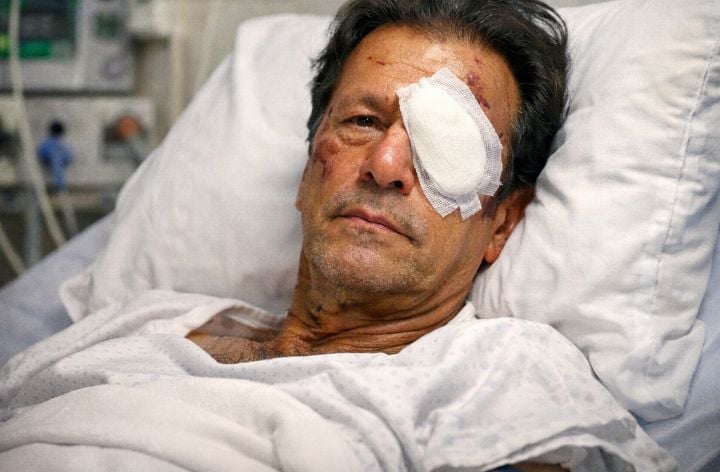




ISLAMABAD: Former prime minister Imran Khan has suffered complete and irreversible damage to his right eye, according to senior journalist Absar Alam, who cited sources including medical inputs from Pakistan Institute of Medical Sciences doctors.
The claim emerged in recent days through Alam’s vlogs and social media statements, where he described the condition as beyond recovery, with the eye’s structure reportedly lost after delayed treatment.
Alam emphasized that the damage became permanent due to prolonged neglect, stating it was “too late” for effective intervention despite eventual medical attention.
This assertion aligns with broader concerns raised in court about Khan’s deteriorating health while imprisoned at Adiala Jail.
A medical report dated February 6, 2026, diagnosed Khan with right central retinal vein occlusion, a serious condition involving a blood clot blocking the central vein in the retina.
The report, presented by court-appointed amicus curiae Barrister Salman Safdar, indicated that Khan retained only about 15 percent vision in the affected eye, equating to an approximate 85 percent loss.
Khan himself informed the amicus that he enjoyed normal 6/6 vision in both eyes until around October 2025, when persistent blurred and hazy vision began.
He repeatedly reported these symptoms to the then jail superintendent but alleged no timely action was taken to provide specialist care.
The condition reportedly worsened rapidly over three to four months, culminating in sudden and substantial vision impairment in the right eye.
Central retinal vein occlusion often leads to significant vision reduction if not addressed promptly, with factors such as hypertension, diabetes, glaucoma or clotting disorders increasing risk.
In untreated or delayed cases, permanent retinal damage can occur, limiting recovery even with later interventions like injections or laser therapy.
Pakistan Tehreek-e-Insaf leaders and supporters have described the situation as gross negligence, possibly deliberate, given restricted access to family and lawyers in recent months.
They argue that timely transfer for specialized treatment could have prevented irreversible harm.
The Supreme Court of Pakistan took suo motu notice of the health concerns, directing authorities to form a medical board for thorough examination.
The apex court also ordered facilitation of a telephone call between Khan and his two sons in the United Kingdom before February 16, 2026.
Government officials, including Information Minister Attaullah Tarar, confirmed that Khan would undergo specialized eye treatment at a leading facility, with examinations by prominent ophthalmologists.
Authorities urged avoiding speculation while treatment proceeds, noting that initial medical steps began in late January following earlier complaints.
Khan was shifted to hospital care under supervision amid the escalating controversy over prison medical provisions.
Critics within opposition circles have linked the incident to broader allegations of institutional neglect toward political detainees.
Public discourse has intensified, with calls for independent verification of Khan’s condition to counter conflicting narratives.
No official medical bulletin from the hospital or government has fully confirmed the extent of permanence claimed by Alam or the 85 percent loss figure presented in court.
However, the diagnosis of central retinal vein occlusion remains consistent across reports, highlighting the gravity of the vascular eye disorder.
Medical experts note that while some vision stabilization is possible through anti-VEGF injections or other therapies, full restoration is often unlikely in advanced cases.
The episode has reignited debates on prisoner rights, healthcare access in custody and judicial oversight of high-profile detentions.
As examinations continue, the focus remains on ensuring appropriate ongoing care for the former premier to manage any further complications.