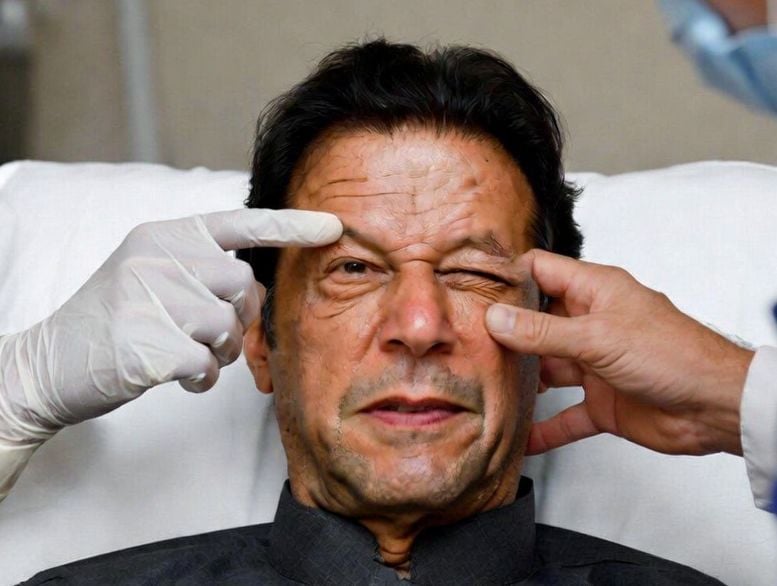




ISLAMABAD: The federal government’s decision to transfer jailed former Prime Minister Imran Khan to a specialized medical facility for urgent eye treatment has fueled widespread speculation about an underlying political deal or backchannel negotiation, particularly following a rare high-level security meeting in Peshawar and the Supreme Court’s swift intervention. Reports indicate Khan has suffered severe vision loss in his right eye—down to approximately 15 percent due to central retinal vein occlusion—allegedly from delayed care in Adiala Jail, prompting opposition protests and judicial directives that appear to have accelerated the process.
The announcement came from Information Minister Attaullah Tarar, who stated that leading ophthalmologists would conduct further examinations and treatment at a specialized institution, with a detailed report submitted to the Supreme Court. This follows a seven-page amicus curiae report by Barrister Salman Safdar, who met Khan on February 10 and detailed how complaints of blurred vision since October 2025 were reportedly ignored, leading to irreversible retinal damage from a blood clot. The Supreme Court responded by ordering a medical board examination before February 16 and allowing Khan a 20-minute phone call with his UK-based sons.
Pakistan Tehreek-e-Insaf (PTI) has rejected aspects of the government’s handling, accusing authorities of secrecy in the transfer process and demanding treatment at Shifa International Hospital under Khan’s personal physicians, with family accompaniment. Party leaders, including Salman Akram Raja, have emphasized no further delays, while Khan’s sister Aleema Khan highlighted the absence of a written court order and consultations, framing the move as potentially inadequate or politically motivated.
The timing of this development coincides with an unusual February 10 meeting at Peshawar’s Corps Headquarters, attended by Federal Interior Minister Mohsin Naqvi, KP Chief Minister Sohail Afridi, the National Security Adviser, Peshawar Corps Commander, and other senior officials. Discussions focused on provincial security, economy, law and order, and counterterrorism coordination, resulting in a special subcommittee for development monitoring and decisions on governance transitions in areas like Malakand. The inclusion of PTI-aligned provincial leadership in such talks, despite ongoing public tensions with federal authorities and military spokespersons, has led analysts to interpret it as a possible confidence-building gesture.
Some observers point to emerging signs of thawing relations, including confidence-building measures and potential indirect contacts involving figures like opposition leader Mehmood Khan Achakzai for future meetings with both Khan and the prime minister. The Supreme Court’s facilitation of extended jail access for Safdar and family communication is viewed by certain quarters as a subtle signal of softening institutional stances toward PTI. These elements suggest the eye treatment transfer may form part of a broader, albeit unconfirmed, negotiation framework to address political deadlock amid Khan’s prolonged incarceration.
PTI continues street protests, including a multi-day sit-in near Parliament House, demanding not only specialized care but Khan’s unconditional release on health grounds. The party alleges institutional neglect contributed to his condition, with lawyers filing high court petitions seeking bail or transfer on humanitarian basis. Government officials, however, urge avoiding speculation and politicization, insisting all constitutionally guaranteed medical facilities are being extended in line with legal requirements.
The convergence of judicial pressure, medical urgency, and recent administrative engagements underscores the complex interplay between health concerns, legal oversight, and political maneuvering in Pakistan’s current landscape. While no explicit deal has been acknowledged, the rapid sequence—from the Peshawar meeting to court orders and government action—has intensified debate over whether Khan’s deteriorating health is prompting quiet reconciliation efforts or merely compliance under scrutiny.
As the medical board’s assessment proceeds and the Supreme Court awaits the detailed report, the situation remains fluid, with implications for detainee rights, opposition dynamics, and civil-military relations. International observers and human rights groups continue monitoring, emphasizing the need for transparent, independent medical intervention in high-profile cases.