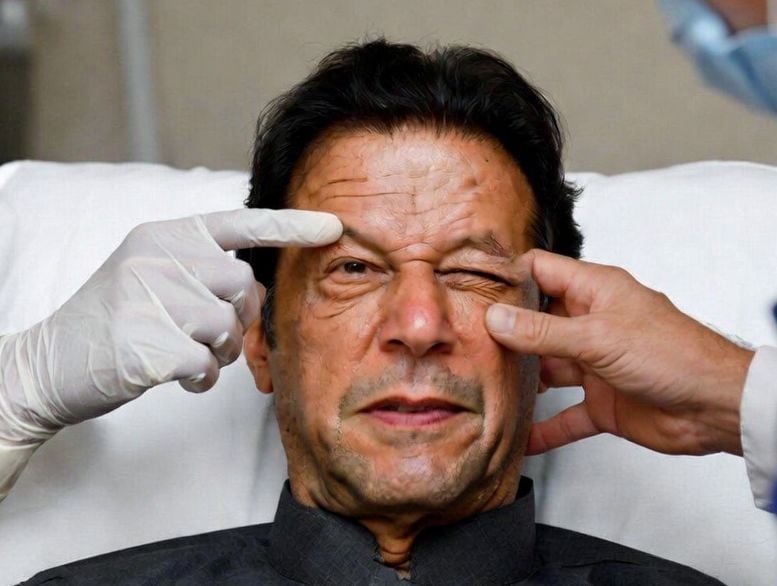




ISLAMABAD: Pakistan’s Supreme Court has ordered the constitution of a specialist medical board to examine jailed former prime minister Imran Khan’s severe eye condition, following persistent family demands for his urgent transfer to Shifa International Hospital in Islamabad. Khan’s sister Aleema Khan and other relatives have intensified calls for his immediate shift to the private facility, arguing that only expert care there can prevent irreversible blindness after a medical report revealed he retains merely 15 per cent vision in his right eye. The apex court’s intervention comes against the backdrop of growing allegations of deliberate delays in treatment, with the family warning that any further postponement risks total loss of sight in the affected eye.
The alarming details emerged from a seven-page report submitted by court-appointed amicus curiae Salman Safdar after his visit to Adiala Jail. According to the document, Khan was diagnosed with right central retinal vein occlusion caused by a blood clot, a condition that led to significant retinal damage despite an eventual injection treatment. Khan informed Safdar that his vision, previously normal at 6/6 in both eyes, began deteriorating in October 2025 with persistent blurring that jail authorities allegedly ignored for months. By the time specialist consultation occurred, the damage had advanced severely, leaving limited prospects for meaningful recovery without advanced intervention.
Aleema Khan has repeatedly stressed that the family will accept nothing less than Khan’s admission to Shifa International Hospital under the supervision of his chosen ophthalmologists. She described the current situation as critical, asserting that government hospitals lack the specialized equipment and expertise required for such a complex retinal issue at this stage. The family’s position gained momentum after the Supreme Court facilitated a brief phone call between Khan and his sons, during which he expressed deep concern over his rapidly declining eyesight and isolation from proper medical attention.
Opposition lawmakers from Pakistan Tehreek-e-Insaf and the Tehreek Tahaffuz-e-Aiyeen Pakistan alliance have amplified these demands through an ongoing sit-in protest outside Parliament House, now in its second day. Protesters, including prominent party figures, are staging a continuous demonstration specifically calling for Khan’s immediate transfer to Shifa International Hospital. They argue that prison medical facilities have proven inadequate, pointing to the months-long delay between initial symptoms and effective diagnosis as evidence of negligence that has already caused substantial harm.
Government officials have responded by assuring that no further delays will occur in arranging specialist care. Information Minister Attaullah Tarar confirmed that additional examinations by leading eye specialists are being scheduled, with a comprehensive report to be presented before the Supreme Court. While authorities have previously arranged check-ups at public institutions such as Pakistan Institute of Medical Sciences, the family maintains that these measures fall short of what is medically necessary given the advanced stage of the retinal vein occlusion and associated complications.
Central retinal vein occlusion typically results in sudden or progressive vision loss due to blocked blood flow, retinal swelling and hemorrhages. Medical experts note that prompt laser therapy, anti-VEGF injections or other advanced treatments offer the best chance of stabilizing or partially restoring vision, particularly when administered in well-equipped private settings. In Khan’s case, the reported three-to-four-month gap between symptom onset and specialist intervention has reportedly diminished these prospects considerably, heightening the urgency of the family’s plea for transfer to a facility like Shifa International.
The Supreme Court bench, led by Chief Justice Yahya Afridi, has set a deadline of February 16 for the medical board’s assessment and recommendations. This directive builds on earlier orders concerning Khan’s prison conditions and health, reflecting judicial concern over custodial medical standards in politically charged cases. Should the board endorse the need for specialized private care, it could pave the way for Khan’s temporary or supervised shift to Shifa International Hospital, potentially de-escalating the ongoing protests and family-led campaign.
As the medical evaluation approaches, the debate over Khan’s treatment has spotlighted broader questions about healthcare equity for detainees. The 73-year-old former prime minister’s supporters view the vision crisis as symptomatic of systemic issues, while the authorities emphasize commitments to expert care. The forthcoming board findings and any subsequent decisions on hospital transfer will likely prove decisive in shaping the trajectory of this high-profile health and legal matter.