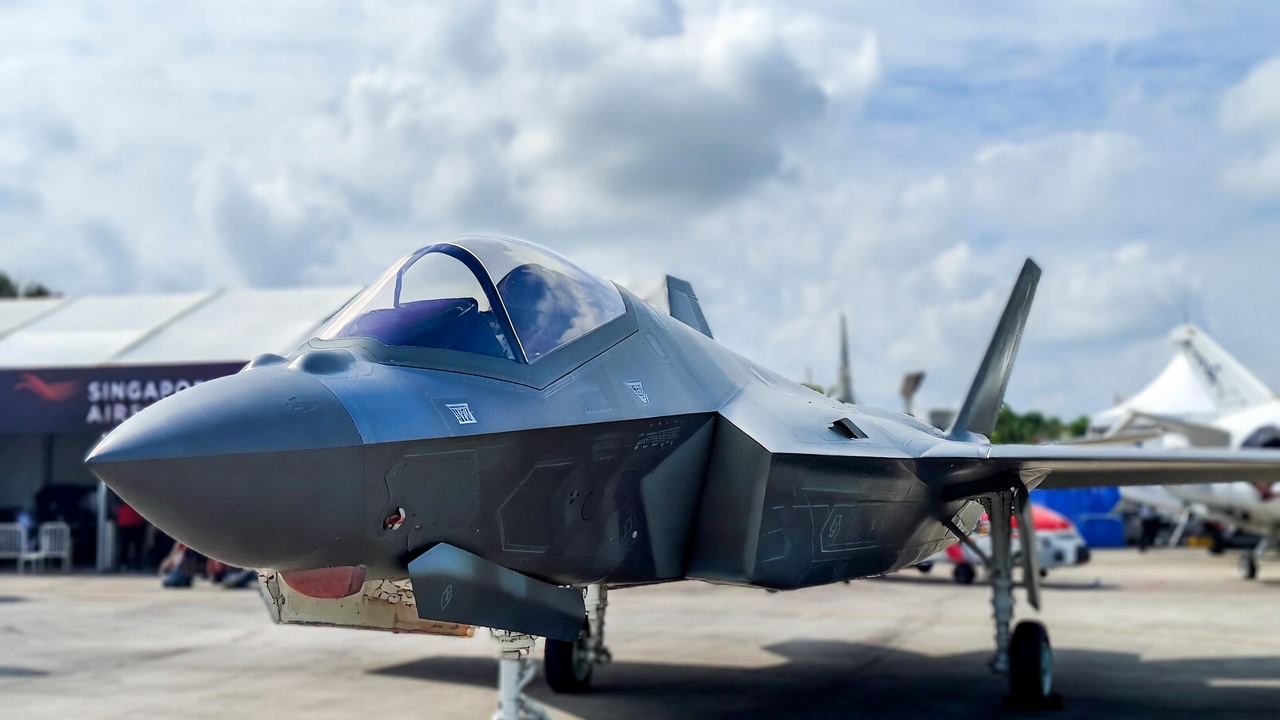




ISLAMABAD: Pakistan has emerged as the leading prospective buyer for China’s newly marketed Shenyang J-35A stealth multirole fighter following its high-profile presentation as an export product at the 2026 Singapore Airshow in February. Official indications and persistent defence reporting confirm that negotiations for an initial order of up to 40 aircraft are actively progressing, positioning the Pakistan Air Force to become the first foreign operator of this fifth-generation platform. The development reflects deepening Sino-Pakistani strategic cooperation and Islamabad’s determination to acquire advanced combat capabilities without the political and financial constraints often attached to Western alternatives.
The J-35A, a land-based derivative of the J-35 family, entered limited service with the People’s Liberation Army Air Force in late 2025 after successful maturation from its origins as the FC-31 Gyrfalcon demonstrator. First flown in 2012 as a privately funded project, the design evolved into a formal military programme emphasising stealth shaping, internal weapons bays, advanced sensor fusion, and networked warfare capabilities. Unlike the carrier-optimised naval variant, the J-35A features conventional landing gear and non-folding wings tailored for sustained land-based operations, air superiority, and multirole missions.
A pivotal milestone occurred in September 2025 when the naval J-35 successfully conducted electromagnetic aircraft launch system trials aboard the Type 003 carrier Fujian. State media released footage of catapult-assisted launches, demonstrating the platform’s ability to depart with maximum internal fuel and ordnance loads while maintaining low radar observability. These trials validated key technologies that enhance the family’s operational flexibility and indirectly bolster confidence in the land-based J-35A variant now offered for export.
At the Singapore Airshow, the Aviation Industry Corporation of China placed a prominent full-scale model of the J-35A at the centre of its exhibit, deliberately shifting focus from the carrier version to the land-based model. This strategic presentation targeted air forces seeking fifth-generation performance at a reported unit cost of approximately $50 million—significantly below the F-35’s acquisition price in most configurations. The absence of stringent end-use monitoring, technology transfer restrictions, or political conditions typically associated with American platforms further strengthens the J-35A’s appeal to nations pursuing sovereign defence modernisation.
Pakistan’s interest in the J-35A aligns with longstanding requirements to replace ageing fleets and counter regional airpower asymmetries. Mid-2025 announcements from Pakistani official channels referenced a comprehensive Chinese proposal encompassing not only 40 J-35A fighters but also associated systems, including the Shaanxi KJ-500 airborne early warning and control aircraft and the HQ-19 long-range surface-to-air missile system. Although subsequent clarifications moderated the immediacy of any formal contract signature, sustained reporting indicates ongoing technical evaluations, pilot familiarisation activities in China, and preparatory infrastructure planning within Pakistan.
The proposed 40-aircraft package would represent one of the largest single export orders for a Chinese fifth-generation fighter to date and would markedly enhance the Pakistan Air Force’s ability to conduct contested operations. Integration of the J-35A would introduce stealth penetration, reduced detectability, and advanced electronic warfare capabilities, complementing existing JF-17 Thunder and F-16 fleets while providing a qualitative leap in survivability against modern integrated air defence systems.
China’s export strategy, showcased effectively at Singapore, seeks to capture markets traditionally dominated by Western and Russian suppliers. The J-35A’s competitive pricing, flexible acquisition terms, and lack of data-sharing obligations resonate strongly with procurement entities in Asia, the Middle East, and Africa that face fiscal limitations or geopolitical barriers to purchasing American equipment. Beijing’s concurrent demonstration of extended-range power projection—evidenced by the PLA Air Force’s mid-air refuelled deployment of J-10C fighters to the airshow—reinforced perceptions of maturing operational maturity across its aviation programmes.
Should negotiations culminate in a signed contract, deliveries could commence as early as 2027, subject to production ramp-up and finalisation of technology transfer and support arrangements. The transaction would further consolidate the all-weather defence partnership between Islamabad and Beijing, while signalling China’s growing capacity to challenge long-established monopolies in the global fighter aircraft market through cost-effective, politically unencumbered alternatives.
In aggregate, Pakistan’s pursuit of 40 J-35A fighters underscores a calculated effort to modernise its air arm with cutting-edge stealth technology, leveraging China’s rapid advances in fifth-generation aviation to maintain credible deterrence in an evolving regional security environment.