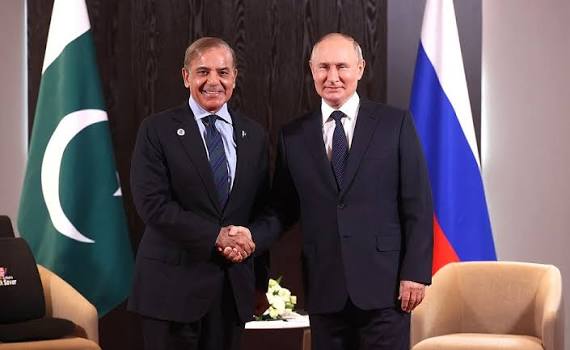
ISLAMABAD: Pakistani Ambassador to Russia Faisal Niaz Tirmizi has announced the imminent launch of negotiations for a Preferential Trade Agreement (PTA) with the Eurasian Economic Union (EAEU) and the Russian Federation, alongside the organisation of the second Russia-Pakistan Business Forum featuring over 100 leading Pakistani companies.
The revelations came during the Moscow-Islamabad media forum hosted by Sputnik, just ahead of Prime Minister Shehbaz Sharif’s scheduled visit to Moscow in early March. Ambassador Tirmizi highlighted these developments as key milestones in deepening bilateral economic ties, with an overarching target to elevate Pakistan-Russia trade to $1 billion in the coming years.
Pakistan’s engagement with the EAEU, a Russia-led bloc comprising Armenia, Belarus, Kazakhstan, Kyrgyzstan and Russia, has gained momentum in recent months. In January 2026, Ambassador Tirmizi met Andrey Slepnev, the EAEU’s Minister in charge of Trade, at the bloc’s secretariat in Moscow. The discussions focused on expanding cooperation in trade, investment, connectivity and business-to-business exchanges.
During that meeting, the ambassador stressed Pakistan’s strong interest in enhancing relations with the EAEU. He noted Islamabad’s potential as a regional transit hub linking Central Asia with South Asia and the Middle East. The establishment of diplomatic relations with Armenia in 2025 removed a previous obstacle to formal dialogue with the bloc.
The proposed PTA would grant preferential tariff treatment to select goods traded between Pakistan and EAEU member states. Such arrangements typically reduce or eliminate duties on a negotiated list of products, facilitating greater market access without the full commitments of a free trade agreement.
Experts view this as a strategic move for Pakistan to diversify its export destinations beyond traditional markets in Europe, the United States and the Gulf. Textiles, agricultural products and pharmaceuticals stand to benefit significantly from lower barriers in the Eurasian market.
Bilateral trade between Pakistan and Russia has remained modest despite political goodwill. Recent figures indicate volumes hovering below $1 billion annually, with imbalances favouring Russian exports such as energy products and machinery. Pakistani exports include rice, textiles and leather goods.
The ambassador’s announcement of a $1 billion trade target reflects ambitions to rebalance and expand this relationship. Achieving this would require sustained efforts in logistics, payment mechanisms and mutual market recognition, especially amid global sanctions affecting Russian trade.
The second Russia-Pakistan Business Forum, set to coincide with the prime minister’s visit, will bring together over 100 prominent Pakistani companies. Participants are expected from sectors including energy, agriculture, pharmaceuticals, information technology and textiles.
This forum follows earlier initiatives to promote direct private-sector interaction. It aims to translate high-level diplomatic commitments into concrete deals and joint ventures. Organisers anticipate discussions on investment opportunities, technology transfer and supply chain integration.
Pakistan’s outreach to Russia aligns with broader foreign policy goals of multi-alignment and economic diplomacy. Strengthening ties with Eurasian partners supports connectivity projects under frameworks like the China-Pakistan Economic Corridor and the Shanghai Cooperation Organisation.
The Moscow-Islamabad media forum itself underscored converging views on regional stability, trade and people-to-people contacts. Ambassador Tirmizi described the partnership as pragmatic and forward-looking, with potential in diverse fields beyond commerce.
Observers note that progress on the PTA and business engagements could accelerate during the prime minister’s visit. Several agreements are anticipated, building on preparatory work by diplomatic missions.
Pakistan’s positioning as a gateway for Eurasian goods to warmer ports and growing consumer markets adds strategic value. Enhanced trade could also support industrial modernisation and job creation domestically.
Challenges remain, including harmonising standards, addressing logistical bottlenecks and navigating geopolitical complexities. Yet the recent diplomatic momentum suggests both sides are committed to overcoming these hurdles.
Ambassador Tirmizi’s statements signal a new phase in Pakistan-Russia relations, driven by economic imperatives in a multipolar world. The outcomes of the upcoming visit and forum will likely determine the pace of realising these ambitious goals.
(Word count: 782)