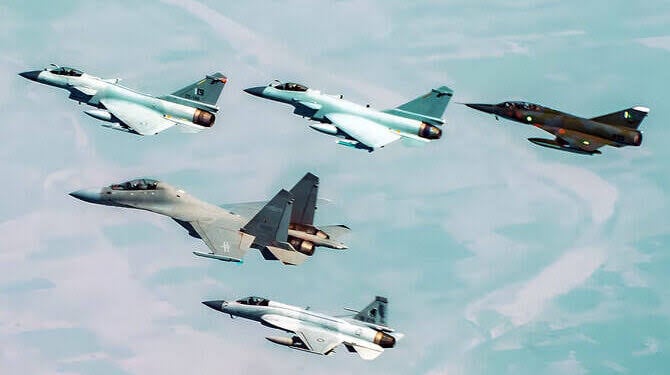
ISLAMABAD: Pakistan has heightened surveillance over its airspace and placed its air force and air defence systems on high alert following joint United States and Israeli airstrikes on Iran that triggered explosions across Tehran and other cities on Saturday.
The strikes, described by US President Donald Trump as the start of “major combat operations,” targeted Iranian military sites, nuclear-related facilities and reportedly high-level leadership compounds, escalating long-standing tensions over Tehran’s nuclear programme and regional influence.
Reports from Iranian state media indicated multiple missile impacts in central Tehran, including areas near University Street, the Jomhouri district, and unconfirmed claims of strikes close to the presidential palace and the residence of Supreme Leader Ali Khamenei.
Smoke was observed rising from several suburban neighbourhoods in the capital, with local accounts describing air-raid sirens and widespread blasts, though independent verification of casualties or structural damage remained limited at the time of reporting.
Neither Washington nor Tel Aviv provided immediate detailed official accounts of the operation’s scope or outcomes, but sources indicated the coordinated assault involved dozens of targets aimed at degrading Iran’s ballistic missile capabilities and preventing nuclear weapon development.
In response, Iranian forces launched retaliatory missile and drone attacks toward Israel and US military positions in the region, with explosions reported in Gulf states including the United Arab Emirates, Bahrain and Kuwait, heightening fears of a broader conflict.
The Pakistan government acted swiftly to safeguard civilian aviation amid the volatility, directing the Civil Aviation Authority and Air Traffic Control to exercise extreme vigilance, especially along air corridors bordering Iranian and Afghan territories.
Official sources confirmed that Pakistani airlines received explicit instructions to reroute flights and avoid Iranian airspace entirely until further assessment, a measure intended to mitigate risks from potential spillover or misdirected projectiles.
The Pakistan Air Force, alongside integrated air defence units, was placed at elevated readiness to monitor and respond to any unauthorised incursions or threats approaching national boundaries.
This precautionary posture aligns with Pakistan’s consistent emphasis on neutrality in Middle Eastern conflicts while prioritising the security of its citizens and airspace integrity.
The sudden escalation has disrupted regional air travel patterns, with Iran’s temporary closure of its airspace forcing some international carriers to seek alternative routes, potentially increasing overflight traffic through Pakistani corridors during nighttime hours.
Analysts noted that such rerouting could impose additional operational costs on airlines but also underscored Pakistan’s strategic position in global aviation networks.
Simultaneously, global financial markets reacted sharply to the developments, with gold prices surging to historic highs as investors sought safe-haven assets amid geopolitical uncertainty.
Reports indicated spot gold climbing past $5,260 per ounce, reflecting heightened demand driven by war jitters, failed diplomatic efforts to curb Iran’s nuclear ambitions, and broader concerns over potential prolonged instability in the Middle East.
In local markets, bullion prices mirrored the upward momentum, registering significant jumps that affected both retail investors and institutional holders.
The precious metal’s rally extended a multi-month upward trend, bolstered by persistent inflation pressures in major economies and uncertainty surrounding US policy directions.
Market observers pointed to the Iran strikes as a key catalyst accelerating the flight to safety, with silver also posting gains amid similar dynamics.
Pakistan’s response has drawn attention to the delicate balance Islamabad maintains in regional affairs, particularly given its proximity to Iran and historical ties with both Tehran and Western powers.
Foreign Office statements have condemned escalation while urging diplomatic channels to prevent further deterioration.
The events underscore the interconnected nature of security and economic stability in South Asia and the broader region, where distant conflicts can rapidly influence local measures and market sentiments.
As the situation evolves, Pakistani authorities continue to monitor developments closely, ready to adjust protocols to ensure uninterrupted and secure air operations.