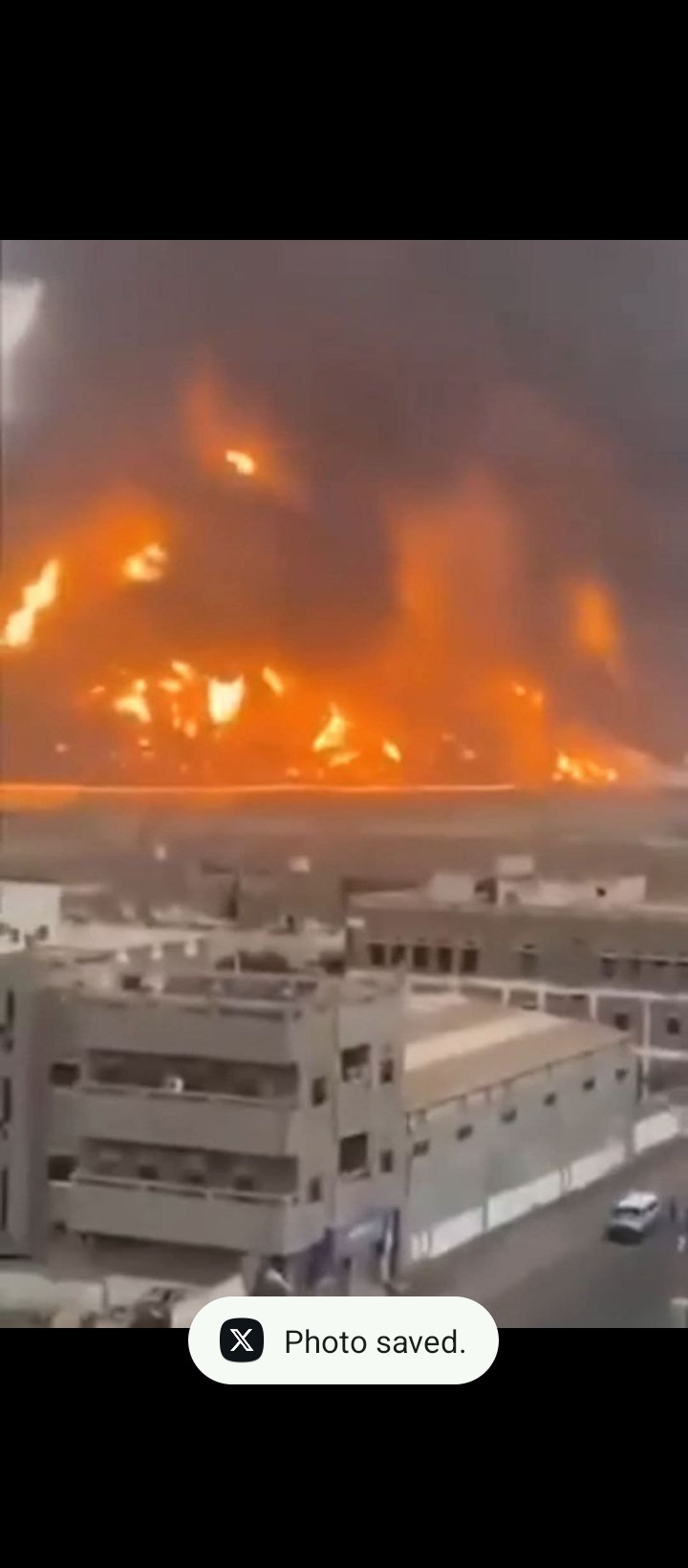
ISLAMABAD: Iran’s Islamic Revolutionary Guard Corps has initiated a fresh wave of missile strikes targeting United States military bases in the Gulf, according to Iranian state television reports citing the IRGC.
The attacks come as direct retaliation for coordinated US and Israeli military operations against Iranian territory earlier on Saturday, marking a sharp escalation in the ongoing regional confrontation.
Iranian state media described the operation as “Truthful Promise 4”, with the IRGC claiming successful hits on multiple American facilities hosting troops and assets.
Reports indicate that missiles and drones were launched towards key sites including the US Navy’s Fifth Fleet headquarters in Bahrain, Al Udeid Air Base in Qatar, Al Dhafra Air Base in the United Arab Emirates, and Ali Al Salem Air Base in Kuwait.
Bahrain confirmed an attack on its territory, with authorities reporting strikes near the US Naval Support Activity Bahrain, accompanied by plumes of smoke and activated sirens across Manama.
The United Arab Emirates stated that its air defences intercepted incoming projectiles, though falling debris from one missile resulted in a civilian casualty in a residential area of Abu Dhabi.
Qatar and Kuwait also reported engaging their defence systems to counter the Iranian barrage, with no immediate details on casualties or damage at their respective US-hosted installations.
The IRGC asserted in statements that all US military targets in the Middle East had been struck by “powerful blows” from Iranian missiles, vowing that the operation would persist until the perceived enemy is decisively defeated.
Iranian officials emphasised that US bases across the region remain legitimate targets in response to what Tehran describes as aggressive violations of its sovereignty.
The initial joint US-Israeli strikes targeted Iranian military infrastructure, including missile sites, Revolutionary Guard facilities, and elements linked to the country’s nuclear and ballistic programmes.
Explosions were reported in Tehran and other Iranian cities, with Israeli officials indicating precision strikes aimed at high-value leadership and command structures.
US President Donald Trump characterised the American involvement as “major combat operations” under Operation Epic Fury, aimed at dismantling Iran’s missile capabilities and naval forces while calling for regime change in Tehran.
The rapid Iranian counter-response has heightened fears of a broader regional war, potentially disrupting critical oil shipping routes through the Strait of Hormuz.
Gulf Arab states hosting US forces, including Bahrain, Qatar, the UAE, and Kuwait, expressed concern over the spillover, with some activating emergency protocols and urging civilians to seek shelter.
Air raid sirens sounded across parts of the Gulf as the missile waves unfolded, underscoring the immediate threat to civilian populations near military installations.
Defence analysts note that Iran possesses an extensive arsenal of ballistic missiles and drones, estimated in the thousands, capable of reaching targets throughout the Middle East.
Previous Iranian retaliatory actions, such as limited missile strikes following the 2020 killing of General Qassem Soleimani, demonstrated a pattern of calibrated responses to avoid full-scale escalation.
However, the current operation appears more expansive, incorporating multiple fronts including direct strikes on Israel alongside Gulf targets.
The IRGC’s declaration of continued operations suggests potential for sustained barrages, though interception rates by advanced air defence systems in the region have historically been high.
International observers warn that further escalation could draw in additional actors, complicating diplomatic efforts to contain the conflict.
The United Nations and regional powers have yet to issue formal responses, but the unfolding events have prompted urgent calls for de-escalation to prevent a wider conflagration.
As the situation develops, military movements and statements from involved parties indicate that the confrontation remains fluid and highly volatile.