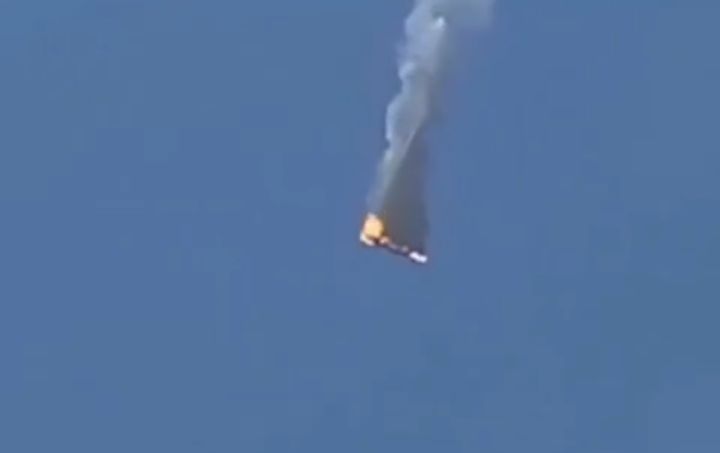
ISLAMABAD: Unverified footage circulating on social media platforms purports to show an Israeli fighter jet being struck and downed by Iranian air defense systems while traversing Iraqi airspace, heightening tensions in an already volatile Middle East conflict zone.
The clip, which has gained rapid traction online, depicts what appears to be a high-speed aircraft engulfed in flames following an apparent missile impact, with debris scattering across a barren landscape. Proponents of the video assert it captures a direct hit on an advanced Israeli platform, possibly an F-35 stealth fighter, during transit through neutral Iraqi territory.
Independent verification of the footage remains elusive, with no official confirmation from Israeli, Iranian, or Iraqi authorities as of late February 2026. Military analysts caution that such visuals often emerge in propaganda efforts during heightened confrontations, drawing parallels to previous unconfirmed claims in the region.
The alleged incident unfolds against the backdrop of coordinated United States and Israeli airstrikes launched on February 28, 2026, targeting multiple military sites across Iran under operations described by Israeli officials as aimed at degrading nuclear and missile capabilities.
Reports indicate that over 50 Israeli Air Force jets participated in initial waves, striking facilities linked to centrifuge production, surface-to-surface missiles, and command infrastructure in western Iran. Drone footage subsequently released by the Israel Defense Forces showcased precision impacts on designated targets.
In response, Iran launched retaliatory missile barrages toward Israeli territory and US military installations in the region, triggering defensive interceptions and widespread airspace closures. Countries including Iran, Iraq, Israel, Jordan, Kuwait, Bahrain, and Qatar halted civilian flights, leading to significant disruptions in regional and international aviation.
Flight tracking data revealed near-total emptiness over Iraqi skies, with aircraft rerouting to avoid potential missile trajectories or debris risks. Iraq’s Ministry of Transport confirmed the temporary shutdown of its airspace following the escalation, citing safety concerns amid cross-border military activity.
The purported downing, if substantiated, would mark a rare instance of Iranian systems engaging Israeli aircraft outside direct borders, underscoring the extended reach of Tehran’s air defenses. Iran’s layered network, incorporating Russian-supplied S-300 and indigenous Bavar-373 systems, has long been touted as capable of countering stealth intrusions.
However, historical precedents cast doubt on such assertions. During a prior escalation in June 2025, Iranian media initially claimed the destruction of multiple Israeli F-35 jets, including reports of captured pilots, only for state broadcasters later to retract the statements as based on unreliable sources.
Fact-checking organizations identified several viral images and videos from that period as AI-generated fabrications or repurposed footage from unrelated conflicts, including Russian aircraft losses. One prominent clip circulated as evidence of an F-35 interception was traced to video game simulations, highlighting the challenges of authenticating combat visuals in real time.
Israeli officials have consistently denied aircraft losses in recent engagements, labeling Iranian announcements as propaganda designed to project strength domestically. In the current crisis, no Israeli statement has acknowledged any jet downed over Iraq or elsewhere.
The involvement of Iraqi airspace adds complexity, given Baghdad’s delicate position between US allies and Iran-backed militias. Past incidents have seen Iranian missiles transit Iraqi territory en route to regional targets, occasionally drawing Iraqi protests over sovereignty violations.
Smoke and explosions near US bases in northern Iraq, including around Erbil, were reported on the same day, with local accounts describing intercepted projectiles. Drone strikes also targeted Iran-linked militia positions southwest of Baghdad, resulting in casualties among non-state actors.
Broader implications extend to global energy markets and diplomatic channels. Airspace closures have forced rerouting of commercial flights, increasing fuel consumption and operational costs for carriers traversing Asia-Europe routes. Airlines urged passengers to monitor updates amid uncertainty over reopening timelines.
Observers note that such unverified claims, even if debunked, contribute to information warfare, shaping public perceptions and pressuring adversaries. The rapid dissemination of the footage illustrates how social media amplifies unconfirmed events in fast-moving conflicts.
Regional powers and international mediators continue monitoring developments closely. The United Nations Security Council has convened emergency sessions to address the escalation, with calls for de-escalation to prevent wider spillover.
Until independent analysis or official disclosures emerge, the footage remains in the realm of speculation, serving as a stark reminder of the fog enveloping modern aerial warfare.