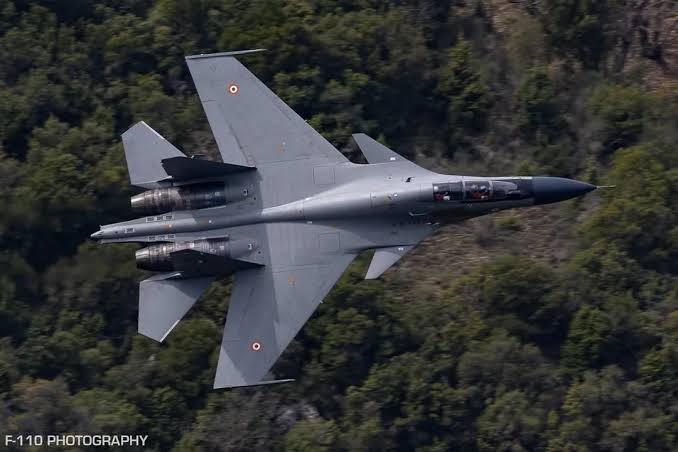
ISLAMABAD: During the Indian Air Force’s high-profile Exercise Vayu Shakti 2026 held at the Pokhran Field Firing Range in Jaisalmer, Rajasthan, a Sukhoi Su-30MKI fighter jet fired an R-73 short-range air-to-air missile at a simulated drone target, but the projectile failed to achieve a hit, highlighting persistent concerns over the reliability of legacy missile systems in modern aerial combat scenarios.
The incident, observed during a live-fire demonstration on February 27, 2026, occurred amid an otherwise impressive showcase of India’s air power, attended by high-ranking officials including President Droupadi Murmu.
Exercise Vayu Shakti 2026 featured participation from over 120 aircraft and helicopters, including frontline platforms such as Rafale, Tejas, Jaguar, Mirage-2000, MiG-29, and the Su-30MKI backbone of the Indian fleet.
The exercise aimed to demonstrate precision strikes, multi-domain operations, rapid response capabilities, and integration of indigenous and imported systems across day, dusk, and night conditions.
The R-73 missile, known by its NATO designation AA-11 Archer, represents a Soviet-era design introduced in the 1980s and remains a key component of within-visual-range engagements for the Indian Air Force.
This infrared-homing missile offers high off-boresight capability, allowing locks up to 40 degrees off the aircraft’s centerline, and a maximum range of approximately 30 kilometres under optimal conditions.
It equips numerous Indian platforms, including the Su-30MKI, which carries it on outer wing stations for close-combat agility.
Despite its manoeuvrability advantages, with thrust-vectoring enabling extreme turns at high g-forces, the R-73 has faced scrutiny in various global contexts for limitations against evolving threats.
The failure during Vayu Shakti 2026 underscores broader challenges in short-range air-to-air weaponry, particularly when engaging small, low-signature targets such as drones.
Drones present unique difficulties due to their minimal heat emissions, erratic flight patterns, and low radar cross-sections, which can confound traditional infrared seekers designed primarily for larger manned aircraft.
In recent years, similar incidents have been reported in Indian exercises, including prior demonstrations where other platforms encountered difficulties intercepting aerial targets with legacy missiles.
Such events fuel ongoing debates about the need for modernisation in the Indian Air Force’s short-range missile inventory.
The Indian Air Force has pursued upgrades to address these gaps, including integration of more advanced systems alongside the R-73.
For instance, the indigenous Astra Mk-1 beyond-visual-range missile has been progressively incorporated on the Su-30MKI, offering improved guidance and range for layered air defence.
Additionally, reports indicate efforts to equip select Su-30MKI units with longer-range options, such as the Russian R-37M hypersonic missile, to enhance beyond-visual-range superiority.
The Super Sukhoi upgrade programme further aims to modernise the fleet with advanced radars like the Virupaksha GaN AESA system, capable of detecting targets at extended distances.
These enhancements reflect a strategic push toward self-reliance under the Aatmanirbhar Bharat initiative, reducing dependence on ageing Russian-origin munitions.
The Vayu Shakti 2026 demonstration also highlighted successes in other domains, including effective neutralisation of ground targets by various aircraft and surface-to-air systems such as Akash and SpyDer.
Counter-unmanned aerial systems and short-range loitering munitions performed notably, illustrating progress in addressing asymmetric threats.
Nevertheless, the R-73 shortfall serves as a reminder that even robust platforms like the Su-30MKI, numbering over 260 in service, require continuous technological refresh to maintain edge in contested environments.
Defence analysts note that drone proliferation in regional conflicts has accelerated the demand for specialised counter-drone munitions and sensors.
The Indian Air Force’s experience aligns with global trends, where operators increasingly seek high-off-boresight missiles with dual-mode seekers or network-centric capabilities.
While the exercise overall projected operational readiness and coordination, the missile miss has drawn attention to potential vulnerabilities in close-in air combat scenarios.
Military observers emphasise that such live demonstrations, though intended to showcase strength, inevitably expose areas for improvement.
The incident may prompt accelerated procurement or development of next-generation short-range air-to-air missiles, possibly building on collaborations with international partners.
As regional security dynamics evolve, maintaining credible air superiority remains a priority for the Indian Air Force.
The Vayu Shakti series continues to serve as a critical platform for validating capabilities and signalling deterrence.