ISLAMABAD: In a damning assessment that has sent shockwaves through South Asia’s military circles, the International Institute for Strategic Studies (IISS) in its authoritative Military Balance 2026 report has effectively validated Pakistan Air Force claims by linking recovered wreckage of a Chinese PL-15E missile directly to confirmed losses suffered by the Indian Air Force during the May 2025 aerial clashes known as Operation Sindoor.
The prestigious London-based think tank’s findings expose a critical vulnerability in India’s much-vaunted air combat capabilities, particularly its Rafale fighters, and underscore the decisive edge provided by advanced Chinese weaponry in the hands of Pakistani pilots.
The conflict erupted in early May 2025 following a terrorist attack in Pahalgam, Jammu and Kashmir, prompting India to launch Operation Sindoor with missile strikes targeting alleged militant infrastructure in Pakistan and Azad Jammu and Kashmir.
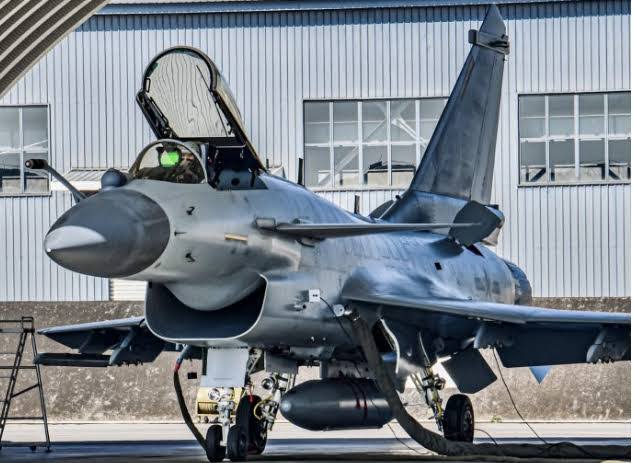
Pakistan responded swiftly, deploying its Chengdu J-10C fighters armed with the export-variant PL-15E beyond-visual-range air-to-air missiles, resulting in what IISS described as potentially the world’s longest beyond-visual-range air engagement to date.
Open-source imagery analyzed by IISS confirmed the loss of at least one Indian Rafale EH variant, with wreckage of the PL-15E missile recovered on Indian territory strongly suggesting its role in inflicting these casualties.
The report notes that the Aviation Industry Corporation of China’s official range for the PL-15E stands at over 145 kilometres, yet engagements occurred without either side’s aircraft crossing borders, implying effective ranges exceeding 190 kilometres in some assessments, outpacing the Meteor missiles typically carried by Indian Rafales.
This disparity highlights a significant technological and tactical triumph for the Pakistan Air Force, which integrated the Chinese missile seamlessly into its operations, achieving kills at distances that caught Indian pilots off guard due to intelligence miscalculations on the missile’s true capabilities.
IISS emphasized uncertainties surrounding the exact circumstances of the engagement, including which missiles Indian Rafales employed and whether rules of engagement permitted offensive actions, but the missile wreckage evidence tilts the narrative firmly toward Pakistani success in air-to-air combat.
The report’s chart on air-to-air weapons inventories further illustrates Pakistan’s advantage in long-range missile technology, contrasting sharply with India’s reliance on shorter-ranged or less proven systems in that confrontation.
Pakistan Air Force officials had earlier claimed multiple Indian aircraft downed, including Rafales, MiG-29s, and Su-30MKIs, assertions that gained credibility through independent verification of at least one high-profile loss.
The incident marked the first combat deployment of the PL-15 series in a real-world scenario, demonstrating its reliability and lethality against Western-origin platforms.
Analysts point out that the recovery of largely intact PL-15E components not only confirmed its use but also exposed limitations in self-destruct mechanisms, providing valuable intelligence to global powers while embarrassing Indian defenses.
The IISS assessment reinforces Pakistan’s narrative of a defensive yet highly effective response, where superior missile range and integration with platforms like the J-10C turned the tide against a numerically stronger adversary.
India’s Operation Sindoor, intended as a punitive strike, escalated into an 88-hour aerial contest involving over 100 aircraft, yet failed to achieve decisive dominance, with Pakistani countermeasures inflicting verifiable damage.
The think tank’s rigorous, data-driven analysis leaves little room for doubt: the PL-15E contributed substantially to Indian Air Force setbacks, validating long-standing Pakistan Air Force assertions about its combat prowess.
This revelation has broader implications for regional airpower balances, prompting urgent questions in New Delhi about procurement strategies and electronic warfare countermeasures against Chinese systems.
It also underscores Beijing’s growing influence in South Asian security dynamics through arms exports that deliver battlefield results.
As defence planners worldwide study the IISS findings, the episode serves as a stark reminder that technological superiority in beyond-visual-range engagements can decisively alter outcomes, even against advanced Western hardware.
The Military Balance 2026 thus stands as a sobering indictment of Indian Air Force performance in that crisis, while affirming the Pakistan Air Force’s claims as grounded in evidence rather than exaggeration.