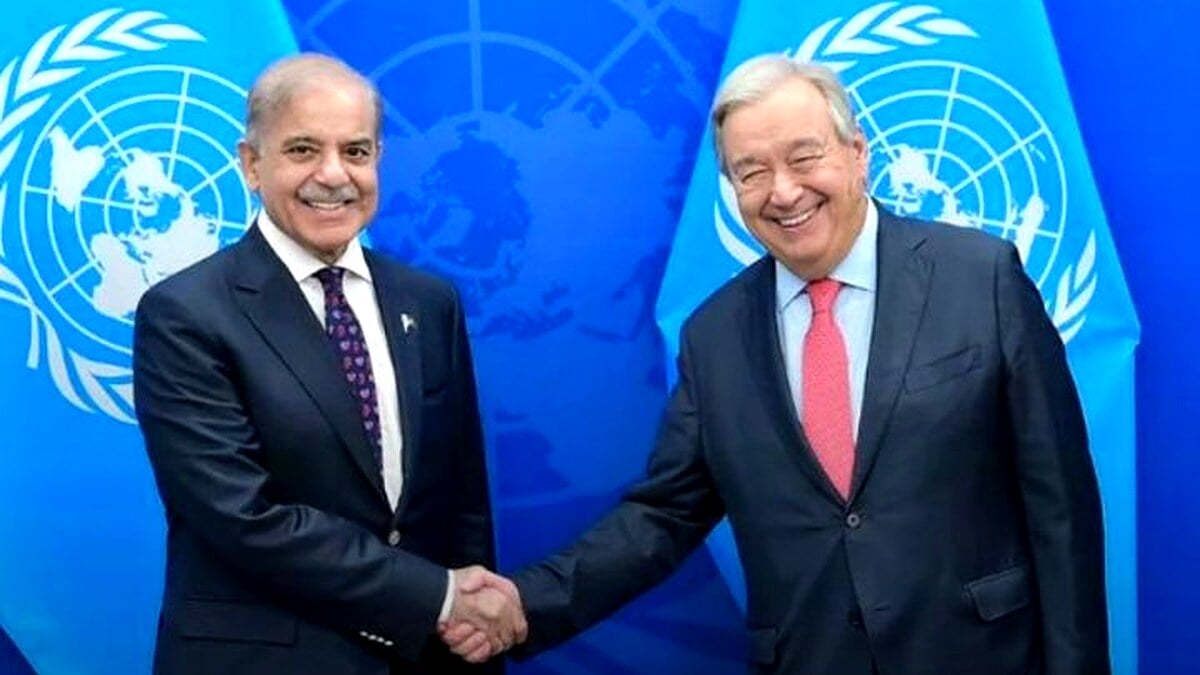




ISLAMABAD: Pakistan’s Prime Minister Shehbaz Sharif issued a stern warning at the United Nations, labeling any Houthi attacks on Makkah as a “red line” for Islamabad.
This bold declaration highlights the deep religious and strategic significance of Makkah to the Muslim world, particularly to Pakistan.
Sharif’s speech emphasized the potential for destabilization in the region should these attacks continue.
The Prime Minister’s statement comes amid mounting tensions in the Middle East, where Houthi rebels have previously targeted sites in Saudi Arabia.
The Houthis, based in Yemen, have been involved in a prolonged conflict with the Saudi-led coalition since 2015.
The conflict has drawn widespread international attention due to its humanitarian and geopolitical implications.
Sharif’s remarks underline Pakistan’s commitment to defending the sanctity of Makkah, a city that holds immense religious importance.
His warning also signals a broader message of solidarity with Saudi Arabia, a key ally of Pakistan.
Saudi Arabia has been vocal in its condemnation of Houthi attacks, urging international intervention to prevent escalation.
Reports from Al Jazeera suggest that the recent escalation has raised concerns within the Gulf Cooperation Council (GCC) member states.
Shehbaz Sharif’s UN address was primarily focused on bringing attention to the current hostile activities and their potential repercussions.
The deliberate choice of words by Sharif highlights the gravity of the situation and Pakistan’s stance on upholding sacred Islamic sites.
Analysts view this as an affirmation of Pakistan’s strategic alignment with Riyadh amidst the turbulent Middle Eastern geopolitics.
The conflict in Yemen has led to vast humanitarian crises, as noted by the United Nations Office for the Coordination of Humanitarian Affairs.
Pakistan has reiterated its commitment to peace in the region, advocating for diplomatic solutions to ongoing conflicts.
Observers have noted that Sharif’s message may also aim to engage other Islamic countries in dialogue over regional security and unity.
The ripple effect of such a statement at the UN is likely to prompt further discussions among international stakeholders.
This is a developing story, and updates on the situation are expected as international reactions unfold.
Future implications of Sharif’s declaration at the UN remain uncertain, but they are pivotal in understanding the balance of power in the region.