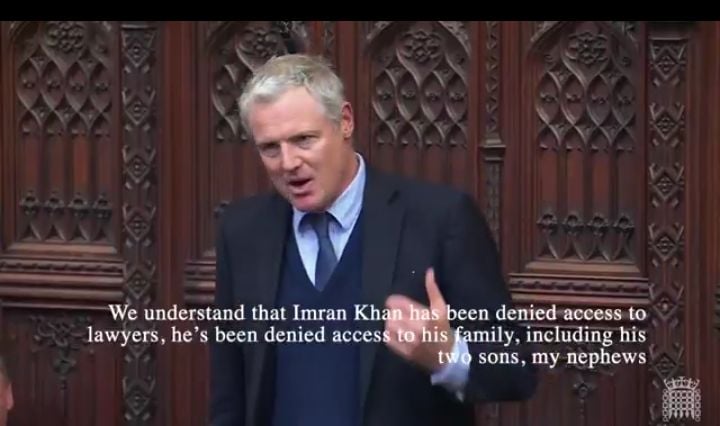
ISLAMABAD: The treatment of former Pakistani Prime Minister Imran Khan by the current government has sparked international condemnation, with UK peers in the House of Lords recently urging the Foreign Minister to step up diplomatic efforts for his release.
This call comes amid reports of severe medical neglect and prolonged solitary confinement, conditions that violate basic human rights standards.
Khan, imprisoned since August 2023, remains in Adiala Jail in Rawalpindi, facing multiple convictions in cases he and his supporters describe as politically motivated.
The urgency of the situation was highlighted on February 25, 2026, when Baroness Alexander of Cleveden posed a pointed question in the House of Lords.
She inquired about discussions between the UK government and Pakistani authorities regarding Khan’s imprisonment, with a specific focus on his access to medical care.
This parliamentary intervention reflects growing concern over Khan’s deteriorating health, including claims of significant vision loss in one eye due to untreated conditions.
According to the United Nations Working Group on Arbitrary Detention, Khan’s incarceration lacks legal basis and constitutes arbitrary detention.
In a 2024 opinion, the UN body called for his immediate release, stating that the charges against him—ranging from corruption to treason—appear fabricated to sideline him politically.
Amnesty International has echoed these findings, documenting a pattern of judicial misuse in Pakistan to target opposition figures.
Their reports detail how Khan has been denied adequate preparation time for his defense in numerous trials, with cases piling up rapidly.
The organization’s 2024 assessment highlighted the weaponization of the legal system, particularly following the controversial 26th Constitutional Amendment, which critics argue undermines judicial independence.
Khan’s party, Pakistan Tehreek-e-Insaf (PTI), reports that he has not seen family members for over eight weeks and lawyers for more than five weeks, with the last legal meeting lasting just eight minutes.
PTI attributes this isolation to efforts by the military establishment, led by Chief of Army Staff General Asim Munir, to prevent Khan from communicating with the outside world.
Government officials, however, deny these allegations, insisting that restrictions stem from Khan’s violation of jail rules prohibiting political discussions.
Interior Minister Talal Chaudhry has described Khan as the “most privileged prisoner in Pakistan,” equipped with gym facilities and a personal cook.
Despite such claims, independent observers note that Khan endures conditions akin to solitary confinement, which international human rights law deems cruel and inhumane if prolonged.
The UN’s Special Rapporteur on Torture has previously warned that such isolation can lead to irreversible psychological damage.
Medical reports leaked by PTI suggest Khan suffers from untreated ailments, exacerbating his vision impairment and other health issues.
His ex-wife, Jemima Goldsmith, a British citizen, has publicly appealed to platforms like X (formerly Twitter) to address suppression of posts highlighting his plight.
She revealed that her updates on Khan’s treatment reach almost zero visibility in Pakistan and globally, limiting awareness of his situation.
Goldsmith emphasized the personal impact, noting that her two adult sons, British nationals, have been denied visits or calls with their father for 22 months.
This family connection underscores the UK’s vested interest in the case, given Khan’s deep ties to Britain.
Khan attended Aitchison College in Lahore but pursued higher education at Worcester Royal Grammar School and later at Keble College, Oxford, where he studied philosophy, politics, and economics.
He captained Oxford’s cricket team and played professionally for Worcestershire and Sussex counties in the UK.
His leadership in Pakistan’s 1992 Cricket World Cup victory, which included memorable matches in England, further cemented his popularity among the British-Pakistani diaspora, numbering nearly two million.
Despite these links, the UK government’s response has been notably subdued, drawing criticism for selective outrage.
A March 2025 article by Declassified UK highlighted Britain’s silence, contrasting it with vocal condemnations of political repression in China, Iran, and Russia.
Analysts attribute this reticence to strategic alliances with Pakistan’s military, including intelligence-sharing with the Inter-Services Intelligence (ISI) and over $1 billion in arms sales.
Pakistan’s alignment on geopolitical issues, such as a tempered stance on the Gaza crisis, aligns with UK and US interests, potentially overshadowing human rights concerns.
Khan’s ouster in a 2022 no-confidence vote, which he alleges was orchestrated with foreign involvement, marked the beginning of his legal troubles.
Declassified sources suggest his refusal to accommodate military demands and criticism of external influences led to his targeting.
The February 2024 general elections in Pakistan, widely condemned as rigged, saw PTI-backed candidates win the most seats despite Khan’s disqualification.
International observers, including the European Union, noted irregularities, but the UK stopped short of direct criticism, merely calling for adherence to democratic norms.
Over 20 cross-party UK parliamentarians have now signed an appeal initiated by Liverpool Riverside MP Kim Johnson.
At the behest of Khan’s international affairs advisor, Zulfi Bukhari, the letter urges Foreign Secretary David Lammy to press the Shehbaz Sharif government for Khan’s immediate release.
Signatories express alarm over the politically motivated nature of his detention, aimed at suppressing opposition and ensuring his electoral exclusion.
They cite the UN’s findings of no legal basis for his arrest and Amnesty’s warnings about military court interventions.
The appeal also addresses broader clampdowns on PTI, including detentions of supporters under the Public Order Act during permitted rallies.
In Pakistan, opposition protests have intensified, with a February 13, 2026, sit-in at Parliament leading to lights being turned off to disperse demonstrators concerned about Khan’s health.
Khan reportedly issued a defiant message from prison, challenging the establishment to either release him or face consequences.
Protests have spilled abroad, with demonstrations in the UK prompting Pakistan to summon the British envoy over a Bradford rally video criticizing General Munir.
This diplomatic friction highlights the international ramifications of Khan’s treatment.
Human rights groups like CODEPINK have joined the chorus, decrying his medical neglect and isolation as violations of international law.
They urge global leaders to prioritize his freedom, emphasizing that the world is watching Pakistan’s slide toward authoritarianism.
The UK’s Pakistani diaspora has mobilized, with petitions calling for parliamentary debates on Khan’s “inhumane detention.”
One such petition on Change.org seeks a House of Commons discussion, arguing that Britain must uphold democracy and human rights.
As pressure mounts, the UK government’s next steps could signal its commitment to these values or continued prioritization of realpolitik.
For now, Khan’s fate remains a litmus test for international accountability in the face of domestic repression.
His supporters hope that interventions like the House of Lords query will catalyze change, ensuring that arbitrary detention does not go unchecked.
The broader implications for Pakistan’s democracy are profound, with judicial independence and political freedoms hanging in the balance.
International bodies continue to monitor the situation, ready to escalate if conditions worsen.
Ultimately, resolving Khan’s case could pave the way for genuine political dialogue in Pakistan, restoring faith in its institutions.