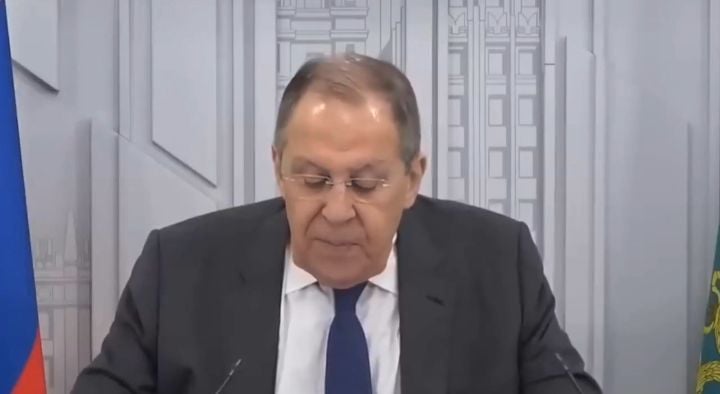
ISLAMABAD: A deadly suicide explosion outside Moscow’s Savyolovsky Railway Station has intensified Russia’s scrutiny of security risks emanating from Afghanistan, with Foreign Minister Sergey Lavrov reiterating that the Taliban pose threats to regional stability by permitting jihadist elements to use Afghan soil as a base.
The blast, which occurred in the early hours of February 24 near a police patrol vehicle, killed one traffic police officer and the attacker himself while injuring two other officers. Russian authorities described it as a suicide attack, with the assailant identified as a 22-year-old Russian national from the Udmurt Republic who had traveled from St Petersburg.
Investigations by Russia’s Investigative Committee continue to probe the motive, amid the incident coinciding with the fourth anniversary of Russia’s invasion of Ukraine. No immediate claims of responsibility emerged linking the attack to Afghan-based groups, though the timing has fueled broader concerns over transnational terrorism.
In the wake of the Moscow incident, Lavrov has highlighted persistent worries over jihadist activities in Afghanistan. He has stressed that new security challenges linked to Central Asia and Afghanistan rank among the top priorities for the Collective Security Treaty Organization (CSTO), a Russia-led military alliance.
Lavrov’s statements reflect Russia’s long-standing position that threats from groups such as the Islamic State Khorasan Province (ISKP), along with other militants, continue to originate from Afghan territory despite Taliban control since 2021.
Russia maintains that full normalization of relations with Kabul hinges on the complete elimination of these threats and the dismantling of safe havens for jihadists. Officials argue that until such guarantees are provided, deeper political, economic, or diplomatic engagement remains conditional.
This stance persists even after significant shifts in Russia’s approach toward the Taliban. In April 2025, Moscow removed the Taliban from its list of terrorist organizations, followed by formal recognition of the Taliban government in July 2025, making Russia the first country to do so.
These moves enabled high-level interactions, including meetings between Lavrov and Afghan acting Foreign Minister Amir Khan Muttaqi, and participation in the Moscow Format consultations on Afghanistan.
During these engagements, Lavrov has acknowledged Taliban efforts against ISKP and reductions in narcotic cultivation, crediting them with positive changes in counterterrorism and drug control.
Yet he has consistently conditioned broader cooperation on addressing remaining risks, particularly those affecting Central Asian neighbors and Russia’s southern borders.
Central Asian states, including Tajikistan and Uzbekistan, share these apprehensions. Recent incidents, such as Tajik security forces neutralizing militants crossing from Afghanistan, underscore fears of spillover instability.
The Taliban have repeatedly disputed Russian claims, asserting that no threats have emanated from Afghan soil in recent years and that they actively combat terrorist groups.
Taliban spokespersons argue that accusations overlook their operations against ISKP and other extremists, while blaming external factors for regional tensions.
Russia’s position balances pragmatic engagement with caution. Moscow views Taliban cooperation as essential to prevent jihadist radicalization near its borders and to curb narcotics trafficking, which historically flows through Central Asia into Russia.
At the same time, concerns over groups like ISKP—responsible for past attacks, including the 2024 Crocus City Hall assault—fuel demands for stronger Taliban action.
The Moscow bombing has revived debates on whether domestic radicalization or external influences played a role, though no direct Afghan link has been established.
Analysts note that such incidents highlight vulnerabilities in Russia’s security apparatus and the challenges of managing threats from afar.
Russia continues to push for international support in stabilizing Afghanistan, urging the return of frozen assets and reconstruction aid while criticizing Western policies.
Lavrov has called for coordinated regional efforts through forums like the CSTO to counter emerging threats without foreign military infrastructure in Afghanistan or neighboring states.
The interplay between the recent Moscow attack and longstanding Afghan concerns illustrates the complex security landscape Russia navigates.
While pursuing dialogue with Kabul, Moscow insists on tangible progress against jihadist safe havens before committing to unrestricted ties.
This conditional approach reflects broader geopolitical calculations, prioritizing border security amid evolving regional dynamics.
As investigations into the Savyolovsky blast proceed, the incident serves as a reminder of the enduring risks Russia associates with instability in Afghanistan.