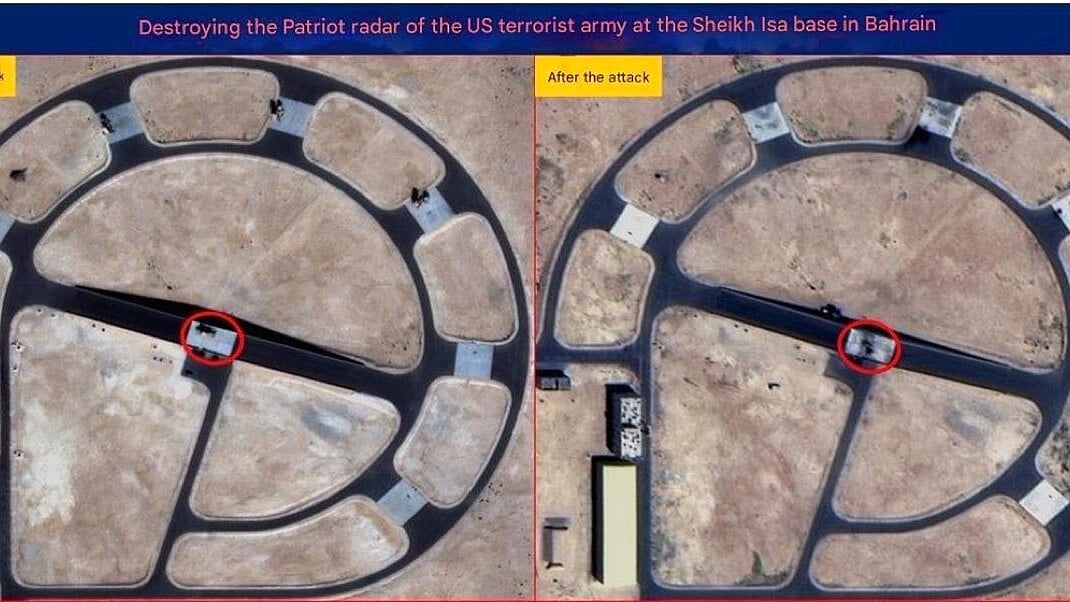
ISLAMABAD: Iran’s Islamic Revolutionary Guard Corps has released high-resolution before-and-after satellite images showing successful precision strikes on two vital United States radar systems in Bahrain.
The images purportedly depict clear structural damage to the Patriot AN/MPQ-65 fire control radar and the TPS-75 early warning radar at key Bahraini installations.
IRGC officials described the operation as part of a calculated response amid ongoing regional tensions, with visuals showing debris and craters at the targeted sites.
The AN/MPQ-65 serves as the primary fire control radar for the MIM-104 Patriot missile battery, capable of simultaneously tracking up to 100 aerial threats while guiding interceptors at speeds exceeding Mach 5.
Each such radar unit costs approximately 300 million dollars and forms the backbone of layered air defence protecting Gulf bases, according to defence industry assessments.
The TPS-75, a long-range surveillance system with a detection envelope of over 400 kilometres, provides critical early warning against ballistic missiles and aircraft for allied forces.
Satellite imagery released by the IRGC indicates total disablement of both systems, potentially reducing warning times for incoming projectiles by hundreds of kilometres across the Gulf.
International analyses from outlets like Military Watch Magazine have independently verified similar damage to Patriot components at Riffa Air Base and related facilities in Bahrain.
Planet Labs commercial satellite photos from early March 2026 corroborate structural impacts at Sheikh Isa Air Base, where these radars were operational.
The strikes align with a pattern of at least ten documented attacks on US and allied radar sites across Bahrain, Qatar, Kuwait and the UAE since late February.
Bahrain hosts the US Navy’s Fifth Fleet headquarters, making these facilities central to American power projection in the region with over 7,000 personnel stationed nearby.
Damage to the Patriot AN/MPQ-65 alone could compromise interception success rates, which have already dropped below 50 percent in recent Iranian barrages, per open-source reports.
Experts estimate the combined replacement value of the two radars exceeds 500 million dollars, excluding associated launchers and support infrastructure.
Iranian state media highlighted the use of advanced drones and missiles achieving pinpoint accuracy, bypassing multi-layered defences valued at billions across the Gulf.
No official denial has emerged from US Central Command, though Pentagon briefings have noted increased pressure on forward-deployed assets in the area.
Regional security analysts warn that such degradations erode the overall missile shield protecting oil infrastructure handling 20 percent of global supply.
The IRGC images, timestamped post-strike, show before-and-after comparisons with annotations marking exact impact points on radar antennas and control vans.
This visual evidence has amplified claims of systematic erosion of American early-warning networks, as echoed in New York Times reviews of Gulf base imagery.
In the broader conflict spanning three days of intense exchanges, these radar losses represent a strategic blow potentially altering threat response timelines for allies.
Pakistani defence observers tracking Gulf stability emphasise the implications for energy security, given Pakistan’s reliance on regional oil routes.
The event underscores shifting dynamics where precision strikes on high-value sensors could reshape deterrence equations in the Middle East.