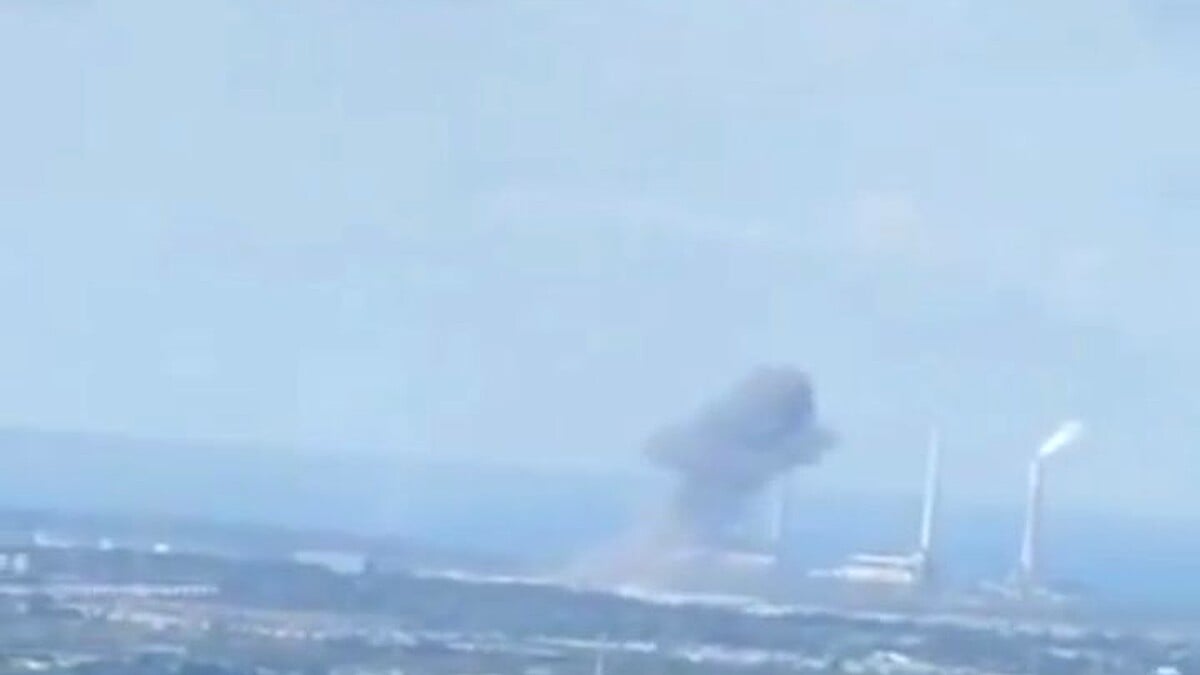
ISLAMABAD: In a stunning escalation of the 2026 Iran-Israel war, an Iranian ballistic missile has slammed directly into the Orot Rabin power plant, Israel’s largest electricity-generating facility on the Mediterranean coast in Hadera.
The strike has triggered widespread blackouts across central Israel, including parts of Tel Aviv, exposing critical vulnerabilities in the Jewish state’s energy grid amid relentless missile barrages.
The Orot Rabin station, located just 45 kilometres north of Tel Aviv, supplies roughly 20 percent of Israel’s total electricity output with a nameplate capacity of 2,590 megawatts.
Israeli media reports confirm that several hypersonic projectiles evaded multi-layered air defences to score direct hits on the coastal complex, forcing emergency shutdowns of multiple generation units.
Iran’s Islamic Revolutionary Guard Corps has claimed responsibility for the precision strike, describing it as retaliation for recent Israeli and American attacks on Iranian energy infrastructure.
Regional outlets including Pakistan’s own Times of Islamabad reported on March 9 that the barrage involved advanced Fattah-series missiles capable of reaching speeds between Mach 13 and Mach 15 over a 1,400-kilometre range.
The Fattah hypersonic ballistic missile family, unveiled by Tehran in 2023, features manoeuvrable re-entry vehicles that drastically complicate interception by systems such as Israel’s Arrow and David’s Sling.
Defence analysts note that the weapon’s terminal-phase agility allowed at least two warheads to penetrate the protective shield and detonate within the power station’s coal and gas-fired units.
Power outages have already affected hundreds of thousands of households and businesses in the Tel Aviv metropolitan area, according to preliminary assessments by the Israel Electric Corporation.
Emergency crews are racing to isolate damaged sections while backup generators struggle to maintain supply to hospitals and essential services.
This is not the first time Orot Rabin has come under fire. Houthi rebels in Yemen claimed a similar hypersonic strike on the same facility in January 2025 using a Palestine-2 missile.
Yet the latest Iranian assault marks the deepest and most damaging penetration of Israeli energy infrastructure since the war erupted on February 28.
Israeli officials have yet to release full casualty or damage figures, but local media describe thick smoke rising from the plant and firefighters battling secondary blazes near fuel storage tanks.
The strike has also sent global oil prices surging past 100 dollars a barrel as traders price in further disruptions to Middle Eastern energy flows.
Iran has launched over 400 ballistic missiles at Israel since the conflict began, according to IDF tallies, with interception rates hovering around 92 percent.
However, the persistent leakage of even a handful of warheads has inflicted cumulative damage on civilian infrastructure, raising fears of prolonged blackouts and fuel shortages.
Defence experts warn that targeting power stations represents a dangerous new phase in the conflict.
With Orot Rabin accounting for nearly one-fifth of national generation capacity, any extended outage could paralyse industrial output and strain emergency services across central Israel.
Pakistani diplomatic sources monitoring the crisis have expressed grave concern over the humanitarian implications.
Should the damage prove irreparable in the short term, rolling blackouts could last days or even weeks, affecting millions and compounding the suffering already witnessed in previous exchanges.
The Israeli military has vowed swift retaliation, with fresh airstrikes already reported over Iranian missile production sites.
Yet Tehran’s ability to strike high-value targets deep inside Israel has clearly rattled strategic planners in Jerusalem and Washington.
Energy security has now become the central battleground. Iran’s explicit warnings to target Israeli and Gulf power plants if its own facilities are hit have turned electricity grids into legitimate military objectives on both sides.
As rescue teams continue their work at the smouldering Orot Rabin complex, the region braces for the next chapter in a war that shows no signs of abating.
The direct hit on Israel’s energy heartland has not only darkened its cities but also illuminated the fragile balance of deterrence that once kept such infrastructure off-limits.