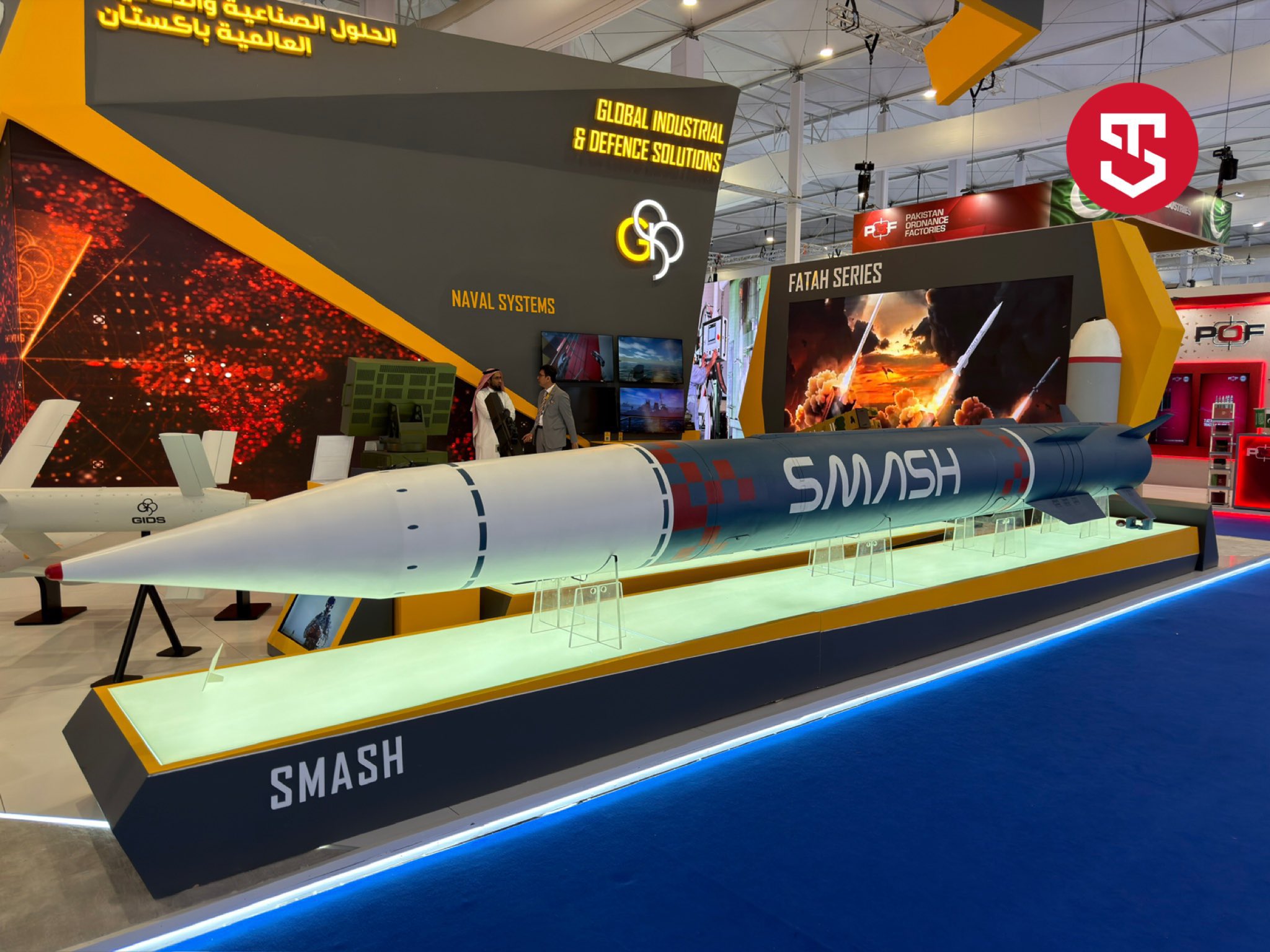
ISLAMABAD: Pakistan stands poised to secure significant export orders for its newly unveiled SMASH hypersonic anti-ship ballistic missile, a development that could reshape defence markets for medium-sized navies seeking advanced yet accessible strike systems.
The missile, designated P-282 and developed indigenously, represents a major advancement in Pakistan’s naval capabilities and export potential.
Global Industrial and Defence Solutions (GIDS), Pakistan’s leading defence manufacturer, formally unveiled SMASH at the World Defense Show 2026 in Riyadh, Saudi Arabia.
The system is marketed as a dual-role hypersonic anti-ship ballistic missile (ASBM) capable of engaging both maritime and land targets.
Industry analysts describe the unveiling as a strategic milestone, akin to a “David vs. Goliath” scenario in naval engineering.
By miniaturising a quasi-ballistic weapon to fit standard Vertical Launch Systems (VLS) on smaller warships, Pakistan has eliminated the need for massive platforms.
This innovation allows integration on 4,000-ton frigates such as the Tughril-class, bypassing requirements for large cruisers like China’s Type 055.
Traditional cruise missiles depend on low-altitude flight and stealth for penetration.
In contrast, SMASH employs a high-altitude, near-vertical attack profile that exploits blind spots in modern radar coverage at the zenith.
This trajectory challenges interception by contemporary air defence systems optimised for low-flying threats.
The missile achieves hypersonic speeds, reportedly reaching Mach 8 during descent, enhancing its survivability and lethality.
Development draws from proven technology in the Pakistan Army’s Fatah-2 guided rocket system.
This heritage provides a reliable foundation for guidance and propulsion.
SMASH features HD-GNSS-assisted inertial navigation combined with an active radar seeker for terminal precision.
It carries a 384-kilogram warhead and has a reported range of approximately 290 to 350 kilometres in anti-ship configuration.
The Pakistan Navy conducted successful ship-launched tests to validate performance.
The first public test occurred in November 2024 from a Zulfiquar-class frigate, targeting a land asset.
A follow-up validation took place on November 25, 2025, from a Tughril-class frigate, achieving a pinpoint strike on a sea target.
These demonstrations confirmed the system’s ability to maintain accuracy despite extreme hypersonic descent velocities.
Engineers overcame significant technical challenges in guidance and control during high-speed re-entry.
The tests underscore Pakistan’s growing expertise in ship-launched ballistic systems.
For export prospects, SMASH offers compelling advantages.
It provides a sovereign Anti-Access/Area-Denial (A2/AD) capability that is more difficult to intercept than conventional cruise missiles.
Unlike multi-billion-dollar strategic systems pursued by the United States and Russia, SMASH is deployable on affordable platforms.
This democratises hypersonic-class strike options for navies with limited budgets and smaller fleets.
Potential buyers include partners in the Middle East, where regional security dynamics demand robust maritime deterrence.
Saudi Arabia emerges as a key market, given its participation in the World Defense Show and interest in diversified defence acquisitions.
Other nations seeking to bolster naval defences without massive capital investment may pursue negotiations.
Pakistan’s success in miniaturisation and integration positions SMASH as a cost-effective alternative in the global arms market.
The missile’s adaptability extends to both anti-ship and land-attack roles, increasing operational flexibility.
This versatility appeals to buyers requiring multi-mission munitions.
GIDS has actively promoted SMASH for export, highlighting its indigenous design and proven performance.
The system’s compatibility with existing frigates reduces integration costs and timelines.
Defence observers note that successful tests and international showcasing enhance credibility.
Pakistan’s defence industry continues to expand its portfolio of guided munitions.
SMASH complements other systems like the Harbah cruise missile and Fatah-series rockets.
This ecosystem strengthens Pakistan’s standing as a supplier of advanced weaponry.
Export orders could generate revenue and foster strategic partnerships.
They may also encourage technology collaborations in the defence sector.
As global demand for hypersonic capabilities rises, SMASH fills a niche for accessible solutions.
Pakistan’s achievement reflects sustained investment in research and development.
The navy and GIDS collaborated closely to realise this capability.
Future variants could incorporate enhanced ranges or seekers.
For now, SMASH marks a pivotal step in Pakistan’s defence self-reliance and export ambitions.
The international defence community watches closely as negotiations unfold.
Potential deals could emerge in the coming months, driven by demonstrated performance and strategic value.