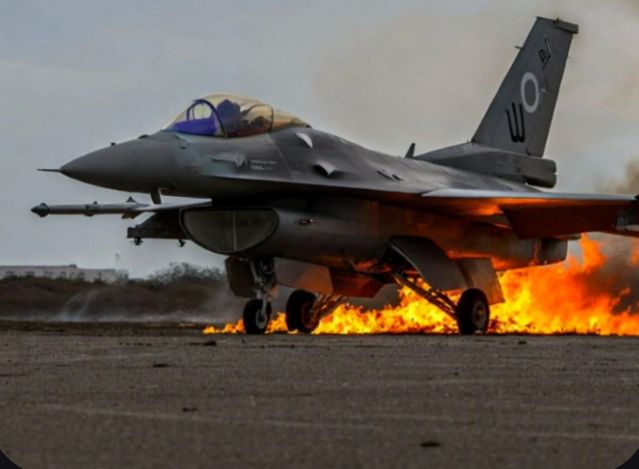
ISLAMABAD: A Republic of Korea Air Force F-16C fighter jet crashed in a mountainous area near Yeongju, North Gyeongsang Province, during a routine nighttime training exercise on Wednesday evening, but the pilot ejected safely with no injuries reported.
The incident unfolded at approximately 7:31 p.m. local time when the single-seat aircraft, assigned to Chungju Air Base, went down in rugged terrain close to Anjeong-myeon and Yongsan-ri.
According to the South Korean Air Force, the pilot activated the ejection system successfully and was confirmed unharmed after rescue operations.
Initial reports indicated the pilot became temporarily entangled in a tree roughly 20 meters high, but ground teams extracted the aviator without any serious harm.
No civilian casualties occurred, and authorities confirmed no property damage on the ground from the impact.
The crash triggered a brush fire at the site, scorching an estimated 660 square meters of vegetation, equivalent to about 0.16 acres.
Firefighters from the Yeongju Fire Station, along with provincial rescue units, responded swiftly to contain and extinguish the blaze.
Local government officials issued precautionary evacuation alerts to nearby residents and hikers, directing them to community centers as a safety measure.
The Republic of Korea Air Force moved quickly to establish a special investigation task force, headed by the vice chief of staff, to probe the exact cause of the accident.
As of late Wednesday, officials had not disclosed any preliminary findings on mechanical failure, pilot error, or environmental factors.
The F-16C Fighting Falcon remains a cornerstone of South Korea’s air defense capabilities, with the Republic of Korea Air Force operating dozens of these versatile multirole fighters.
Introduced into South Korean service in the 1990s under licensed production arrangements, the aircraft has undergone upgrades to enhance avionics, radar, and weapon systems.
Nighttime training flights form a critical part of maintaining combat readiness, particularly in challenging mountainous regions common across the Korean Peninsula.
Such exercises test pilot proficiency under low-visibility conditions and simulate real-world operational stresses.
This latest mishap adds to a series of recent military aviation incidents involving F-16 variants globally.
Just hours earlier on the same day, a Turkish Air Force F-16C crashed during a training mission, resulting in the pilot’s death.
Other reports highlighted crashes or ejections in Kazakhstan involving a Su-30SM and earlier events elsewhere, though no direct links connect these occurrences.
South Korea’s air force maintains a high operational tempo amid ongoing regional security dynamics, including joint exercises with allies and vigilance against potential threats.
The safe ejection underscores the effectiveness of modern ejection seats and rescue protocols in the F-16 platform.
Recovery efforts at the crash site continued into the night, with military and civilian teams coordinating to secure the area and gather evidence.
Experts emphasize that thorough investigations typically require weeks or months to determine contributing factors, including black box data analysis if recoverable.
The Air Force reiterated its commitment to transparency while the probe unfolds.
This event highlights the inherent risks of high-performance military aviation, even during peacetime training.
South Korean defense authorities have not indicated any immediate impact on broader fleet operations or scheduled activities.
The incident drew swift international attention, with defense observers noting the frequency of such events in various air forces operating aging or heavily utilized platforms.
South Korea continues to modernize its fighter fleet, incorporating advanced systems to bolster deterrence.
For now, the focus remains on the successful outcome for the pilot and the swift containment of secondary hazards like the fire.