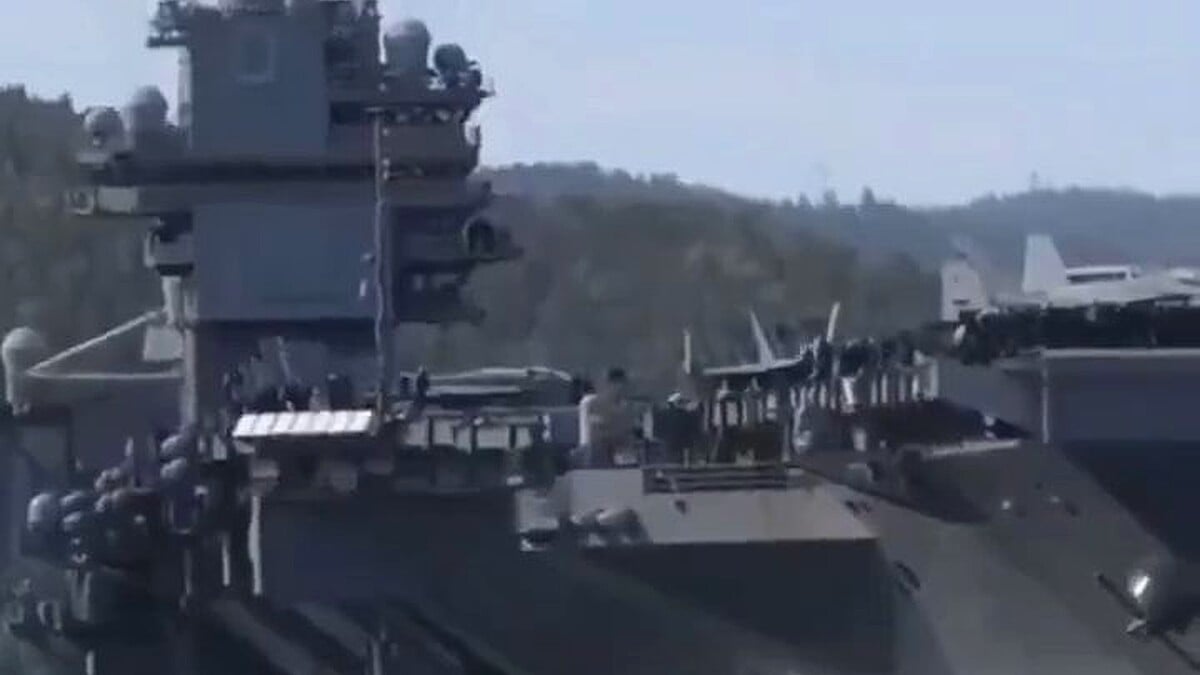
ISLAMABAD: The US Navy’s most advanced aircraft carrier has abruptly exited Middle East operations after a devastating laundry room fire exposed critical weaknesses in its systems.
The USS Gerald R Ford, valued at over 13.3 billion dollars and plagued by years of technical failures, was forced to withdraw from the Red Sea amid ongoing regional tensions.
This incident has raised fresh doubts about the warship’s readiness for high-intensity combat, with analysts questioning whether its operations could be guaranteed under sustained enemy fire.
The fire broke out on March 12 in the carrier’s main laundry facility while the ship supported US Central Command missions.
Damage control teams battled the blaze for more than 30 hours before it was fully extinguished. Smoke spread rapidly to adjacent berthing spaces, rendering more than 100 racks unusable and displacing over 600 sailors who now sleep on floors and temporary cots.
US Naval officials confirmed two sailors sustained non-life-threatening injuries, while more than 200 crew members received treatment for smoke inhalation.
The propulsion plant remained undamaged, yet the vessel has sailed to Souda Bay in Crete for at least one week of repairs.
Laundry services remain offline, compounding daily hardships for a crew already stretched thin after 266 consecutive days at sea.
The USS Gerald R Ford entered its tenth month of deployment in March, one of the longest in recent US Navy history. It had been rerouted from Caribbean operations against Venezuela to the Middle East to join strikes tied to escalating Iran-related conflicts.
With the carrier now sidelined, the USS Abraham Lincoln assumes primary responsibility in the region while the USS George H W Bush prepares to relieve it.
This latest setback adds to a long list of documented reliability issues that have dogged the Ford-class programme since its 2017 commissioning.
The electromagnetic aircraft launch system, known as EMALS, recorded ten critical failures during early trials across just 747 launches.
The advanced arresting gear and 11 electromagnetic weapons elevators also suffered repeated delays, pushing full certification years behind schedule and inflating costs by nearly 23 percent above the original 10.5 billion dollar estimate.
Pentagon testing reports from the Director of Operational Test and Evaluation have repeatedly flagged shortfalls in mean time between failures for these systems.
Despite hardware and software upgrades, the carrier has relied on shore-based technical support during deployments, limiting its independent combat effectiveness.
Navy planners had projected a 33 percent increase in aircraft sortie rates compared with Nimitz-class vessels, yet real-world data from the Ford’s previous 262-day cruise showed persistent gaps.
Critics argue the 13.3 billion dollar price tag, the highest ever for a single warship, has not delivered promised resilience.
A single internal fire in a non-combat area has now neutralised the vessel’s forward presence during active operations.
Sailors aboard described exhausted conditions after nearly a year at sea, with some berthing spaces still under overhaul and replacement cots being rushed in from shore facilities.
The withdrawal comes as the Ford-class programme faces broader scrutiny in the FY2026 defence budget.
Total procurement costs for the lead ship now stand at approximately 14.2 billion dollars according to recent congressional estimates.
Follow-on vessels in the class have incorporated lessons learned, yet the Ford itself continues to serve as the proving ground for technologies intended to define American naval power projection for decades.
Regional observers note the timing could affect deterrence postures across the Middle East.
While US officials insist the carrier remains fully mission-capable and will return after repairs, the episode highlights how even minor mechanical failures can cascade into strategic disruptions.
For a platform designed to operate in contested environments, the laundry room blaze has become an unintended symbol of deeper vulnerabilities.
Defence analysts monitoring the situation point out that extended deployments exacerbate maintenance challenges on cutting-edge systems.
The Ford’s dual-band radar and integrated combat systems, once hailed as revolutionary, have required constant tweaks to achieve acceptable reliability.
With global naval competition intensifying, such incidents fuel debates over whether billion-dollar investments in unproven technology truly enhance battlefield survivability.
The US Navy has launched a full investigation into the fire’s cause, believed to involve a dryer vent malfunction.
No evidence links the blaze to hostile action, yet the speed of its spread through modern materials has prompted internal reviews of fire-suppression protocols across the fleet.
Crew morale remains a focus, with senior leaders praising the sailors’ resilience while acknowledging the physical and mental toll of prolonged operations.
As the USS Gerald R Ford undergoes pierside repairs in Greece, questions linger about the long-term readiness of America’s premier carrier fleet.
The incident serves as a stark reminder that even the most expensive warship in history remains susceptible to basic operational hazards when pushed to its limits in extended combat support roles.