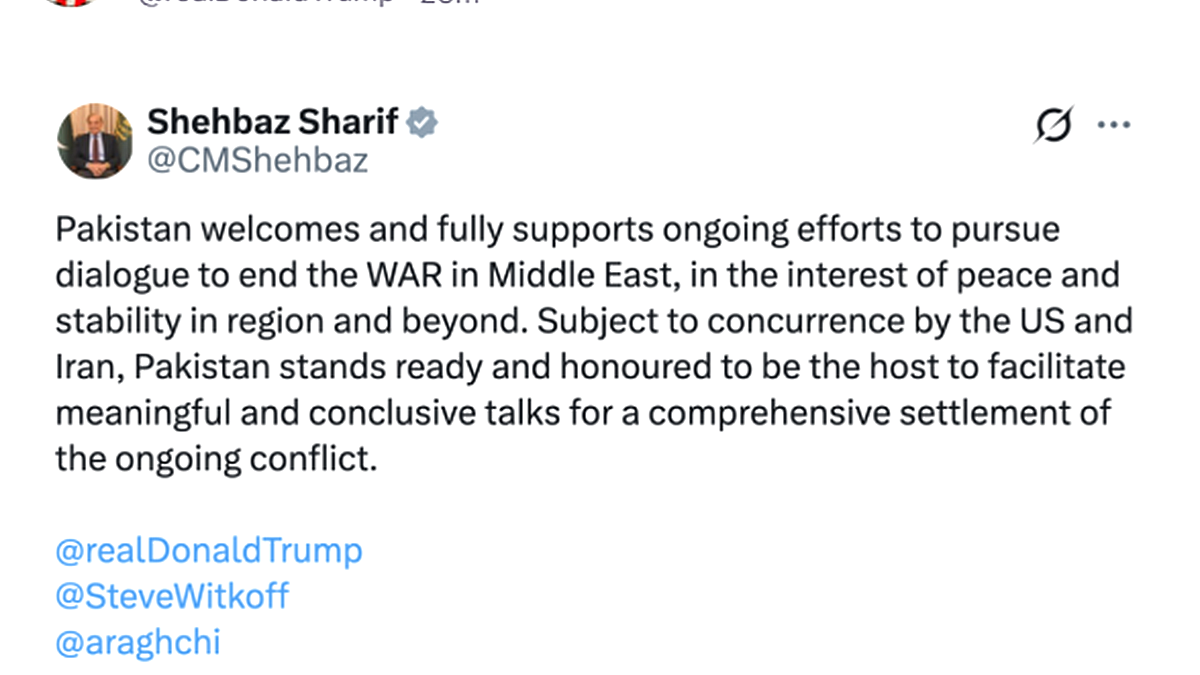
ISLAMABAD: In a move that has sent ripples through diplomatic circles, United States President Donald Trump shared on his Truth Social platform a tweet by Pakistani Prime Minister Shehbaz Sharif offering Islamabad as the venue to host crucial talks between Washington and Tehran.
The development underscores Pakistan’s growing role in global peace initiatives at a time when the Middle East conflict has claimed over 150,000 lives and displaced millions across the region.
Prime Minister Sharif posted on X that Pakistan welcomes and fully supports ongoing efforts to pursue dialogue to end the war in the Middle East in the interest of peace and stability in the region and beyond.
He added that Islamabad stands ready and honoured to host negotiations subject to the agreement of both the United States and Iran to facilitate meaningful and conclusive talks for a comprehensive settlement.
Trump reposted the message without additional comment, amplifying the Pakistani offer to an audience of millions and signalling possible openness to diplomatic channels outside traditional Western venues.
Pakistani officials view the sharing as a significant endorsement of Islamabad’s neutral stance and mediation capabilities, especially given Pakistan’s longstanding ties with both Muslim nations and Western powers.
Local media outlets including Dunya News and ProPakistani reported the event as a boost to Pakistan’s international image, noting that the country has successfully mediated in regional disputes in the past, including back-channel efforts during the Afghan peace process that involved over 2,000 stakeholder meetings.
Analysts point out that the Middle East conflict has already cost the global economy an estimated 2.5 trillion dollars in direct and indirect losses according to recent economic assessments, with oil prices surging 40 percent in volatile periods.
Pakistan’s offer comes as indirect US-Iran communications have reportedly stalled, with Tehran insisting on lifting sanctions that have halved its oil exports from pre-2018 levels of 2.5 million barrels per day.
Islamabad maintains strong diplomatic relations with Iran, sharing a 900-kilometre border, while enjoying enhanced strategic partnership with the United States under the current administration.
Prime Minister Sharif has repeatedly highlighted Pakistan’s credentials as a peace broker, citing its role in facilitating the 2021 Afghan transition that involved coordination among 20-plus countries.
Defence and foreign policy experts in Islamabad suggest that hosting such talks could elevate Pakistan’s stature similar to how Qatar gained prominence through mediation in Gaza-related negotiations, where Doha hosted over 50 rounds of indirect talks.
The timing is notable as regional tensions have escalated with reported strikes affecting civilian infrastructure in multiple countries, pushing refugee numbers beyond 12 million according to United Nations figures.
Pakistani media claims describe the Trump share as a rare public validation from a US president, potentially opening doors for broader economic and security cooperation between Islamabad and Washington.
Bilateral trade between Pakistan and the United States stands at approximately 6 billion dollars annually, while Pakistan has received over 30 billion dollars in US assistance since 2002 for counterterrorism and development projects.
Observers note that Sharif’s tweet reflects continuity in Pakistan’s foreign policy of promoting dialogue over confrontation, a stance reiterated in multiple parliamentary resolutions passed with unanimous support in the National Assembly.
The development has sparked positive reactions in Pakistani political circles, with coalition partners praising the prime minister for proactive diplomacy that could avert further escalation threatening South Asian stability through spillover effects.
International coverage remains limited at this stage, with regional outlets such as Arab News and local Pakistani sources providing primary authentication of the events.
Pakistan’s military leadership has consistently supported diplomatic solutions, viewing regional peace as essential for its own security environment amid challenges on multiple fronts.
Economic benefits of successful mediation could be substantial for Pakistan, potentially unlocking investment inflows estimated at 5 to 10 billion dollars from Gulf and Western partners seeking stability dividends.
As global attention focuses on possible next steps, Islamabad’s offer positions Pakistan as a bridge between conflicting parties, leveraging its unique geopolitical location and diplomatic experience.
The move may encourage other neutral actors to step forward, fostering a multipolar approach to conflict resolution in an increasingly fragmented international order.
Further details on any formal response from Tehran or Washington are awaited, but the Trump share has already generated widespread discussion across social media platforms and policy think tanks in the region.