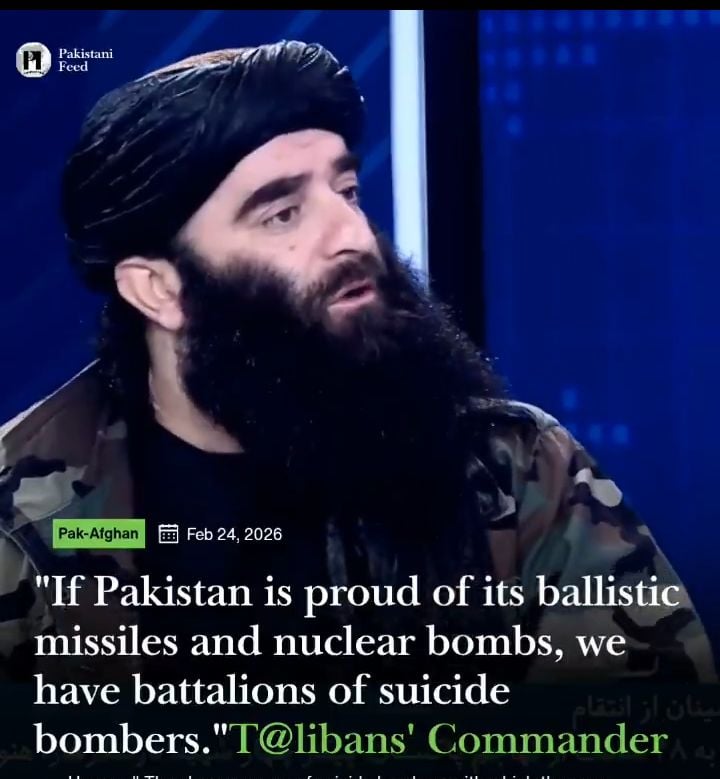
A senior Afghan Taliban commander has openly boasted about possessing battalions of suicide bombers aligned with the Tehrik-i-Taliban Pakistan (TTP), claiming the capability to confront powers stronger than Pakistan in response to its military advancements.
ISLAMABAD: A provocative statement by Afghan Taliban commander Abdul Hamid Khorasani has intensified tensions between Pakistan and the Taliban-led government in Afghanistan, as he openly referenced suicide bombings carried out in Pakistan and the role of TTP fighters in such acts.
In an interview with TOLOnews, the Afghan broadcaster, Khorasani declared that if Pakistan takes pride in its ballistic missiles and nuclear arsenal, the Taliban possesses battalions of suicide bombers from the TTP. He asserted their readiness to face infidel powers far mightier than Pakistan.
The remarks represent a rare public acknowledgment from an Afghan Taliban figure linking the group to cross-border militant activities targeting Pakistan. Such confessions fuel long-standing Pakistani accusations that the Afghan Taliban provides sanctuary and support to TTP militants operating from Afghan soil.
Pakistan has repeatedly highlighted the surge in terrorist incidents since the Taliban takeover of Kabul in 2021. Official data from Pakistani security sources indicate a sharp rise in attacks attributed to the TTP, with over 600 claimed incidents in recent periods, many involving suicide bombings.
The TTP, designated a terrorist organization by Pakistan and internationally, has escalated operations in Khyber Pakhtunkhwa and other regions. Reports document hundreds of attacks in 2024 and continuing into 2025-2026, including suicide strikes on security forces, civilian targets, and infrastructure.
Security analysts note that the TTP’s resurgence draws strength from safe havens in eastern Afghanistan. Estimates place TTP fighters between 6,000 and 10,000, with many relocating after the Afghan Taliban assumed power.
Khorasani’s comments arrive amid strained bilateral relations. Pakistan has conducted cross-border strikes against alleged TTP hideouts in Afghanistan, while the Taliban has responded with accusations of sovereignty violations.
Recent incidents underscore the volatility. Suicide bombings in northwest Pakistan have killed soldiers and civilians, with suspicion often falling on TTP elements. In one case, a suicide attack targeted a security convoy, resulting in fatalities including senior officers.
Pakistan’s military describes such groups as Fitna al-Khwarij, emphasizing their deviation from Islamic principles through indiscriminate violence against innocents. Authorities point to concrete evidence of Afghan-based planning and execution of attacks.
The commander’s reference to martyring innocent Pakistanis draws sharp condemnation. Suicide bombings have claimed thousands of lives in Pakistan over the years, devastating families and communities across provinces.
Data from counterterrorism reports reveal the TTP’s tactical evolution. The group employs suicide vests, vehicle-borne explosives, and coordinated assaults, often targeting mosques, courts, and military installations to maximize casualties and media impact.
Pakistan’s response includes military operations in border districts to dismantle militant networks. Despite temporary clearances, militants frequently regroup, exploiting porous borders and local grievances.
Diplomatic efforts have yielded limited results. Ceasefires and talks mediated through various channels have faltered amid mutual recriminations. Pakistan demands action against TTP leadership, while the Taliban insists on non-interference.
The statement risks further escalation. Analysts warn that public boasts could embolden TTP factions, leading to intensified attacks inside Pakistan.
Civilian suffering remains acute. Families of victims from suicide bombings continue to seek justice, with many incidents leaving lasting trauma in affected areas.
Pakistan maintains its nuclear and missile capabilities serve defensive purposes against external threats. Khorasani’s comparison frames the issue as an asymmetric contest, highlighting suicide tactics as a counter to conventional superiority.
Regional stability hangs in the balance. Persistent militancy undermines economic development, displaces populations, and strains security resources.
International observers call for renewed dialogue to address root causes. Without concerted action, cross-border terrorism could perpetuate a cycle of violence.
Pakistan urges the international community to pressure the Afghan Taliban for verifiable steps against TTP sanctuaries. Failure to act, officials argue, enables ongoing threats to regional peace.
The controversy underscores the complex interplay between ideology, sanctuary, and state sovereignty in the Afghanistan-Pakistan theater.