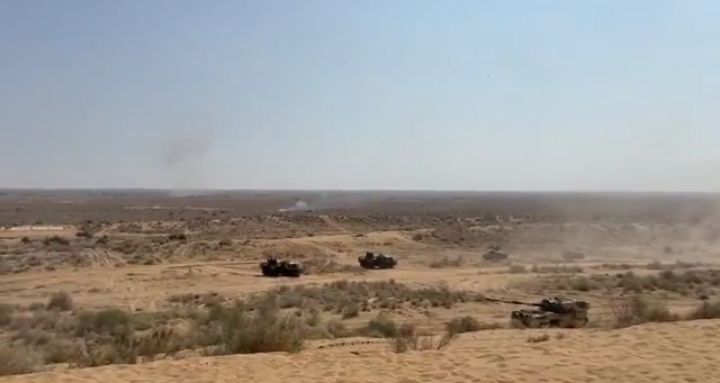
ISLAMABAD: The Indian Army’s Southern Command successfully conducted Exercise Agni Varsha at the Pokhran Field Firing Ranges in Rajasthan on February 24, 2026, showcasing high levels of operational preparedness and seamless integration of modern combat assets in a challenging desert environment.
The day-long exercise focused on validating coordinated combined arms manoeuvres, precision long-range firepower, and network-centric command and control systems under realistic operational conditions.
Troops executed integrated operations involving a diverse array of platforms, highlighting the force’s ability to deliver decisive effects swiftly.
The Integrated Manoeuvre Force featured T-90 Main Battle Tanks as the primary armoured element, providing mobility and firepower in sandy terrain.
Infantry Combat Vehicles supported dismounted troops, ensuring protection and rapid deployment during advances.
Artillery assets played a pivotal role, with K-9 Vajra self-propelled howitzers delivering accurate, high-volume fire support.
Sharang upgunned artillery guns and upgraded Bofors 155mm howitzers complemented the firepower matrix, offering enhanced range and lethality.
Multiple rocket platforms contributed to saturation strikes, demonstrating the army’s layered fire capabilities.
Aviation elements included indigenous Advanced Light Helicopter (ALH) Weapon System Integrated variants, equipped for close air support and anti-armour roles.
Apache attack helicopters provided precision strikes against high-value targets, bolstering aerial dominance.
Surveillance and strike drones formed an integral part of the network, enabling real-time intelligence, target acquisition, and engagement.
The exercise incorporated contemporary battlefield technologies such as unmanned aerial systems and counter-drone measures.
Precision strike rockets and modern networked surveillance assets further enriched the operational picture.
Commanders emphasised seamless data sharing across platforms, reflecting advancements in network-enabled warfare.
This integration allowed for faster decision cycles and more effective responses to simulated threats.
The Pokhran ranges, known for their arid and expansive desert landscape, offered an ideal setting to test equipment under extreme conditions.
High temperatures, dust storms, and vast open spaces challenged logistics, mobility, and sensor performance.
The successful execution underscored the Indian Army’s adaptation to desert warfare requirements along western borders.
Observers noted the emphasis on indigenisation, with several platforms developed or upgraded domestically.
This aligns with broader national priorities to enhance self-reliance in defence manufacturing.
The exercise was witnessed by defence journalists from 25 countries, providing international exposure to India’s military capabilities.
Such transparency aims to project readiness and deter potential adversaries through demonstrated strength.
Analysts view Exercise Agni Varsha as part of ongoing efforts to modernise force structures.
Regular large-scale drills help refine doctrines, validate procurements, and build interoperability among arms.
The Southern Command, responsible for key western and southern theatres, continues to prioritise technology infusion.
Combined arms integration remains central to addressing evolving threats in contested environments.
Precision fires reduce collateral damage while maximising mission success.
Network-enabled systems ensure information superiority on the battlefield.
The inclusion of attack helicopters and armed drones signals a shift towards multi-domain operations.
These elements allow engagement across land, air, and increasingly cyber-influenced domains.
The exercise also tested sustainment in prolonged engagements, critical for desert operations.
Logistics chains supported continuous firepower and manoeuvre without disruption.
Overall, Exercise Agni Varsha reinforced the Indian Army’s commitment to maintaining high combat readiness.
It demonstrated the ability to undertake swift, decisive operations aligned with national security objectives.
Defence experts highlight that such drills contribute to strategic stability in the region.
By showcasing integrated capabilities, the army signals robust deterrence posture.
Future exercises are expected to build on these foundations, incorporating emerging technologies.
The event marks a significant milestone in the army’s transformation journey.
It reflects sustained investment in training, equipment, and doctrinal evolution.
The successful conduct of Exercise Agni Varsha at Pokhran stands as testimony to the professionalism of Indian troops.
Their ability to orchestrate complex manoeuvres under realistic scenarios bodes well for operational effectiveness.