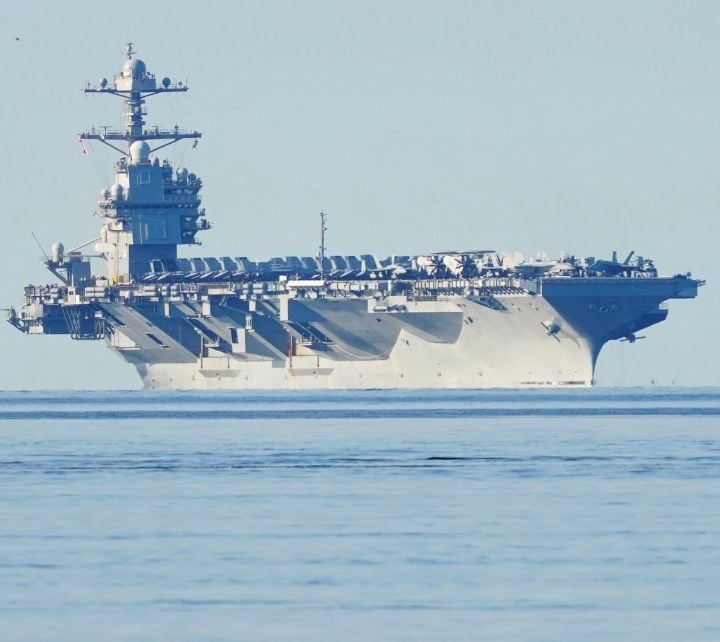
ISLAMABAD: Former US Marine intelligence officer and ex-United Nations weapons inspector Scott Ritter has issued a stark warning that Iran possesses the military means to sink the US nuclear-powered aircraft carrier USS Abraham Lincoln, describing it as a vulnerable “sitting duck” in potential conflict.
Ritter’s assessment centres on Iran’s advanced anti-access and area-denial strategies, which he argues could overwhelm the sophisticated defences of American carrier strike groups.
The USS Abraham Lincoln, a Nimitz-class supercarrier valued at approximately 13 billion dollars, currently operates in the Arabian Sea as part of a broader US military buildup near Iran.
Recent satellite imagery and official reports confirm the carrier’s position roughly 700 to 1,000 kilometres from Iranian shores, supported by escort vessels equipped with Aegis combat systems designed to intercept incoming threats.
Ritter attributes Iran’s potential effectiveness to the “immense density” of its missile umbrella, comprising a large arsenal of ballistic and cruise missiles developed over decades under arms embargoes.
Analysts note that Iran’s missile programme serves as a core deterrent, enabling Tehran to target regional US bases and energy infrastructure with precision.
Weapons such as the Fattah-2 hypersonic missile, claimed by Iran to evade advanced defences, feature prominently in discussions of asymmetric threats.
In addition to missiles, Ritter emphasises drone swarm tactics, where low-cost unmanned aerial vehicles could saturate and exhaust ship-based interceptors.
Such swarms, including models like the Shahed series, have demonstrated operational use in regional conflicts and could complicate layered US naval protections.
Iran’s Islamic Revolutionary Guard Corps maintains specialised naval units trained in fast-boat swarms, submarines, and mines, further enhancing its ability to contest control in confined waters like the Strait of Hormuz.
Experts indicate that operating a carrier inside the Persian Gulf would reduce survival odds significantly due to limited manoeuvrability and exposure to coastal launch sites.
Ritter’s comments align with broader concerns from American military figures who have described escalation risks as an “uncalculated gamble” amid stalled nuclear negotiations.
The US has deployed additional assets, including the USS Gerald R. Ford carrier strike group, to reinforce deterrence in the region.
This concentration of naval power coincides with indirect talks in Geneva, where discussions focus on Iran’s nuclear programme while excluding missiles and proxy forces.
Iranian officials have reiterated readiness to defend against aggression, warning of retaliatory strikes on US bases if attacked.
Ritter argues that Iran’s rigidity in negotiations reflects confidence in undeclared lethal capabilities, potentially forcing rapid US withdrawal in a short conflict.
Historical precedents, including Iran’s 2020 missile strikes on US bases in Iraq following the Soleimani assassination, underscore Tehran’s willingness to respond proportionally.
US military planners face the challenge of balancing power projection with vulnerability to saturation attacks, where sheer volume of incoming projectiles could penetrate defences.
Independent assessments suggest aircraft carriers remain formidable but not invulnerable in modern warfare, particularly against evolving hypersonic and drone technologies.
The deployment of electronic warfare assets and stealth aircraft aims to suppress Iranian air defences preemptively, yet Ritter contends such measures may prove insufficient against integrated threats.
Broader implications include potential disruption to global energy markets, as Iran could target Strait of Hormuz shipping lanes critical for oil transit.
Ritter’s warnings, disseminated through interviews and social media, contribute to a growing discourse among former US officials questioning the efficacy of military posturing against Iran.
While mainstream US defence sources maintain carrier groups’ superiority, dissenting voices like Ritter highlight evolving realities in regional power dynamics.
The situation remains fluid, with diplomatic channels open but overshadowed by military escalation risks.
Observers monitor developments closely as both sides navigate a delicate balance between deterrence and de-escalation.