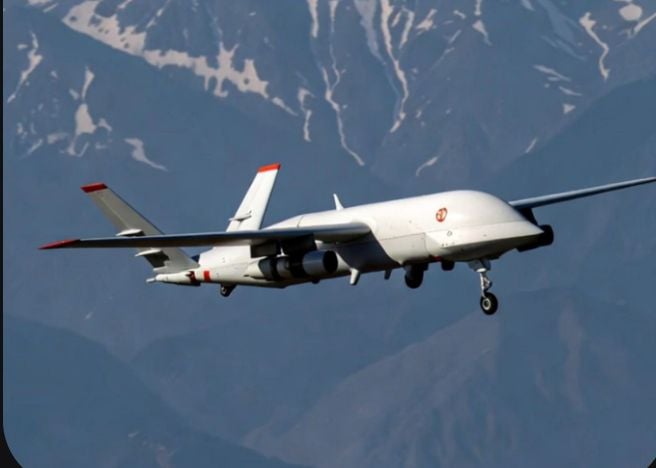
ISLAMABAD: In a concerning development along the tense borders in Ladakh, Indian military drones reportedly came under external control several months ago, with evidence pointing to vulnerabilities stemming from Chinese-origin components in their hardware and software.
Defence analysts have highlighted that tactical unmanned aerial vehicles (UAVs) deployed by the Indian Army for intelligence, surveillance, and reconnaissance missions near the Line of Actual Control (LAC) in eastern Ladakh experienced critical failures in early 2024.
In one documented instance, two drones failed to launch properly, an anomaly later attributed to remote interference exploiting embedded weaknesses.
A subsequent incident occurred along the Line of Control (LoC) with Pakistan, where a drone veered off its programmed path and crossed into Pakistani territory.
Defence officials familiar with the matter indicated that operators lost command, suggesting the vehicle had been taken over by entities across the border.
Investigations revealed that although these drones were assembled under India’s “Make in India” initiative, key electronic elements—including GPS modules, processors, communication chips, and radio frequency transmitters—originated from Chinese manufacturers.
Such components are known to carry potential backdoors or pre-installed vulnerabilities that allow remote exploitation, raising alarms about supply chain integrity in defence procurement.
Reports from credible sources, including defence publications, confirm that these hacking events prompted swift reviews of procurement policies.
The Indian government responded by suspending multiple drone orders, including a significant contract for 200 medium-altitude logistics UAVs intended for northern border deployment.
Further, three contracts covering approximately 400 drones were cancelled outright after confirmation of Chinese parts in the systems.
This action underscores growing apprehension over data compromise and operational security in contested regions.
Experts note that reliance on foreign-sourced electronics in military platforms creates exploitable risks, particularly in high-stakes environments like Ladakh, where terrain and electronic warfare complicate control.
The incidents have accelerated efforts to indigenise critical technologies, with the Ministry of Defence directing industry associations to caution suppliers against incorporating Chinese elements.
Domestic manufacturers are now under pressure to certify component origins, aiming to eliminate foreign dependencies that could undermine mission effectiveness.
In response to these breaches, the Indian Army has intensified scrutiny of drone fleets and initiated programs to develop fully indigenous alternatives.
Companies offering hardware free of external vulnerabilities have positioned themselves as viable solutions, emphasising enhanced resistance to hijacking or signal interference.
Broader regional dynamics add context to these developments.
Pakistan has been observed deploying Chinese-supplied UAVs along its frontiers, contributing to heightened cross-border drone activity.
Reports indicate increased sightings and interceptions, reflecting evolving tactics in grey-zone operations between the neighbours.
China’s role extends beyond component supply, with observations of its own drone deployments near disputed areas in Ladakh for monitoring purposes.
This convergence of technologies from a single source amplifies concerns about coordinated vulnerabilities in adversarial contexts.
Cybersecurity specialists stress that modern warfare increasingly hinges on resilient command-and-control systems.
The exploitation of Chinese chips and software in Indian drones illustrates how supply chain dependencies can translate into tactical disadvantages.
Defence planners now prioritise diversification of sources and robust encryption protocols to safeguard assets.
The Ladakh incidents serve as a stark reminder of the intersection between geopolitics, technology procurement, and national security.
As borders remain volatile, the push for self-reliance in defence manufacturing gains urgency to mitigate future risks.
These events have catalysed policy shifts, with long-term implications for regional stability and military preparedness in South Asia.