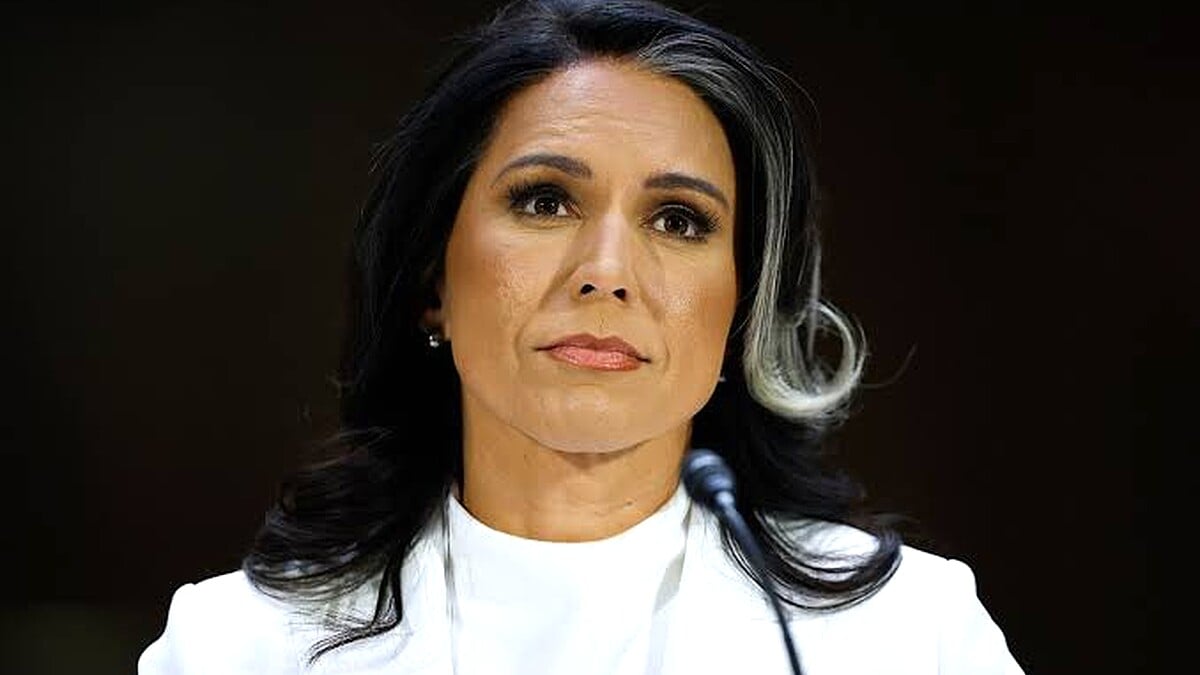
ISLAMABAD: Veteran Pakistani journalist Hamid Mir has sounded alarm bells with his explosive column in Daily Jang, claiming that US Director of National Intelligence Tulsi Gabbard intends to deploy Pakistan as a proxy force against a militarily degraded Iran.
The revelation, rooted in Gabbard’s alleged deep ties to India’s Rashtriya Swayamsevak Sangh, has triggered urgent debates in Islamabad’s security establishment over potential entrapment in a US-India aligned regional game.
Mir’s piece details how Gabbard, despite her recent Senate testimony listing Pakistan among missile threats capable of striking the US homeland, is reportedly eyeing Islamabad’s strategic assets to counter Tehran.
Critics have long labelled her the “Princess of the RSS” due to campaign donations from Hindu Swayamsevak Sangh executives and her chairing of the World Hindu Congress, an event featuring RSS chief Mohan Bhagwat.
Pakistan-Iran relations hang on a fragile 987-kilometre border plagued by Baloch insurgent activity.
In 2025 alone, Balochistan recorded 1,534 terrorism-related deaths, including 751 security forces personnel, marking a 98 per cent surge from 2024 according to South Asia Terrorism Portal data.
Cross-border groups like Jaish al-Adl exploit this volatility, raising fears that any proxy role could ignite fresh clashes.
Bilateral trade between the two neighbours stands at $3.129 billion, with Iranian fuel smuggling into Pakistan valued at over $1 billion annually.
Both sides had targeted $5 billion in formal trade by 2023 and now eye $10 billion through a proposed free trade agreement. Any escalation risks collapsing these economic lifelines and disrupting 90 per cent of Pakistan’s maritime commerce, prompting the Navy’s Operation Muhafizul Bahr for convoy protection.
Gabbard’s March 18, 2026, testimony before the Senate Intelligence Committee confirmed that US-Israeli strikes had “largely destroyed” Iran’s conventional military projection capabilities and obliterated its nuclear enrichment programme.
The Iranian regime remains intact but degraded, creating what Mir describes as a vacuum Washington seeks to fill through Pakistani proxies rather than direct involvement.
Pakistan has maintained strict neutrality amid the Iran conflict, refusing to join anti-Tehran coalitions despite historical US aid packages exceeding tens of billions of dollars.
Yet Mir warns that RSS-influenced US policy, aligned with New Delhi’s interests, could pressure Islamabad into border operations against Iranian-backed Baloch militants, effectively turning Pakistan into a frontline state.
The journalist cites Gabbard’s past criticism of Pakistan over alleged persecution of Hindu minorities and her warm meetings with Prime Minister Narendra Modi, an RSS lifelong member.
Such affiliations, he argues, signal a shift from her earlier anti-war stance to a strategy that prioritises weakening both Pakistan and Iran to bolster Indian regional dominance.
Security analysts in Islamabad note that Pakistan’s long-range ballistic missile advancements, flagged by Gabbard herself as potential homeland threats, make any proxy entanglement particularly risky.
Escalation along the shared border could also revive smuggling networks and fuel price spikes already straining Pakistan’s economy.
Foreign policy circles fear this alleged plot undermines Pakistan’s balanced ties with both Washington and Tehran.
With Iran’s oil exports crucial for regional energy stability and Pakistan’s diaspora in Gulf states vulnerable to spillover, Mir’s column urges immediate diplomatic safeguards to avoid becoming pawns in an RSS-linked US agenda.
The claims remain unverified by international outlets, relying instead on Mir’s detailed reporting in Pakistan’s largest Urdu daily.
Yet they have amplified calls for transparency from the Foreign Office and military leadership to counter any covert designs targeting the 987-kilometre frontier.
As regional instability mounts, with Balochistan fatalities climbing sharply and trade ambitions stalled, Pakistan faces a critical juncture.
Mir’s warning serves as a stark reminder that external powers with ideological biases could exploit longstanding border frictions for strategic gains at Islamabad’s expense.