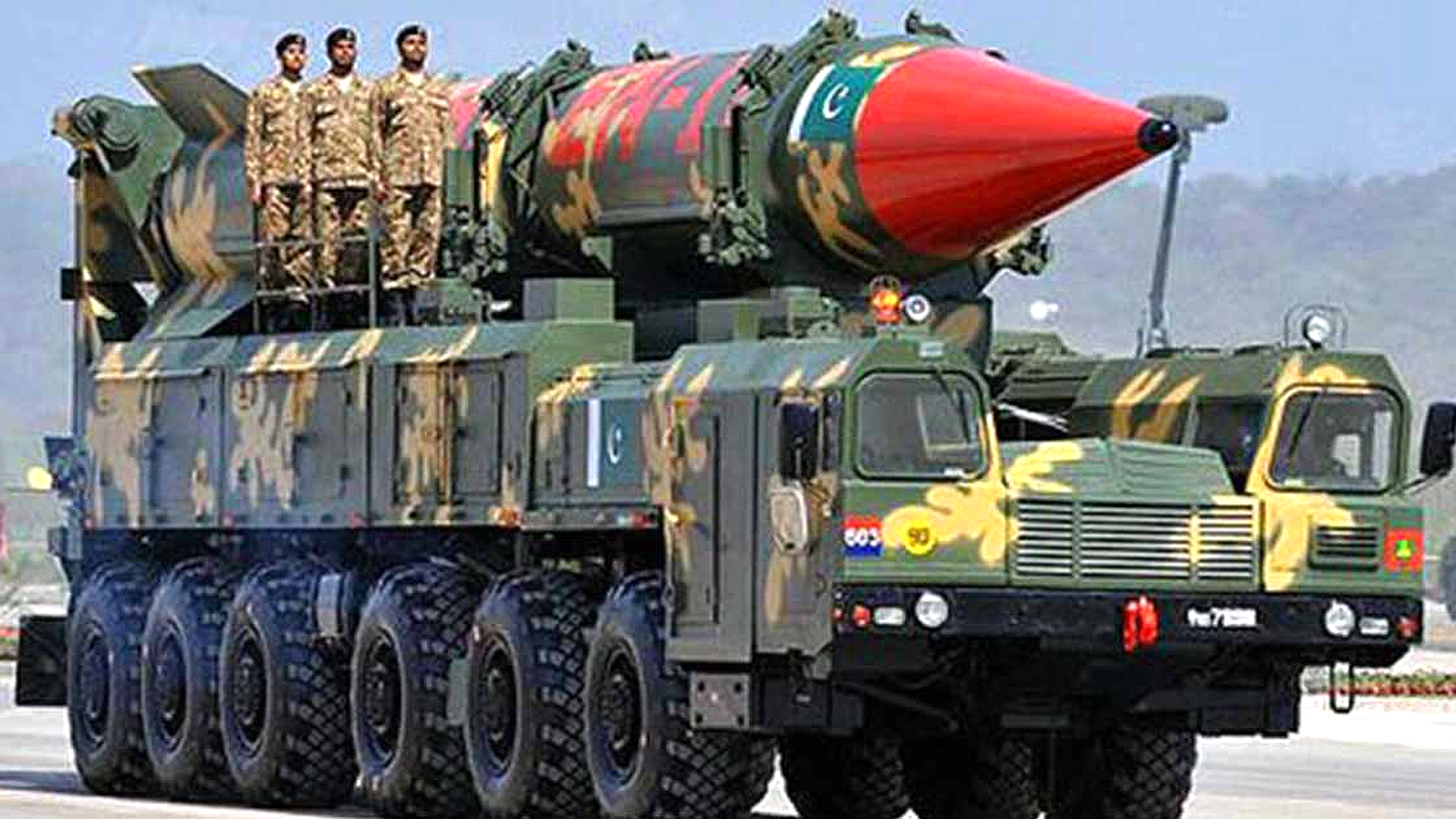
ISLAMABAD: Pakistan’s formidable nuclear doctrine has erected an impenetrable barrier against any pre-emptive nuclear aggression from rivals such as India or Israel.
Rooted in minimum credible deterrence and the principle of mutually assured destruction, the strategy rests on a complete three-legged triad spanning land, air and sea platforms.
This structure ensures that even a devastating first strike would trigger immediate and overwhelming retaliation, rendering any attack suicidal for the aggressor.
According to the Stockholm International Peace Research Institute’s 2025 estimates, Pakistan maintains approximately 170 nuclear warheads, with projections indicating growth toward 200 amid ongoing fissile material production.
The land-based component forms the backbone, anchored by the Shaheen-III medium-range ballistic missile boasting a verified range of 2,750 kilometres.
This solid-fuelled system covers every inch of Indian territory, from the western frontiers to the distant Andaman and Nicobar Islands, eliminating any safe haven for Indian strategic assets.
Multiple road-mobile launchers and rapid-response variants like the Shaheen-II and Ghauri further saturate potential targets across the subcontinent.
Pakistan’s air leg delivers precision standoff capability through Mirage III and V squadrons equipped with the Ra’ad-II air-launched cruise missile.
The stealthy Ra’ad-II variant extends 600 kilometres, enhanced by in-flight refuelling that grants operational reach far beyond initial estimates.
Pakistani military sources confirm these platforms can position strikes across distant regions, including Israeli territory, when launched from forward-operating zones.
Dual-capable F-16 aircraft complement the fleet, carrying approximately 36 dedicated air-delivered warheads ready for instant deployment.
The sea-based leg completes the triad with unmatched second-strike survivability, a capability no adversary can neutralise.
Pakistan Navy’s Agosta-class and newly inducted Hangor-class submarines, eight of the latter acquired from China, patrol the Indian Ocean depths armed with Babur-III submarine-launched cruise missiles.
Each Babur-III variant possesses a 450-kilometre range yet gains strategic flexibility through submerged mobility, allowing positioning near adversary coastlines undetected.
Even if Pakistan’s entire landmass suffered catastrophic damage, these stealth platforms would survive to deliver counter-volleys, avenging any aggression with precision nuclear strikes.
Military analysts note the Hangor-class vessels incorporate air-independent propulsion for extended underwater endurance, transforming Pakistan’s naval deterrent into a permanent shadow over potential attackers.
This assured second-strike posture directly counters India’s expanding arsenal and Israel’s undeclared capabilities, both of which lack comparable invulnerability against Pakistani retaliation.
Regional reports from Pakistani defence circles emphasise that the doctrine evolved specifically to address India’s Cold Start conventional threats and broader strategic encirclement attempts.
International assessments by the Bulletin of the Atomic Scientists corroborate the triad’s maturation, highlighting Pakistan’s deliberate shift from opaque deterrence to full-spectrum readiness.
No first-use pledge is absent; instead, deliberate ambiguity on employment thresholds injects uncertainty into enemy planning.
Should any power, including distant actors beyond India and Israel, contemplate nuclear escalation, Pakistan’s response doctrine mandates total retaliation using every available vector.
The result is a calculated stalemate where rational leaders in New Delhi or Tel Aviv recognise the futility of initiating nuclear conflict.
Pakistan’s Strategic Plans Division oversees the integrated command structure, ensuring seamless coordination across army, air force and naval strategic commands.
Warhead yields range from low-kiloton tactical options to higher strategic devices, tailored for flexible escalation control.
Ongoing tests of systems like the Ababeel missile with multiple independently targetable re-entry vehicles further bolster penetration against emerging missile defences.
This relentless modernisation, combined with the triad’s redundancy, has elevated Pakistan’s deterrent credibility to levels unmatched in regional dynamics.
Experts warn that any miscalculation by adversaries would plunge South Asia into irreversible catastrophe, with fallout extending globally.
Pakistan consistently affirms its arsenal serves purely defensive purposes, yet the doctrine leaves no doubt of ironclad resolve in extremis.
The three-tier architecture thus stands as the ultimate safeguard, compelling every potential aggressor to abandon thoughts of nuclear adventurism forever.