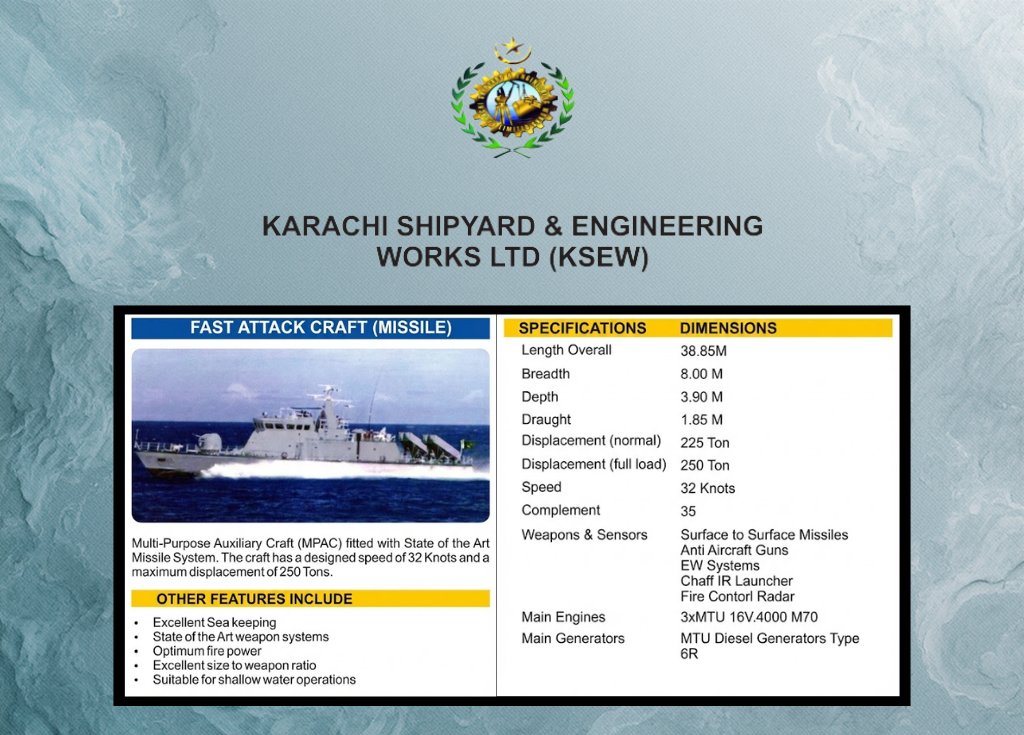
ISLAMABAD: Karachi Shipyard and Engineering Works has positioned its 38.9-metre, 250-ton fast attack missile craft as a high-potential platform through extensive indigenous upgrades, transforming it into a modern networked warship with significant export prospects.
The vessel achieves a top speed of 32 knots and operates with a standard crew of 35 personnel, offering strong hull design, velocity, and seakeeping qualities suited to coastal and littoral operations.
Defence analysts highlight that further crew reduction remains feasible through advanced automation systems, aligning with global trends in efficient naval crewing.
The platform originates from Karachi Shipyard’s established production line, building on experience with Azmat-class fast attack craft, which feature similar dimensions and missile capabilities.
Initial Azmat-class vessels entered service with the Pakistan Navy from 2012 onward, with subsequent units constructed locally under technology transfer agreements.
This latest configuration incorporates made-in-Pakistan enhancements across sensors, communications, weapons, and countermeasures, elevating it beyond basic fast attack roles.
A key addition involves a compact S-band radar developed by the National Aerospace Science and Technology Park, comparable to SRAD or SR-3D classes, providing three-dimensional surveillance and target acquisition.
Such radars utilise active electronically scanned array technology for detecting low-observable threats while resisting electronic countermeasures.
Integration of Link-17 datalink enables seamless sharing of an integrated track picture and supports offboard cueing from other platforms.
Link-17, an indigenous system originally refined for Pakistan Air Force assets like JF-17 fighters, extends network-centric warfare to naval units.
Very short-range air defence gains reinforcement via ANZA Mk-III missiles mounted on stabilized platforms, with eight loaded and eight stored.
The ANZA Mk-III, a shoulder-fired system adapted for naval use, delivers infrared-guided interception against low-altitude aerial threats up to six kilometres.
Offensive firepower upgrades replace earlier launchers with 16 Sarfarosh long-range loitering munitions, shifting from traditional quad configurations to massed precision effects.
Sarfarosh, developed by Global Industrial Defence Solutions, functions as a long-range strike drone capable of autonomous targeting over extended distances.
Electronic warfare capabilities include chaff, infrared decoys, and an suite potentially derived from the Panjnad pod.
The Panjnad pod, integrated on various platforms, provides jamming and self-protection against radar-guided threats.
The vessel accommodates two rotary GIDS ISR UAVs for persistent surveillance, supplemented by two high-speed UAVs deployable as required.
These unmanned systems enhance scouting and targeting, allowing the craft to operate in distributed sensor-shooter networks.
The retained main gun preserves close-in firepower for surface engagements and self-defence.
A unique addition features an unmanned underwater vehicle for special missions, expanding versatility in asymmetric scenarios.
Collectively, these systems render the platform a modern networked shooter, characterised by small size, high speed, and low detectability.
It excels in scouting, receiving external targeting data, and delivering concentrated strikes disproportionate to its displacement.
Such attributes position it as a distributed strike asset in contested littorals, where larger warships face higher risks.
Export potential emerges from full indigenisation, reducing dependency on foreign suppliers and enabling customisation for client needs.
Regional navies seeking affordable yet capable fast attack craft may find appeal in this blend of speed, firepower, and network integration.
Pakistan Navy’s focus on local upgrades reflects broader self-reliance goals in defence production.
Karachi Shipyard’s role in building and modernising these vessels underscores growing competence in naval engineering.
Future iterations could incorporate additional automation or extended-range munitions, further broadening operational scope.
This development aligns with evolving maritime threats emphasising agility, connectivity, and multi-domain effects.
The upgraded craft demonstrates how modest platforms, when equipped with indigenous technologies, can generate outsized strategic value.