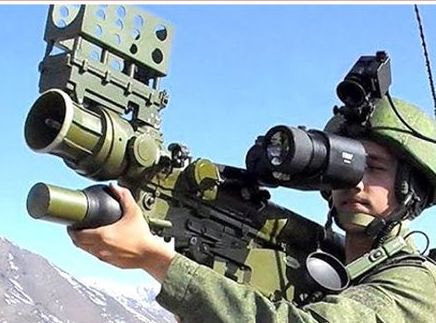
ISLAMABAD: Iran has concluded a secret arms agreement with Russia worth approximately €500 million (about $589 million) to acquire hundreds of advanced man-portable air defense systems, marking a significant step in rebuilding its damaged air defense network.
The deal, signed in Moscow in December 2025, involves the supply of 500 man-portable 9K333 Verba launch units and 2,500 9M336 surface-to-air missiles, according to leaked Russian documents and sources familiar with the transaction reported by the Financial Times.
Deliveries are scheduled in three tranches between 2027 and 2029, though some systems may arrive earlier in smaller quantities.
The Verba system, known as one of Russia’s most advanced fourth-generation MANPADS, entered service in 2014 and represents a major upgrade over earlier models like the Igla series.
It features a tri-spectral infrared seeker operating in ultraviolet, near-infrared, and mid-infrared bands, which enhances resistance to countermeasures such as flares and decoys by up to ten times compared to previous generations.
This multi-channel guidance allows the missile to distinguish real targets from infrared decoys more effectively, improving hit probability against modern aerial threats.
The 9M336 missile has an operational range of up to 6.5 kilometers and can engage targets at altitudes reaching 4.5 kilometers.
It achieves speeds of around 500 meters per second, enabling it to target fast-moving low-altitude aircraft, helicopters, cruise missiles, and drones.
The system includes a 1.5-kilogram high-explosive fragmentation warhead, offering a substantial increase in lethality over older designs.
A full ready-to-fire Verba unit weighs approximately 17.25 kilograms, making it highly portable for infantry deployment in diverse terrains.
The acquisition comes amid heightened regional tensions following reported strikes on Iranian facilities in 2025, which reportedly damaged key air defense assets.
Iran formally requested the Verba systems in July 2025, shortly after those events, as part of efforts to bolster short-range, low-altitude protection.
The contract was negotiated between Russia’s state arms exporter Rosoboronexport and the Moscow representative office of Iran’s Ministry of Defense and Armed Forces Logistics.
This transaction highlights deepening military ties between Tehran and Moscow, building on earlier cooperation where Iran supplied drones and missiles to support Russia’s operations elsewhere.
The Verba’s deployment would significantly enhance Iran’s ability to counter low-flying threats, including unmanned aerial vehicles increasingly used in regional conflicts.
Experts note that the system’s high jamming resistance and sensitivity make it particularly effective against drone swarms and cruise missiles, which often fly at low altitudes to evade radar detection.
At an estimated unit cost of around €40,000 per launcher and higher for each missile, the deal represents one of the largest recent MANPADS procurements in the region.
The inclusion of associated equipment, such as Mowgli-2 night-vision sights, allows for effective operation in low-visibility conditions, extending its tactical utility.
Observers point out that while the deliveries are phased over several years, the agreement signals Iran’s strategic priority to modernize ground-based air defenses against potential aerial incursions.
This move occurs as broader geopolitical dynamics evolve, including ongoing nuclear discussions and military posturing in the Middle East.
Russia’s commitment to supply advanced weaponry underscores reciprocal support in a partnership formalized through recent treaties.
The Verba’s proven capabilities, demonstrated in various exercises and deployments, position it as a formidable tool for asymmetric defense strategies.
Iran’s air defense architecture, previously reliant on a mix of imported and indigenous systems, stands to gain layered protection at the tactical level with these portable units.
Military analysts suggest that widespread deployment of Verba could complicate low-level operations by adversary forces, forcing adjustments in flight profiles and tactics.
The deal also reflects broader trends in arms transfers among non-Western powers amid shifting global alliances.
As deliveries commence, the integration of Verba into Iranian forces will likely involve training programs to maximize operational effectiveness.
This acquisition aligns with Tehran’s long-term goal of achieving greater self-reliance in defense while leveraging partnerships for cutting-edge technology.
The Financial Times report, based on verified leaks, has drawn attention to the opaque nature of such high-value military contracts.
No official confirmation has emerged from Tehran or Moscow, consistent with the secretive handling of sensitive arms deals.
The agreement’s timing and scale indicate a calculated effort to restore deterrence in a volatile security environment.