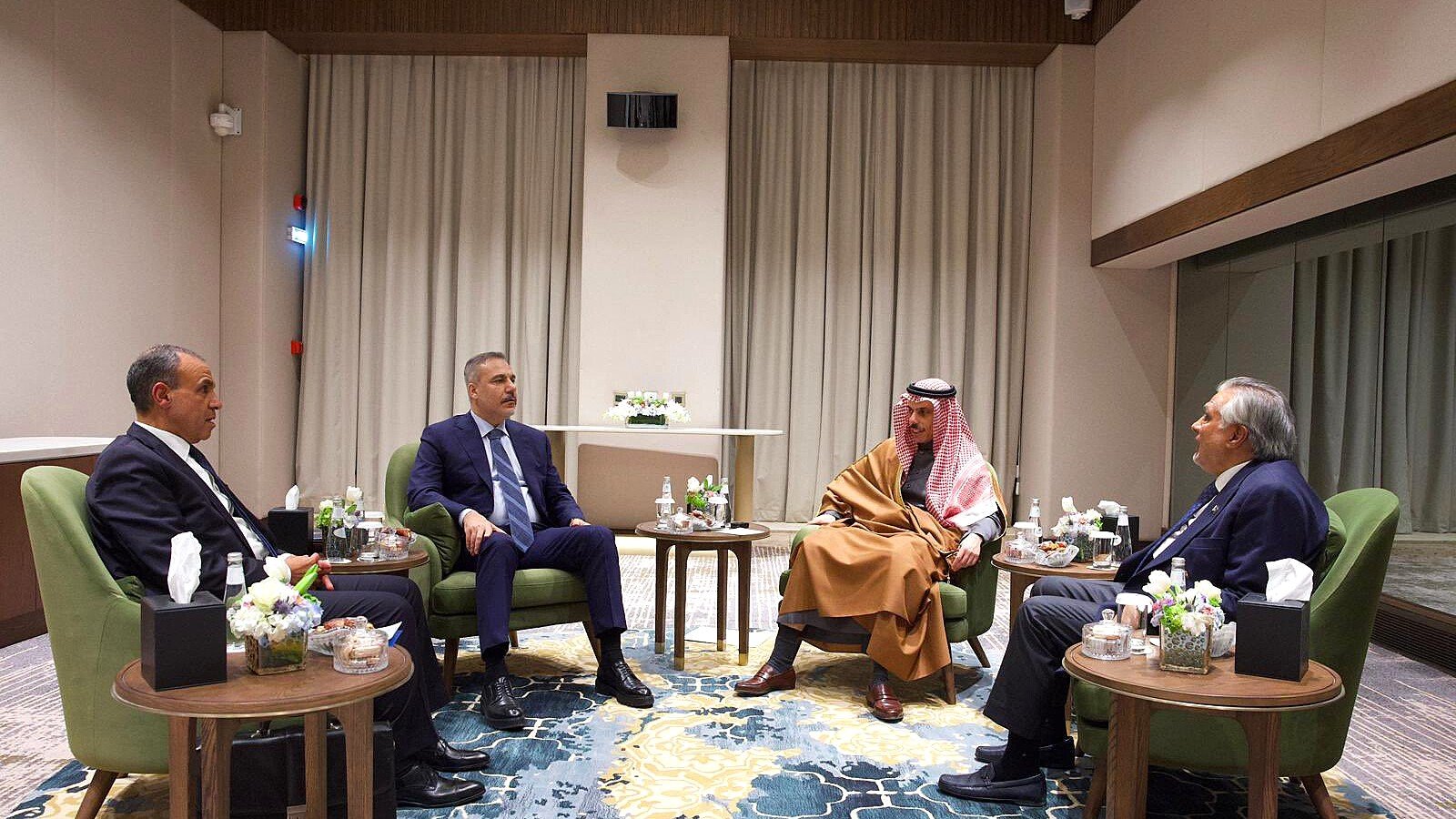
ISLAMABAD: Foreign ministers of Pakistan, Türkiye, Saudi Arabia and Egypt convened in Riyadh on Thursday for a high-level coordination meeting that has crystallised long-standing discussions into the first visible framework for a new security and defence alliance.
The gathering, held on the sidelines of a broader Arab and Islamic foreign ministers’ consultative session, focused on regional stability amid escalating Iranian actions and the ongoing US-Israeli conflict with Tehran.
Turkish press and official sources described the talks as a pivotal moment, transforming informal consultations that had persisted for over a year into concrete statements and commitments.
Pakistan’s Foreign Minister Mohammad Ishaq Dar joined Saudi Arabia’s Prince Faisal bin Farhan, Türkiye’s Hakan Fidan and Egypt’s Badr Abdelatty in what analysts term the second major push towards institutionalised defence cooperation among these four powers.
Turkish Foreign Minister Hakan Fidan explicitly stated that the countries were exploring ways to combine their regional influence to solve problems independently, emphasising trust-building and a common stance against external hegemony.
This marks a departure from reliance on distant powers, with Fidan underscoring that regional nations must learn to address challenges themselves or risk imposed solutions.
The meeting builds directly on the Strategic Mutual Defence Agreement signed between Pakistan and Saudi Arabia in September 2025 during Prime Minister Shehbaz Sharif’s visit to Riyadh.
That pact established mutual defence obligations, declaring any aggression against one as an attack on both, while deepening joint training, intelligence sharing and co-production of military equipment.
Türkiye has been actively lobbying to join this arrangement since last year, with negotiations reaching advanced stages by early 2026, according to multiple reports.
Egypt’s inclusion in the Riyadh discussions represents a significant expansion, leveraging Cairo’s recent bilateral military agreement with Ankara signed in February and a $350 million Turkish arms export deal for ammunition production.
Collectively, the four nations command formidable military assets as ranked by the 2026 Global Firepower Index.
Türkiye leads Muslim-majority countries with the strongest overall capability, followed closely by Pakistan’s nuclear-armed forces, Egypt’s large standing army and Saudi Arabia’s technologically advanced units.
Pakistan maintains an estimated 650,000 active personnel and nuclear deterrence, while Egypt fields over 450,000 troops, Türkiye boasts modern air and naval forces, and Saudi Arabia invests heavily in cutting-edge defence systems.
Their combined active military strength exceeds 2.5 million personnel, creating a potential bloc unmatched in the wider Middle East for conventional and strategic depth.
Economic synergies further underpin the alliance’s viability.
The four countries represent a population of approximately 472 million and substantial GDP aggregates, with Saudi Arabia’s oil wealth complementing Türkiye’s industrial base, Egypt’s strategic Suez Canal position and Pakistan’s emerging defence manufacturing sector.
Bilateral trade between Pakistan and Saudi Arabia alone exceeds $3.5 billion annually, dominated by energy imports, while defence industry cooperation promises joint ventures in drones, cybersecurity and armoured vehicles.
Turkish sources have clarified that the emerging platform does not replicate NATO’s collective defence guarantees but functions as a flexible security mechanism for defence industry collaboration and broader strategic coordination.
This pragmatic approach allows rapid implementation without the legal complexities of formal treaties.
Regional analysts highlight the timing’s significance, coinciding with Iranian ballistic missile and drone strikes on Gulf states, Jordan, Azerbaijan and Türkiye itself.
The quartet strongly condemned these actions in parallel statements, stressing coordinated efforts to safeguard stability.
For Pakistan, participation reinforces its longstanding role as a security provider in the Gulf, where Pakistani troops have historically supported Saudi defence since the 1960s.
The new framework could institutionalise this presence while opening avenues for technology transfer and joint exercises.
Türkiye gains expanded influence in South Asia and Africa through Pakistani and Saudi partnerships, while Egypt secures additional leverage in Arab defence circles.
Saudi Arabia benefits from diversified security options amid shifting global alliances.
Potential impacts extend beyond immediate deterrence.
Enhanced interoperability could lead to shared early-warning systems, joint naval patrols in key waterways and co-development of indigenous weapons platforms, reducing dependency on Western suppliers.
Defence budgets across the group already total tens of billions annually, with scope for pooled procurement yielding cost efficiencies and technological leaps.
Critics caution that success hinges on overcoming historical rivalries, particularly between Türkiye and Egypt, though recent agreements demonstrate improving trust.
The Riyadh meeting’s outcome signals a broader trend towards multipolar regional architectures, where Islamic nations assert ownership over their security architecture.
Pakistani officials have welcomed the development as aligning with Islamabad’s foreign policy of strategic partnerships and regional peace.
No formal treaty text emerged immediately, yet Turkish media portrayed the gathering as delivering the “concrete image and statement” long awaited.
Further ministerial-level follow-ups are anticipated within months to outline specific working groups on intelligence, training and industrial cooperation.
This evolving alliance could reshape power dynamics across West Asia, South Asia and North Africa, offering a counterbalance to external interventions and promoting self-reliant stability.
Observers note that the inclusion of nuclear-capable Pakistan alongside three major conventional powers creates a unique deterrent profile against state-level threats.
As implementation proceeds, economic dividends may materialise through expanded trade corridors linking the Red Sea, Arabian Gulf and Indian Ocean.
The development underscores a maturing strategic convergence among these states, forged through shared concerns over Iranian escalation and a collective desire for autonomous regional solutions.
Pakistan’s active role positions Islamabad at the heart of this emerging architecture, enhancing its diplomatic leverage and defence posture in a volatile neighbourhood.